27 Best Group Games for Kids That Boost Teamwork

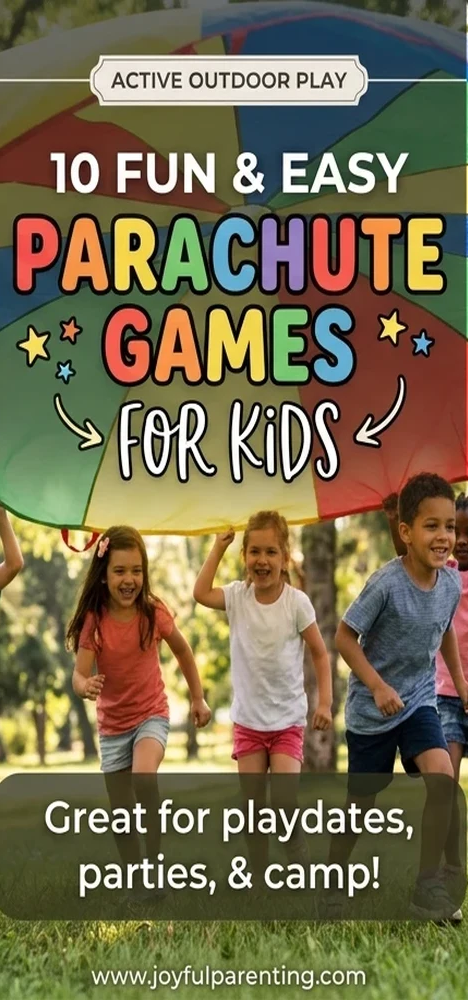
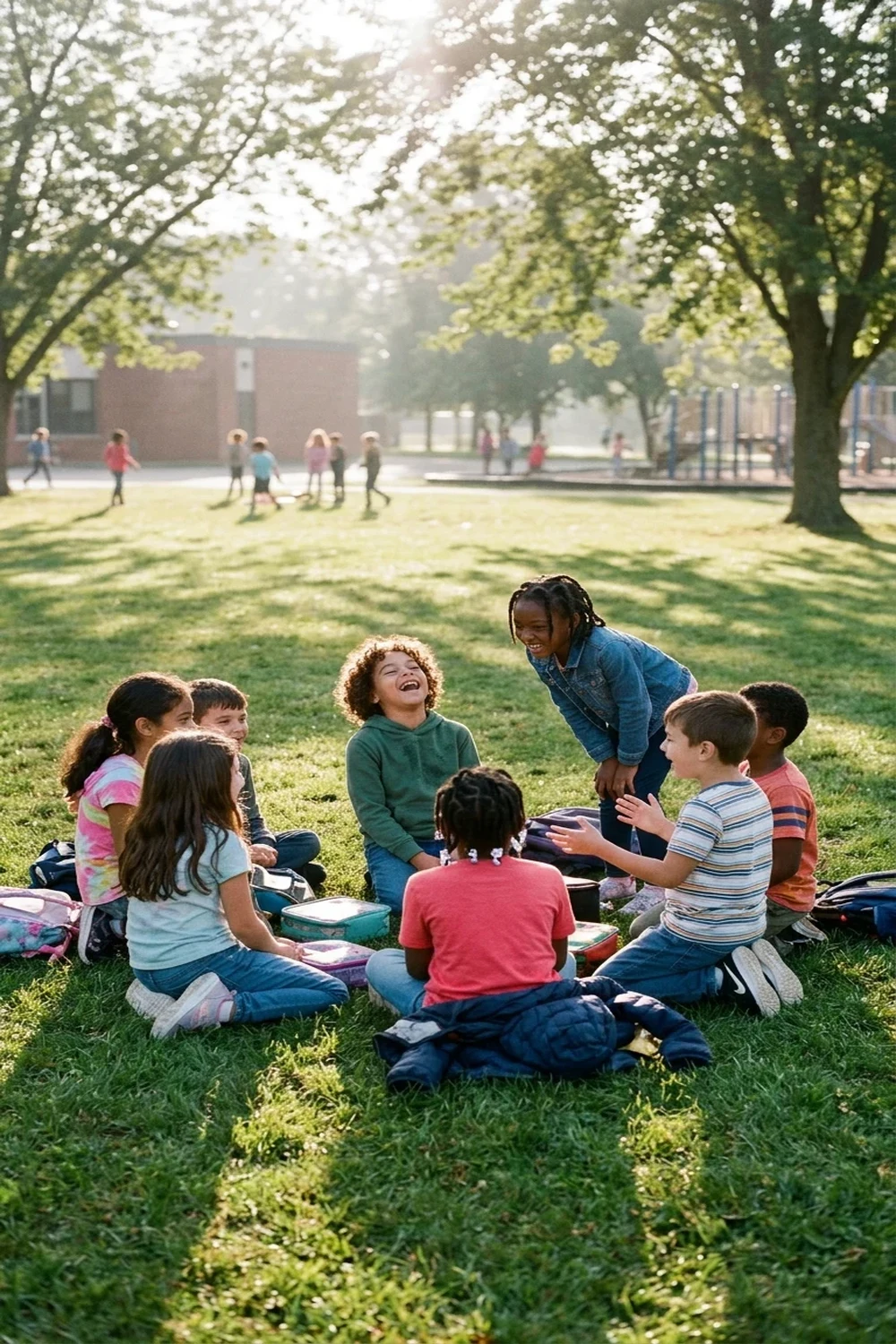
Group games for kids deliver structured opportunities to develop motor coordination, emotional regulation, and communication while burning physical energy. This definitive guide curates 27 screen-free indoor and outdoor activities that keep children of all ages engaged without complex equipment.
Why Group Games for Kids Are Essential for Childhood Development
Group games for kids provide structured interactive environments that accelerate peer bonding, physical coordination, and emotional resilience through collaborative social play. Research in early childhood education shows that cooperative play directly improves conflict resolution, verbal articulation, and motor control across diverse age groups.
- Cognitive Skill Building: Interactive group play sharpens strategic thinking and spontaneous decision-making under low-stakes competitive pressure.
- Social-Emotional Growth: Cooperative activities teach children self-regulation, empathy, active listening, and mutual respect among peers.
- Physical Development: Outdoor and indoor movement games develop vestibular balance, gross motor skills, and spatial awareness.
- Inclusive Engagement: Minimalist rules and low equipment requirements ensure that children of varying skill levels participate equally.
- Lifelong Communication Habits: Navigating shared rules reinforces boundary setting, turn-taking, and expressive negotiation.
Facilitating structured play sessions transforms ordinary playdates and classroom hours into powerful developmental milestones.
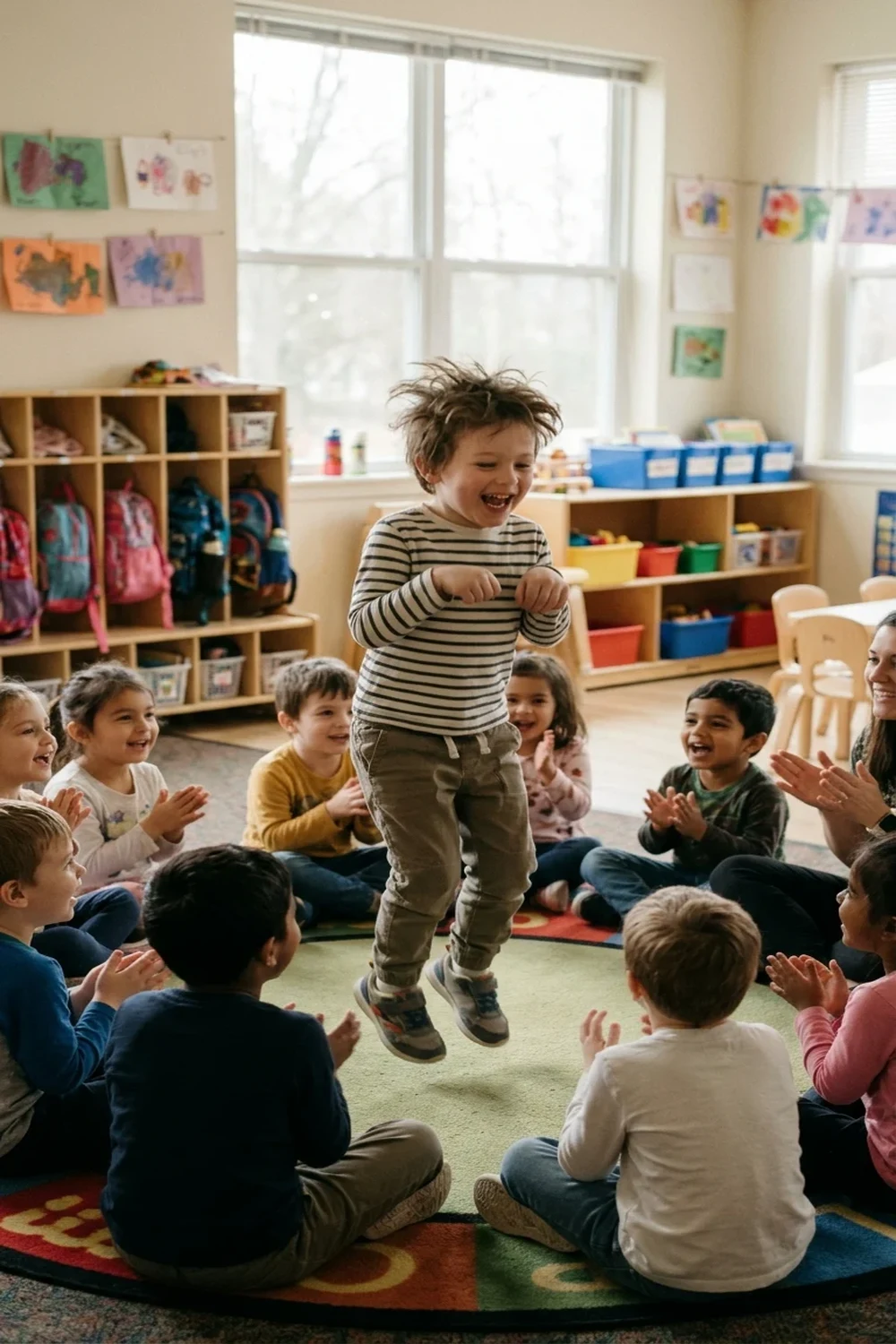
1. Animal Charades: How to Boost Non-Verbal Expression and Creative Thinking
Animal Charades is an active guessing game where children pantomime animal behaviors using physical gestures instead of spoken words or vocal sound effects. This screen-free activity develops imaginative roleplay, body awareness, and non-verbal communication skills in preschool and elementary learners.
- Setup and Player Roles: Children gather in a circle while one selected actor steps into the center to imitate a specific animal silently.
- Observation and Deduction: The surrounding group observes distinct movement patterns, posture shifts, and physical cues to deduce the animal identity.
- Scoring and Turn Progression: The first player to name the correct creature earns one point and assumes the role of actor for the subsequent turn.
- Motor Coordination Benefits: Kids hop like frogs, slither like snakes, or stomp like elephants, activating different core muscle groups.
- Adaptable Difficulty Levels: Teachers or parents can introduce animal habitat themes or rare wildlife cards to challenge older participants.
Introduce Animal Charades during your next indoor session to spark laughter while sharpening creative physical expression.
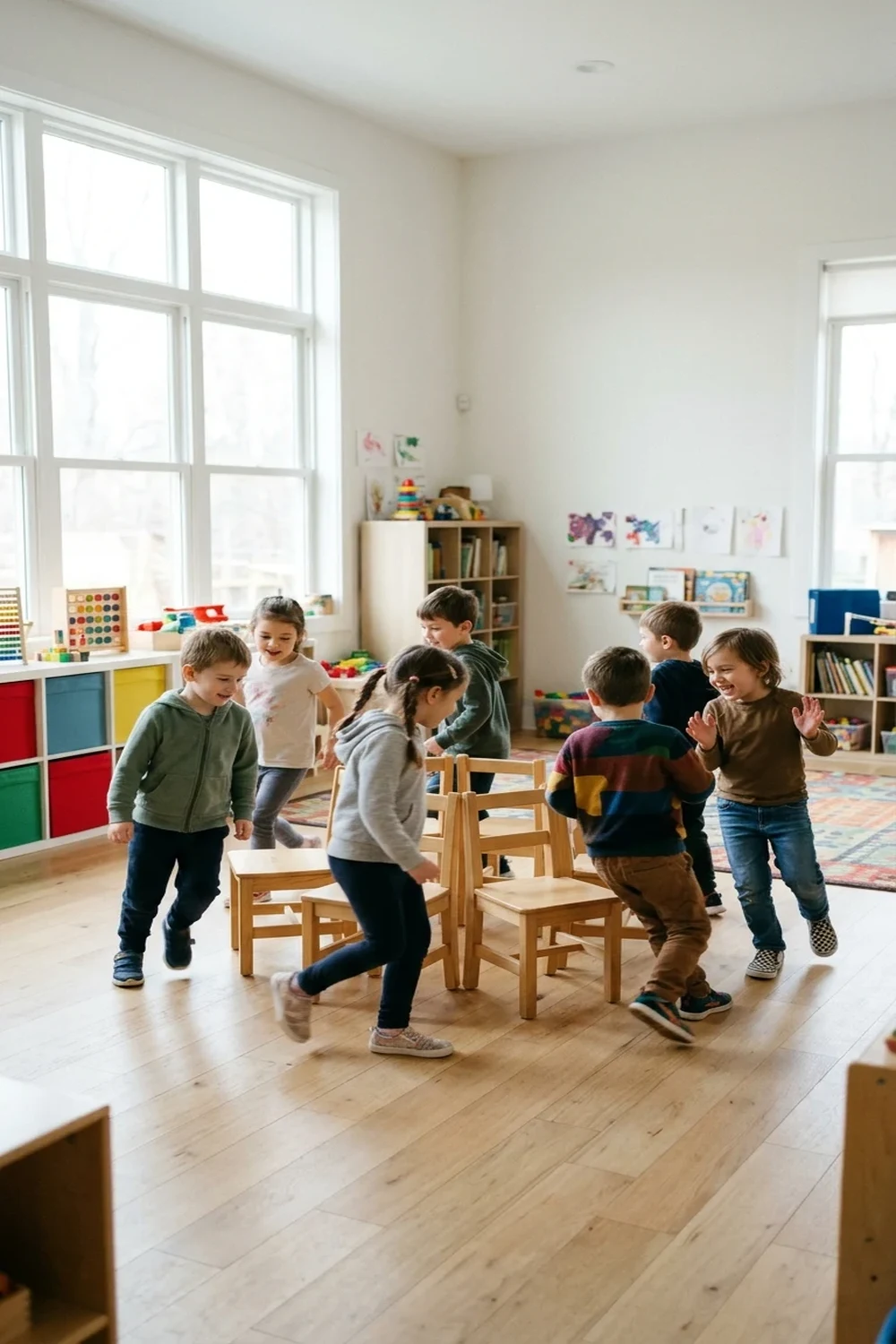
2. Musical Chairs: Mastering Reflexes, Spatial Awareness, and Gracious Play
Musical Chairs is a high-energy elimination game where children circle a row of outward-facing chairs that contains exactly one seat fewer than total players until background audio pauses. The fast-paced activity trains auditory processing, rapid reaction times, and emotional sportsmanship in group environments.
- Circle Configuration: Arrange sturdy chairs back-to-back or in an outward-facing ring, providing safe walking clearance around the perimeter.
- Active Auditory Tracking: Players march rhythmically along the chair line while music plays, maintaining focus on unexpected audio stops.
- Immediate Reaction Testing: When the music halts abruptly, every participant rushes to claim an unoccupied seat without pushing.
- Round Elimination Routine: The single child left standing steps aside to help control the music queue as one additional chair is removed.
- Resilience and Sportsmanship: Stepping out of successive rounds teaches kids to handle disappointment gracefully while cheering on classmates.
Set up a playlist of upbeat songs to challenge your children’s reflexes and spatial awareness through Musical Chairs.
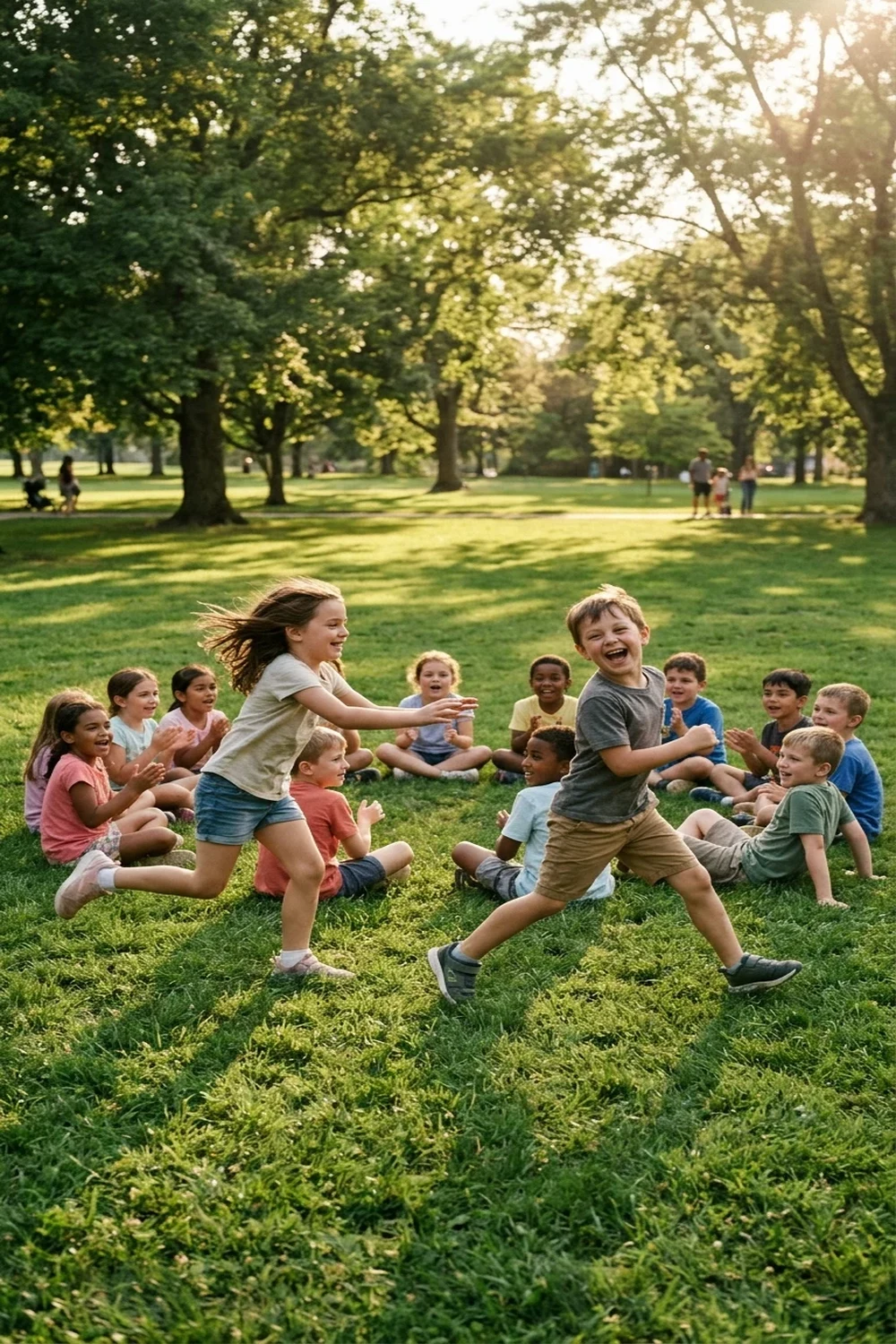
3. Duck Duck Goose: Building Auditory Focus and Sprint Agility in Early Learners
Duck Duck Goose is a classic outdoor circle game where a designated picker walks around seated players, tapping heads while chanting before designating a chase partner. The traditional game sharpens burst sprint acceleration, auditory anticipation, and spatial coordination for toddlers and primary school students.
- Seated Circle Formation: Participants sit cross-legged facing inward, forming a spacious circle on a soft carpet or grassy field.
- Tapping Sequence: The picker walks along the circle exterior, tapping each head gently while repeating the word ‘duck’.
- Sudden Sprint Trigger: Upon tapping an opponent while declaring ‘goose’, the picker sprints clockwise around the perimeter toward the vacant spot.
- Pursuit and Tagging: The chosen goose leaps up instantly, chasing the picker to execute a tag before the picker occupies the open seat.
- Role Alternation: A successful tag sends the picker back to the outer ring, while an escaped picker hands the picker duties to the goose.
Gather a small group on the grass today for an invigorating session of Duck Duck Goose to channel boundless energy into healthy exercise.

4. Capture the Flag: Outdoor Team Strategy and Tactical Movement
Capture the flag is a competitive outdoor territory game where two opposing squads navigate split playing zones to seize an opponent banner and transport it safely across the midfield boundary. Participants build physical stamina and strategic communication skills by designating specialized squad positions such as territory defenders, forward scouts, and jail rescuers across designated zones measuring at least 50 by 30 meters.
- Core Objective: Players cross into enemy territory to extract the opponent flag and return across midfield without being tagged by defending opponents.
- Jail Mechanism: Tagged runners must report to a marked jail zone on the opposing side until an active teammate touches them to grant free passage back.
- Role Specialization: Squads divide players into offensive runners, midfield interceptors, and zone defenders to balance speed and territorial protection.
- Terrain Requirements: A flat, open outdoor field or gym measuring at least 50 meters in length ensures adequate running clearance and line-of-sight navigation.
- Teamwork Benefit: Group problem-solving accelerates as children coordinate synchronized distraction runs to open extraction lanes for flag carriers.
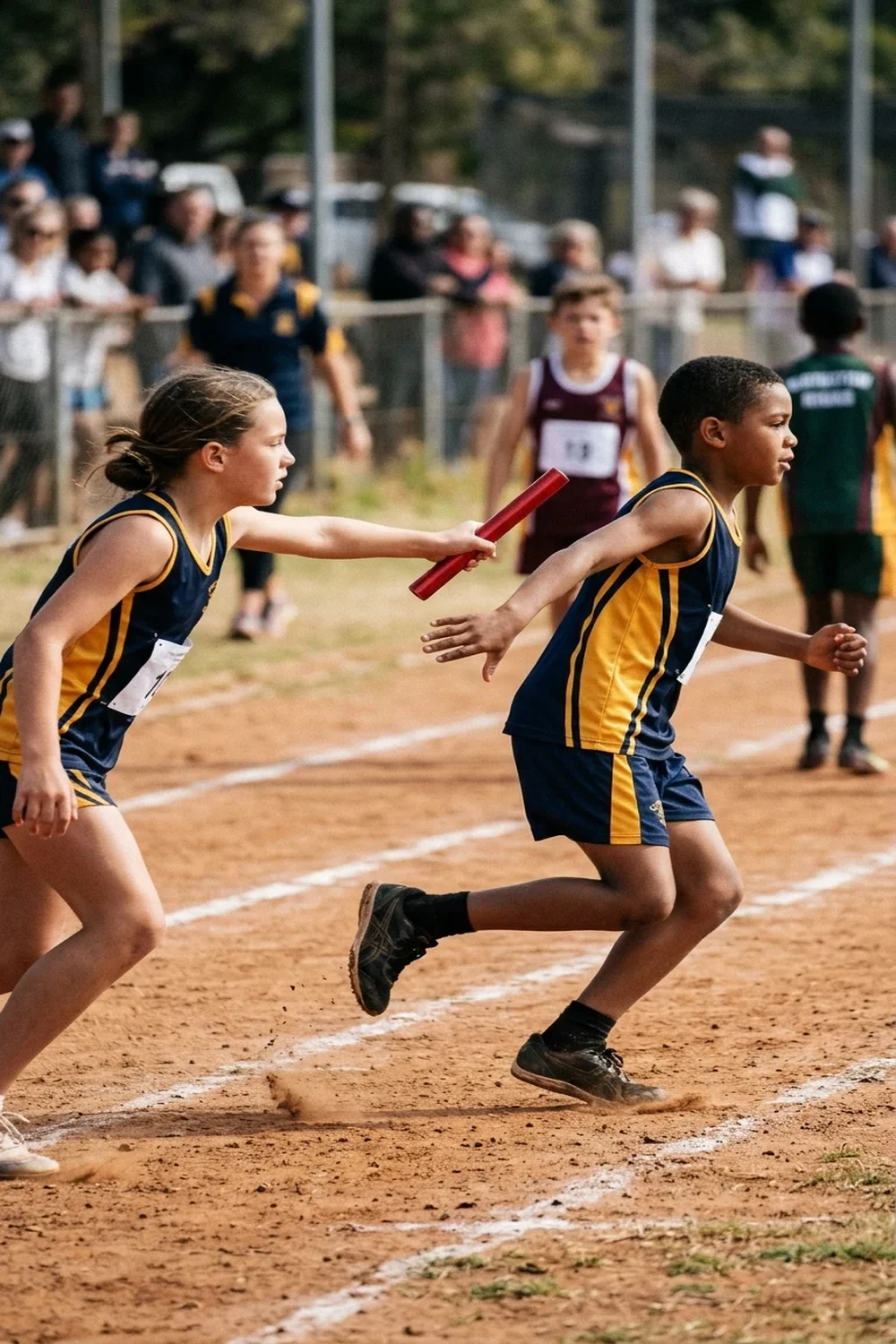
5. Relay Race: Baton Passing and Group Coordination Challenges
A relay race is a high-speed sprint competition where teams transfer a physical baton sequentially across measured intervals to register the fastest total squad time. Participating in relay formats teaches elementary school kids explosive acceleration, hand-eye synchronization during dynamic transfers, and vocal team encouragement across distances spanning 20 to 50 meters per runner.
- Baton Exchange: Runners hand off a hollow baton inside a designated passing zone without dropping the equipment or stepping outside assigned lanes.
- Distance Structuring: Setting running legs between 20 and 50 meters accommodates varied age brackets from kindergarten through middle school.
- Skill Development: Children develop spatial tracking and non-verbal pacing by timing their acceleration strides prior to receiving the baton handoff.
- Format Variations: Organizers can substitute standard running with hopping, backward jogging, or three-legged team pairs to increase balance difficulty.
- Teamwork Benefit: Shared responsibility instills peer encouragement, ensuring every participant contributes equally to overall squad completion times.
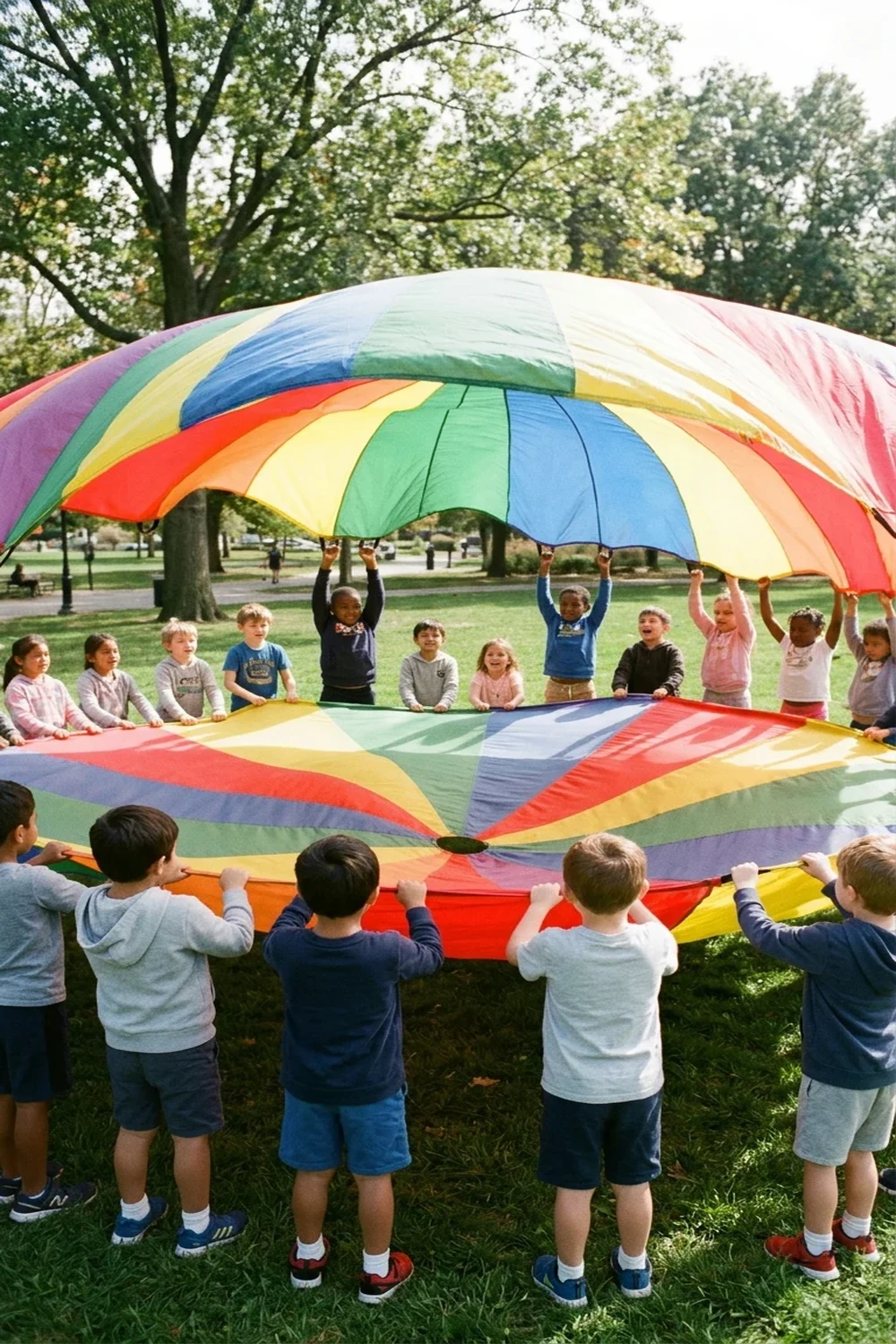
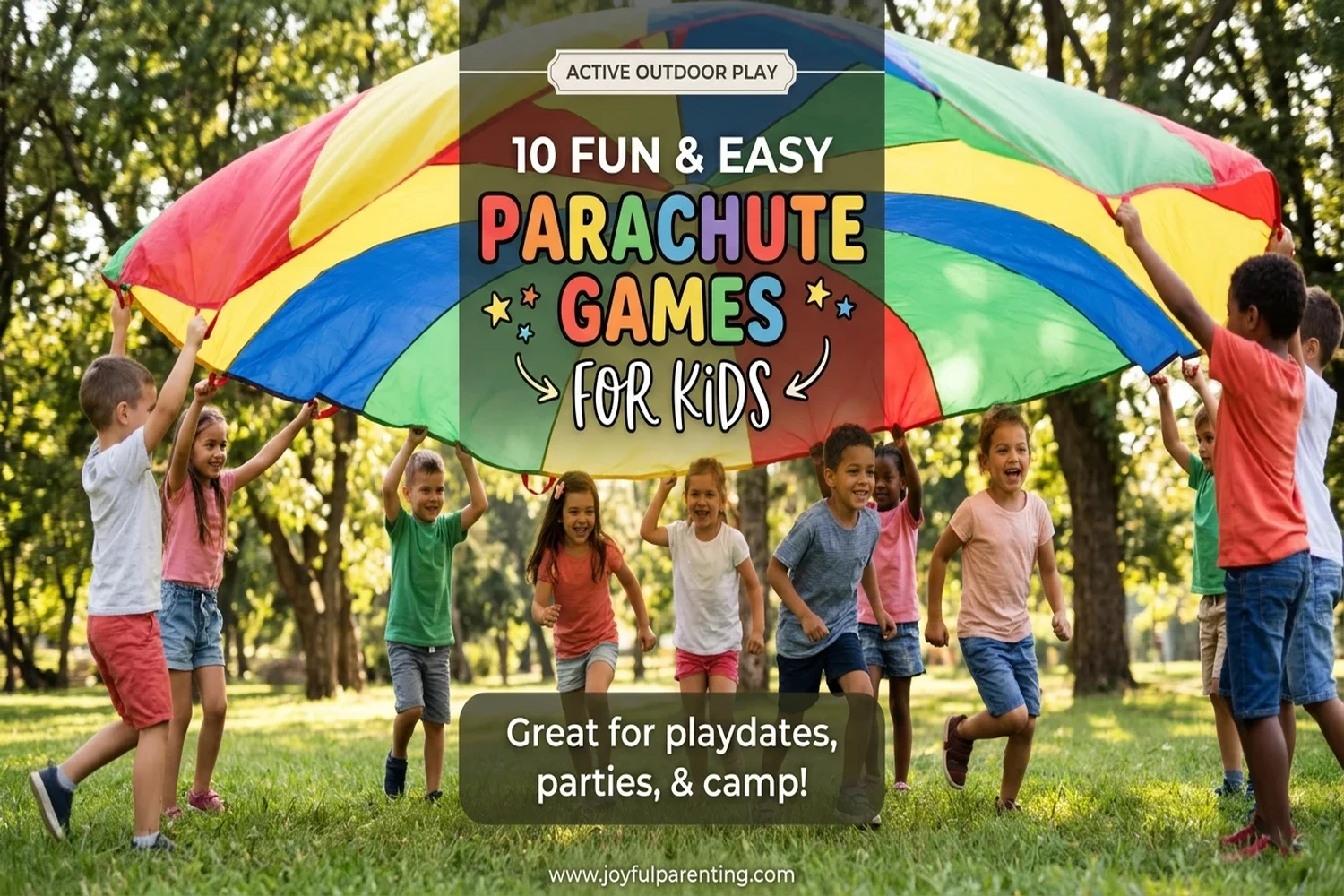
6. Parachute Game: Cooperative Rhythm and Motor Skill Development
The parachute game is a non-competitive cooperative activity where children hold perimeter handles of a multi-colored circular nylon canopy to generate wave ripples and loft lightweight objects into midair. Group canopy play strengthens shoulder motor control and auditory listening skills as six to twenty children manipulate fabric tension simultaneously to execute specific collaborative patterns.
- Mushroom Lift: Participants pull the fabric taut, raise their arms simultaneously upward on command, and step under the canopy to trap warm air pockets.
- Ball Bouncing Challenge: Squads work in rhythm to balance vinyl playground balls on the fabric surface without allowing objects to roll off edge perimeters.
- Under-Canopy Swaps: Group leaders call out birth months or t-shirt colors, prompting matching children to sprint beneath the raised canopy to swap sides.
- Inclusive Design: Circular canopy dimensions ranging from 12 to 24 feet allow mixed age cohorts and diverse physical skill levels to participate equally.
- Teamwork Benefit: Success depends strictly on total collective synchronization rather than individual speed, teaching mutual physical cooperation.
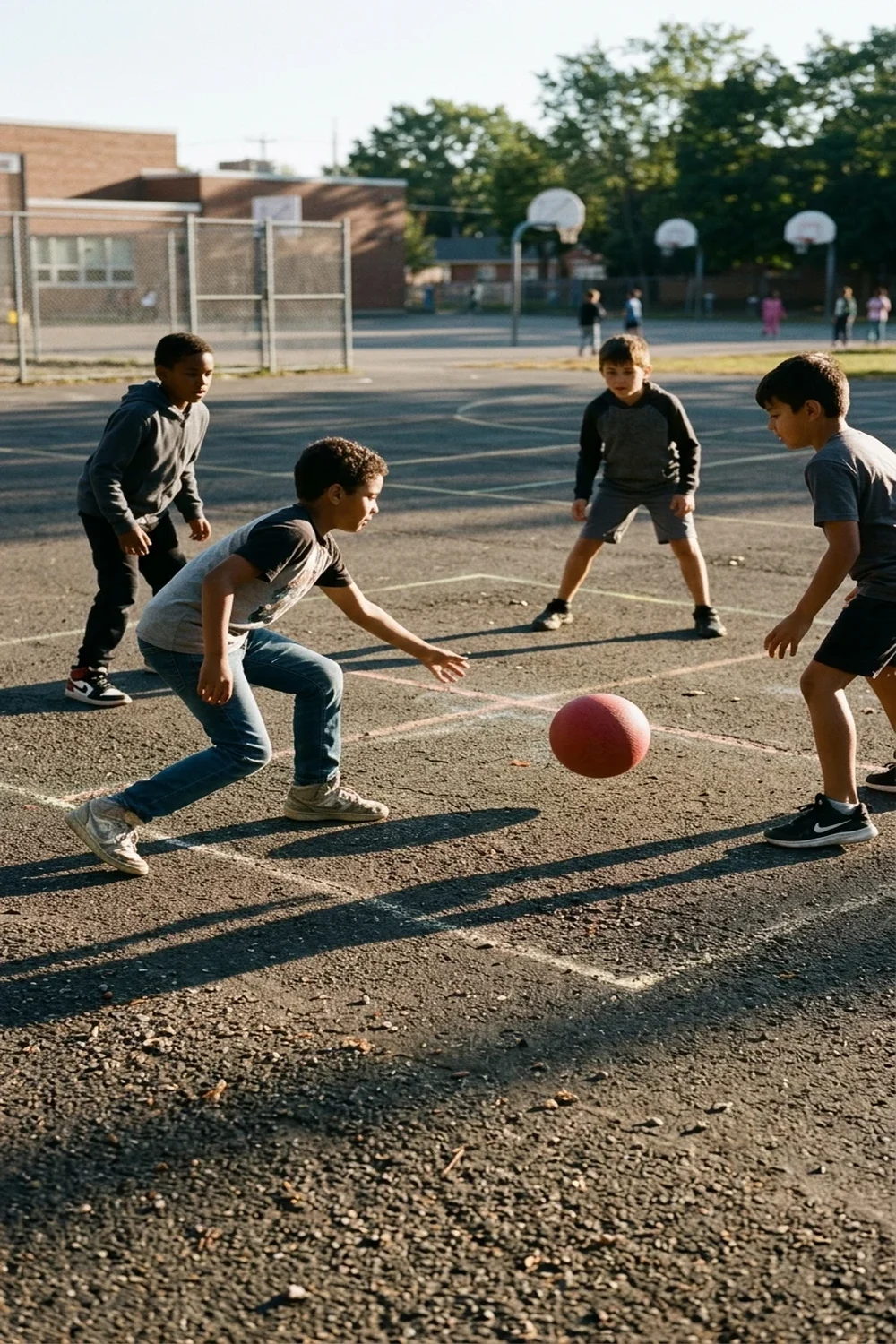
7. Four Square: Reflex Agility and Playground Spatial Awareness
Four square is a fast-paced playground ball game where four players compete in numbered quadrants to advance to the top-ranked server square by hitting an eight-inch rubber playground ball with open palms. Players sharpen rapid sensory processing and motor reflexes as they strike the ball after a single ground bounce while following rotational elimination rules.
- Court Layout: A square court measuring 16 by 16 feet divides into four labeled quadrant squares: Ace, King, Queen, and Jack.
- Ball Mechanics: The server bounces the ball once within their quadrant before striking it underhand into an opponent grid.
- Elimination Triggers: Allowing the ball to bounce twice, hitting lines, or using closed fists sends a player to the lowest quadrant or spectator line.
- Playground Rotation: Eliminated participants exit cleanly while waiting players rotate into the Jack square to maintain continuous engagement.
- Teamwork Benefit: Rapid communication and shared rule enforcement build dispute-resolution capabilities and playground social awareness.
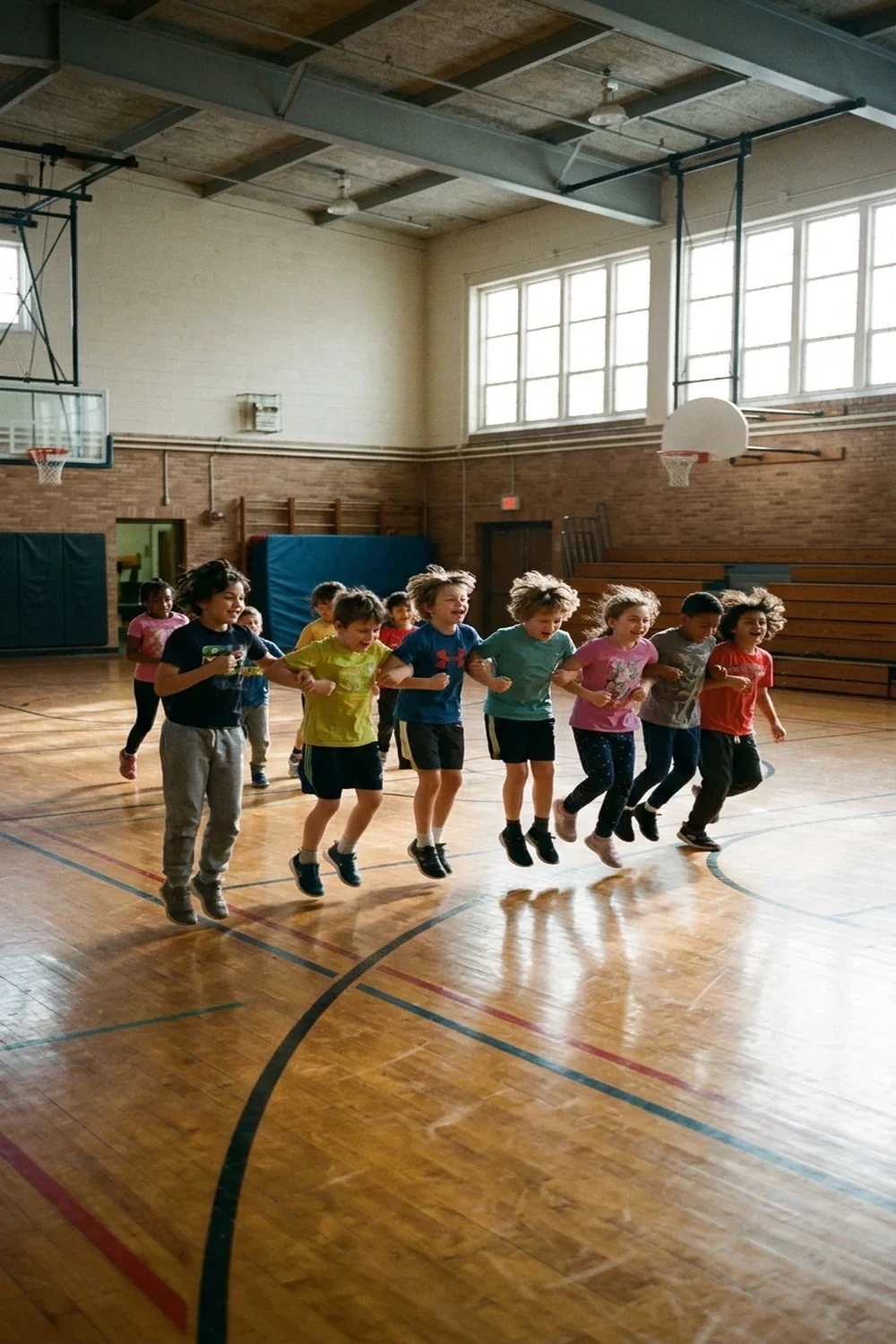
8. Sticky Popcorn: Cooperative Movement Game for Energetic Groups
Sticky Popcorn is a fast-paced cooperative movement game where children pretend to be popping corn kernels that gradually stick together upon collision until the entire group forms a single giant popcorn ball. This zero-equipment physical activity teaches spatial awareness, encourages non-verbal peer coordination, and transitions high-energy play into unified group bonding.
- Core Objective: Players hop around a bounded gymnasium or playground court, linking arms upon physical contact with any peer until all participants fuse into one synchronized unit.
- Movement Mechanic: Every child begins hopping individually like an unpopped kernel, maintaining continuous gentle bouncing motion while scanning the perimeter for nearby players.
- Cooperation Anchor: When two hopping players make contact, they link elbows or hold hands, immediately adjusting their jumping cadence to match each other’s physical rhythm.
- Spatial Awareness Benefit: Navigating crowded boundary lines as an expanding collective chain sharpens peripheral vision and trains players to moderate jumping velocity safely.
- Win Condition: The round concludes successfully when every child joins the chain without breaking links, leaving zero isolated players on the court.
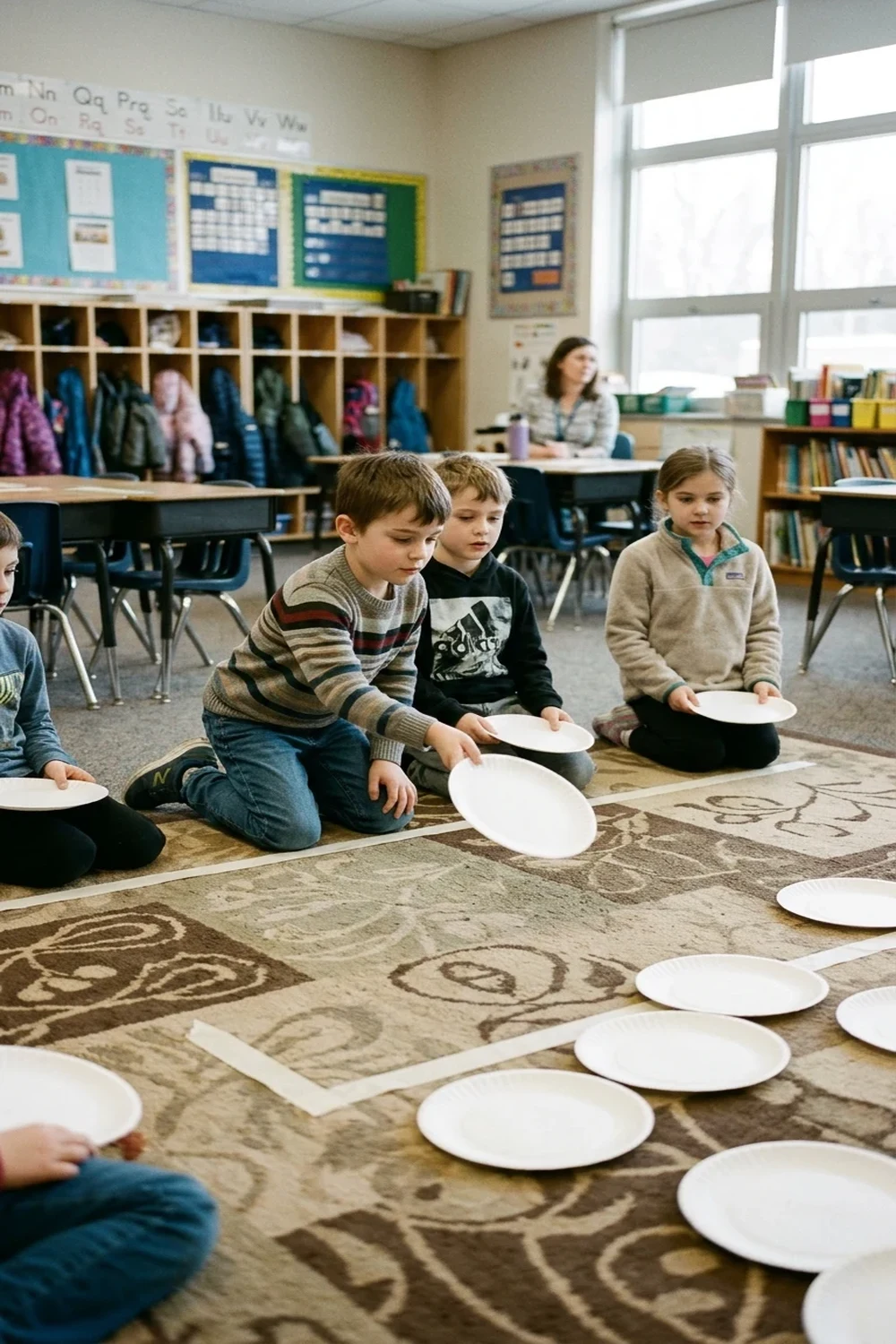
9. The Quiet Olympics: Low-Noise Focus Challenges for Classrooms
The Quiet Olympics is an indoor station-based tournament featuring modified athletic events performed under strict silence or whispering constraints using simple everyday supplies. Teachers and camp counselors rely on this low-decibel competition to channel competitive energy, foster motor self-regulation, and reward precision over volume.
- Paper Plate Discus: Participants launch standard nine-inch paper plates across a classroom carpet, tracking horizontal distance while maintaining complete absolute silence.
- Balloon Shot-Put: Competitors propel a lightweight air-filled latex balloon from the shoulder line, navigating erratic air currents without uttering a single cheer or shout.
- Heel-to-Toe Speed Walk: Racers traverse a twenty-foot masking-tape floor guide placing each heel directly against the opposing toe, testing dynamic balance under time pressure.
- Sustained Whistle Sprint: Players take a single deep breath and hold a gentle whistle tone, measuring lung capacity and breath control against a digital stopwatch.
- Classroom Management Value: Operating beneath a forty-decibel threshold restores calm after recess while allowing children to experience authentic athletic accomplishment.

10. Feather Blow: Breath Control and Core Focus Activity
Feather Blow is a respiratory control and agility game where participants keep a lightweight craft feather suspended mid-air using only upward bursts of breath. Whether played as a solo stamina challenge or as a collaborative circle relay, this activity builds diaphragm strength, visual tracking, and intense physical concentration.
- Single-Breath Rule: Players must sustain the feather purely through oral airflow, strictly prohibiting contact with hands, head, feet, or clothing.
- Team Relay Variation: Small squads of three to four children encircle a single hovering feather, alternating directional exhalations to maneuver the plume across a designated finish perimeter.
- Respiratory Conditioning: Sustained upward exhalation activates deep abdominal muscles while regulating autonomic nervous system arousal during high-stimulation environments.
- Oculomotor Development: Tracking an unpredictable drifting feather develops vertical saccadic eye movement and real-time vestibular recalibration in developing children.
- Low-Cost Adaptability: Requiring only standard synthetic or natural craft plumes, this exercise adapts seamlessly to living rooms, daycare facilities, and outdoor picnic areas.

11. Hula-Hoop Pass: Circle Teamwork and Problem-Solving Drill
Hula-Hoop Pass is a foundational team-building exercise where children stand in a continuous hand-held circle and navigate a plastic hoop along the entire perimeter without releasing their grip. Physical education instructors utilize this classic cooperative drill to reinforce problem-solving dialogue, bodily contortion skills, and collaborative group trust.
- Unbroken Connection: Participants interlock fingers in a complete circle, with one child’s arm threaded through a standard thirty-six-inch polyethylene hoop before joining hands.
- Contortion Maneuvers: Each child bends, ducks, twists, and steps through the circular frame sequentially, relying on peer body adjustments to maintain handholds.
- Verbal Coaching Anchor: Teammates communicate real-time positional cues, advising neighbors when to lower shoulders, elevate wrists, or extend legs through the hoop.
- Speed Run Challenges: Timed trials against a sixty-second countdown clock incentivize squads to streamline body transitions and synchronize joint flexions.
- Motor Inclusivity: The physical simplicity enables mixed-age groups and children of differing athletic aptitudes to contribute equally toward collective mission success.
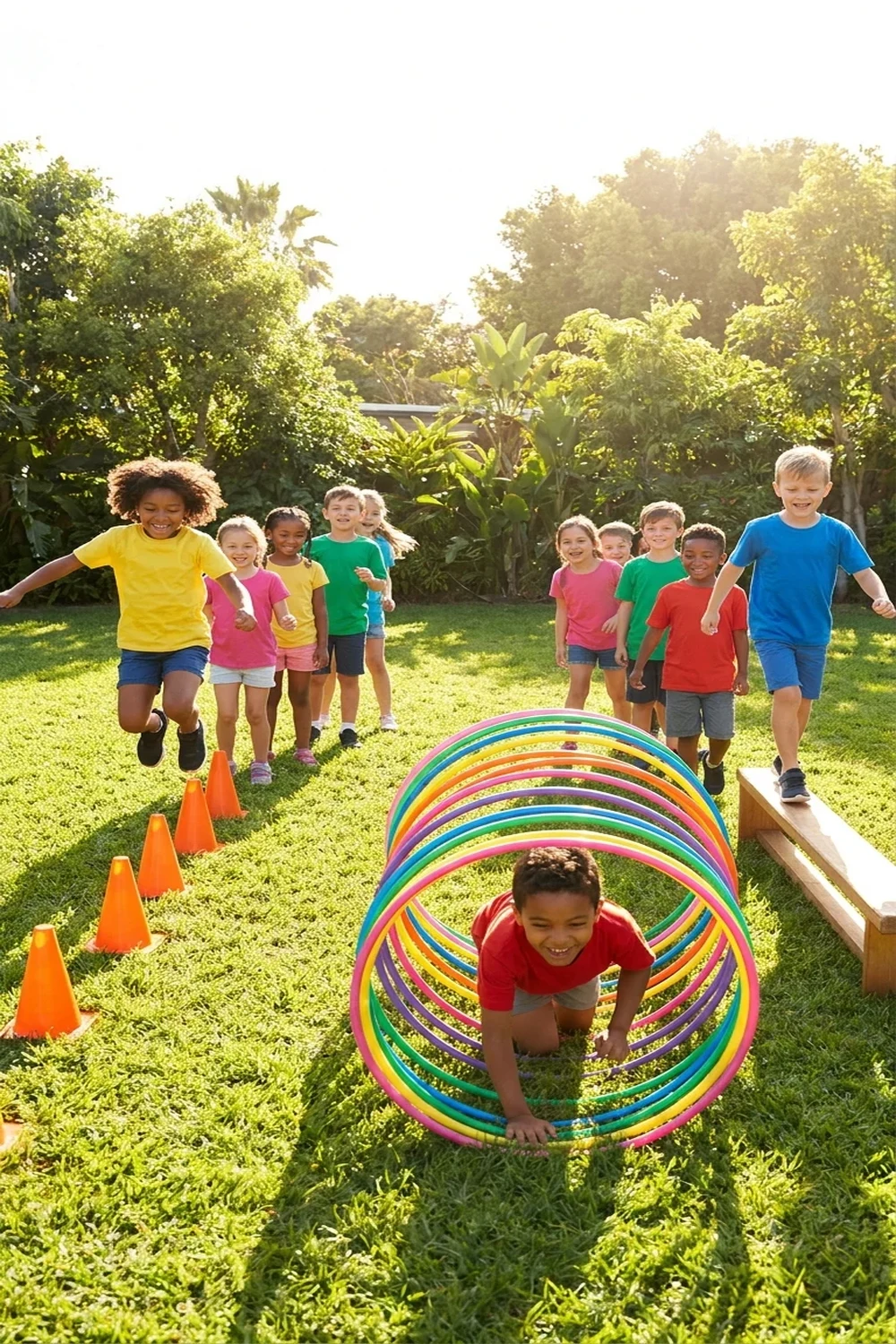
12. Obstacle Course: Creative Physical Team Challenge for Kids
An obstacle course is a structured physical challenge where children navigate multi-stage stations using everyday equipment like cones, pool noodles, and agility rings. Designed for both indoor and outdoor spaces, obstacle courses boost gross motor coordination while reinforcing cooperative problem-solving when run as timed team relays.
- Core Objective: Guide every squad member through sequential physical challenges to record the fastest cumulative completion time.
- Recommended Setup: Position agility cones for zig-zag sprints, place hula hoops flat for single-leg hops, and suspend pool noodles across plastic crates for low-crawl tunnels.
- Teamwork Dynamics: Pair younger participants with older peers who provide verbal navigation cues and pacing support.
- Skill Progression: Introduce tandem carry tasks, such as transporting a lightweight exercise ball between two runners without using hands.
- Safety Protocol: Maintain a minimum 6-foot buffer zone between consecutive obstacle stations and lay cushioned mats over hard indoor surfaces.

13. Treasure Hunt: Cooperative Clue-Solving Quest for Young Explorers
A treasure hunt is a cooperative navigation game where teams decipher sequential riddle cards and map coordinates to discover a hidden prize container. This inquiry-based activity develops deductive reasoning, spatial awareness, and collective decision-making across participants aged 5 to 12.
- Core Objective: Decipher interconnected riddle cards sequentially to locate the hidden prize cache before opposing teams.
- Station Architecture: Distribute 6 to 8 clue checkpoints containing rhyming riddles, compass bearings, or simple cipher wheels.
- Collaborative Roles: Assign specialized squad duties, including the primary map navigator, riddle reader, timekeeper, and clue recorder.
- Adaptable Settings: Deploy visual pictorial markers for indoor playroom searches or natural landscape landmarks for outdoor park excursions.
- Inclusive Design: Balance puzzles with both visual matching challenges and verbal wordplay so players of varying reading proficiencies contribute meaningfully.
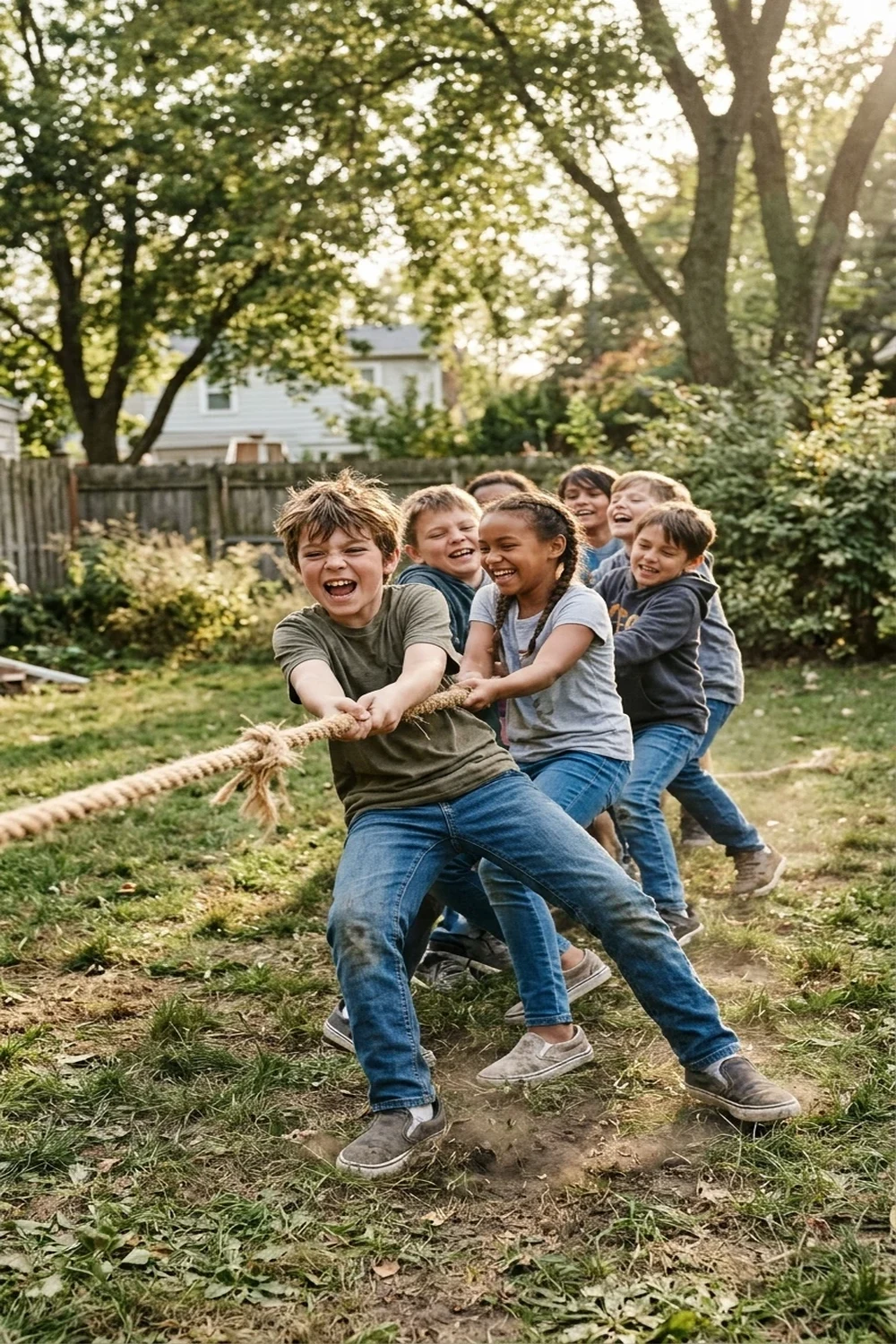
14. Tug-of-War: Classic Strength and Synchronized Teamwork Contest
Tug-of-War is a traditional team strength contest where two equal squads pull opposite ends of a braided rope to draw a central marker across their goal line. Success relies on synchronized pulling cadence, firm foot placement, and cooperative rhythm rather than raw individual muscle power.
- Core Objective: Pull the opposing squad forward until the center ribbon crosses your designated 6-foot boundary marker.
- Equipment Standard: Employ a soft, 1.5-inch diameter natural manila or cotton rope to prevent friction burns and ensure secure handholds.
- Cadence Strategy: Appoint an anchor captain at the rear to shout rhythmic pulling cues like ‘pull and plant’ to coordinate group momentum.
- Postural Foundation: Instruct players to maintain low centers of gravity by planting heels firmly and leaning back at a steady 45-degree angle.
- Safety Guardrails: Never wrap the rope around hands, wrists, or waists, and always conduct matches over soft grass or gym mats.

15. Bob the Weasel: Fast-Paced Circle Passing and Deduction Game
Bob the Weasel is a classic circle-based deduction game where seated players secretly pass a small hidden object behind their backs while a central guesser attempts to identify its current location. This low-equipment icebreaker sharpens situational observation, non-verbal communication, and rhythmic misdirection under playful social pressure.
- Core Objective: Pass a small token smoothly around a closed circle without allowing the center detective to spot who holds it.
- Game Mechanics: Form a shoulder-to-shoulder ring on the floor while chanting the rhythmic call ‘Bob the Weasel, keep him moving’ to mask passing noises.
- Deceptive Technique: Encourage all seated participants to continuously mimic passing arm movements regardless of whether they hold the object.
- Role Rotation: Grant the detective three guesses per round; if correct, the discovered holder swaps places into the center ring.
- Optimal Group Size: Run the game with 8 to 16 participants to ensure smooth circulation tempo and adequate mystery.
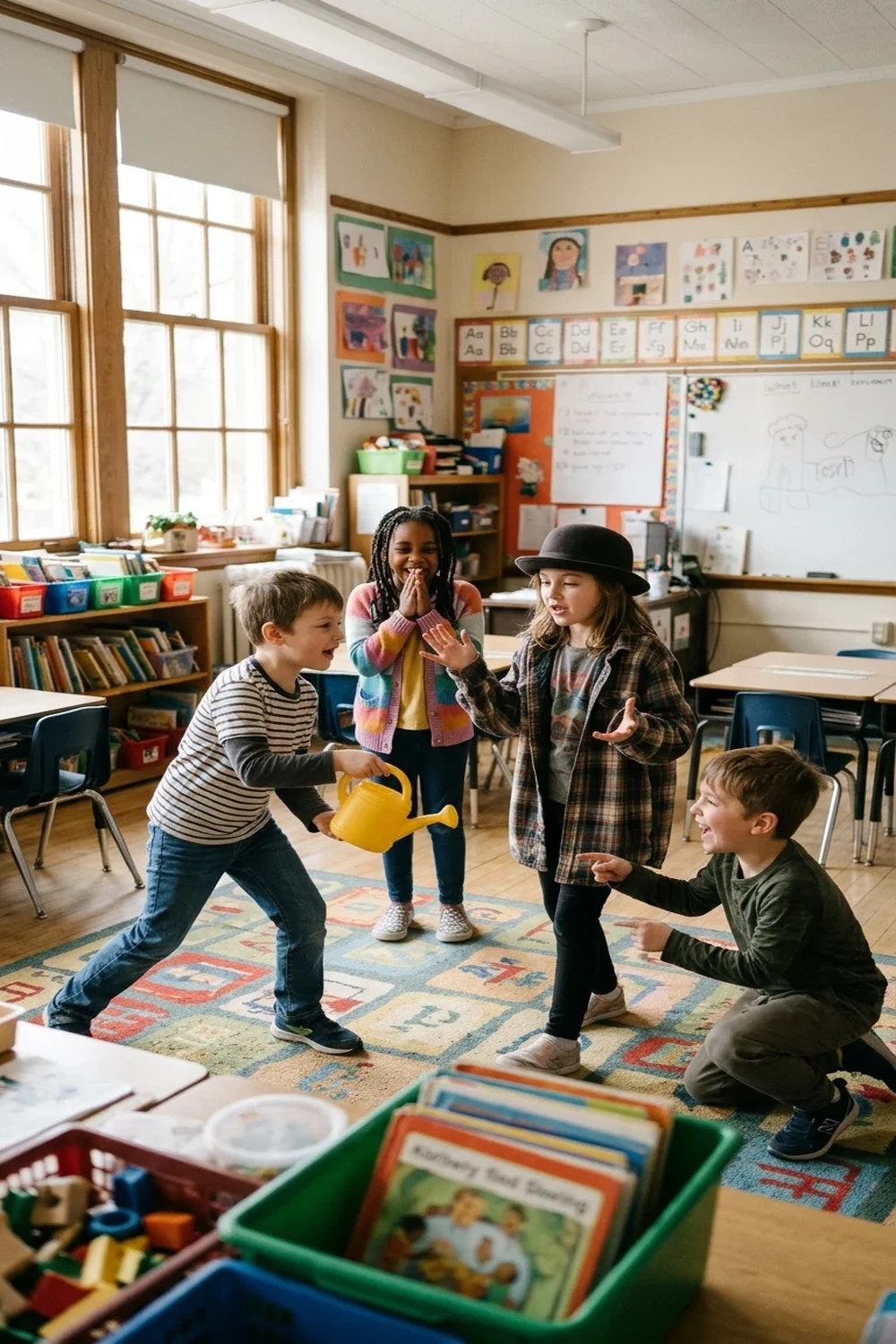
16. Three Things Theater: Creative Group Acting Game for Kids
Three Things Theater is an improvisational drama challenge where small groups of children receive three unrelated everyday props and five minutes to script, rehearse, and perform an original two-minute skit. This high-energy drama exercise builds rapid creative problem-solving, verbal communication, and spontaneous teamwork as participants synthesize diverse objects into a coherent stage narrative.
- Core Objective: Small teams collaborate under a tight five-minute rehearsal window to invent an entertaining scene featuring all three assigned props seamlessly.
- Recommended Age and Group Size: Best suited for children ages 7 to 14, organized into balanced performance squads of 3 to 5 players.
- Essential Equipment: A storage tote filled with varied items such as wooden spoons, oversized hats, plastic watering cans, scarves, and clean cardboard boxes.
- Teamwork Benefit: Every participant contributes plot ideas and character roles, ensuring quiet children gain stage confidence alongside expressive peers.
- Gameplay Rotation: The performing team selects the next group of actors and hands them three new secret props to maintain dynamic engagement across the entire room.
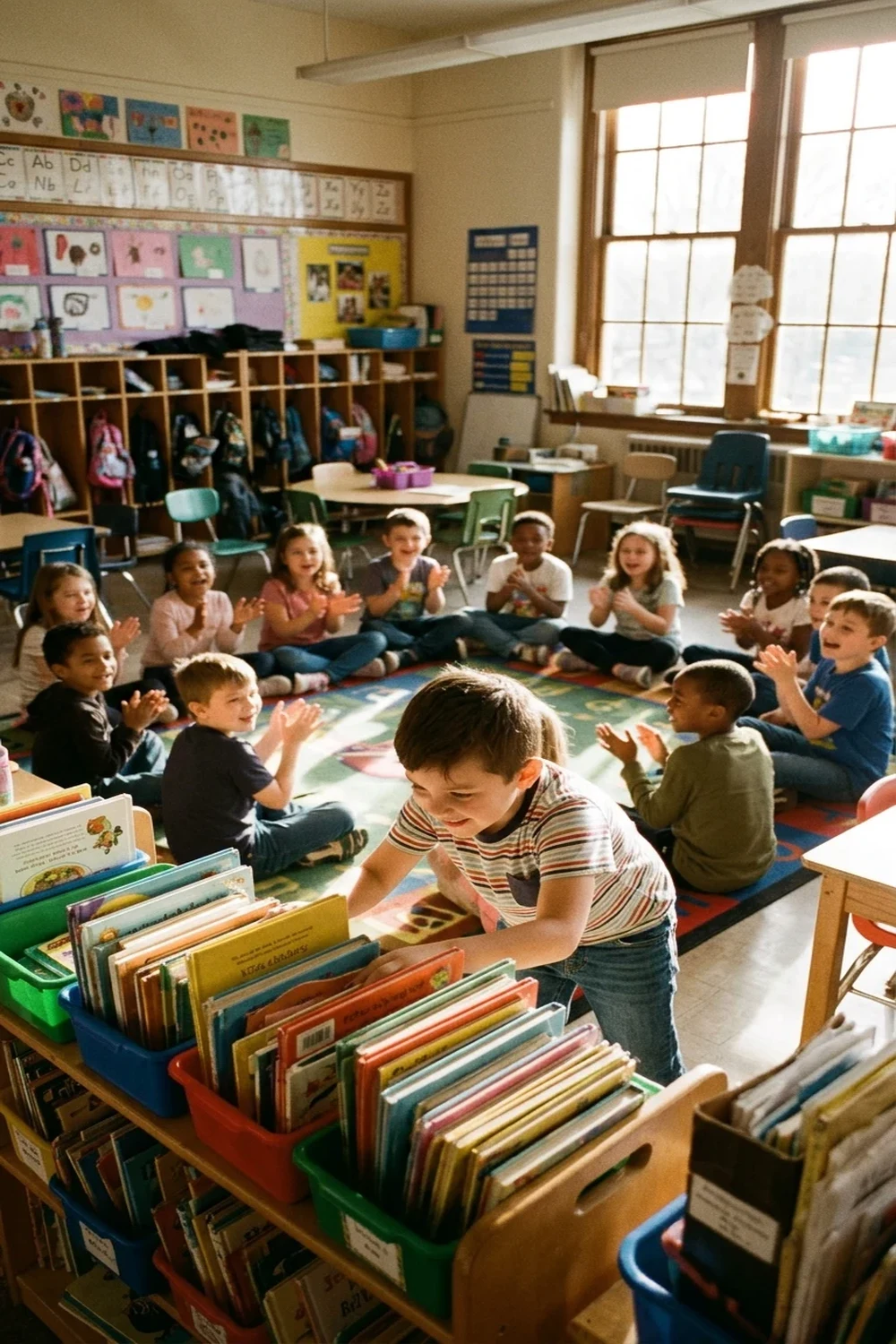
17. Hot and Cold: Spatial Awareness and Active Listening Game
Hot and Cold is a classic cooperative perception game where one seeker hunts for a hidden object using exclusively vocal temperature cues broadcast by the rest of the group. As the seeker navigates the room, teammates modulate their voices between freezing cold for distant mistakes and boiling hot for accurate proximity, cultivating sensory listening and collective guidance.
- Core Objective: The designated seeker must locate a concealed object within two minutes by interpreting real-time verbal proximity signals.
- Recommended Age and Group Size: Ideal for kids ages 4 to 10, functioning smoothly with groups ranging from 4 to 20 children.
- Essential Equipment: Any small, recognizable classroom or household object such as a colorful beanbag, rubber duck, or wooden block.
- Auditory Communication Rule: Teammates can speak single words like ‘freezing’, ‘warm’, or ‘boiling’, or replace speech with rhythmic clapping that accelerates near the prize.
- Cognitive Development: Players practice precise spatial estimation while the seeker sharpens active listening and directional orientation under gentle social cues.
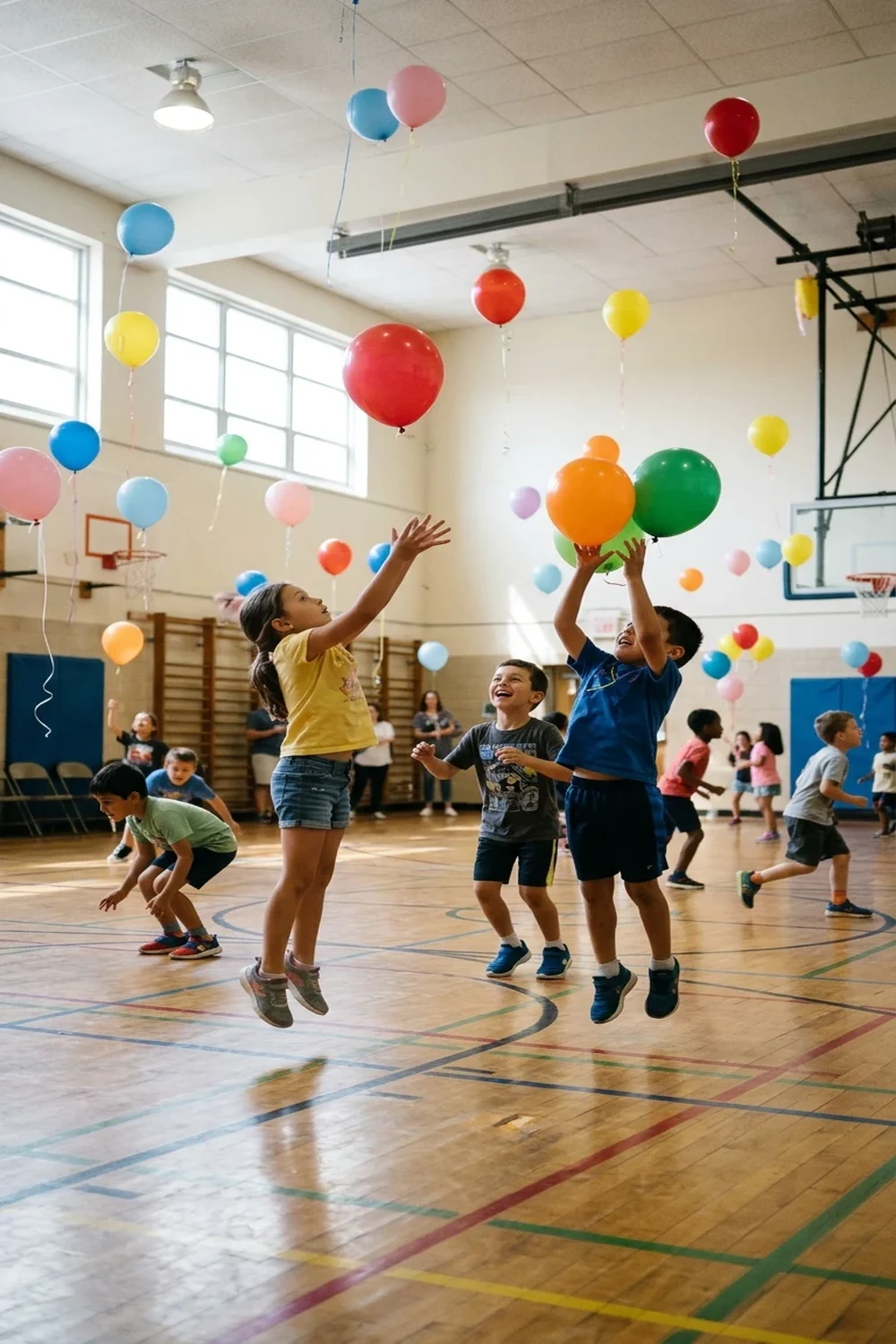
18. Get to Know You Balloons: Interactive Icebreaker Game for Kids
Get to Know You Balloons is an interactive icebreaker activity where children write personal conversation prompts on slips of paper, insert them into brightly colored balloons, and inflate them for a chaotic launch. After tossing the balloons airborne in a cooperative frenzy, each player catches one balloon, pops it with a stomp or squeeze, and reads the question aloud to introduce themselves to the group.
- Core Objective: Children break through social hesitation by answering lighthearted personal prompts revealed from popped colorful balloons.
- Recommended Age and Group Size: Perfect for children ages 6 to 12 in classrooms, summer camps, or youth clubs with 8 to 30 participants.
- Essential Equipment: Standard latex balloons in assorted neon colors, paper question slips, pencils, and optional child-safe plastic popping tools.
- Sample Question Prompts: Thought-provoking starter questions include ‘What superhero power would you choose?’, ‘What is your favorite animal sound?’, and ‘Where is your dream vacation destination?’.
- Social-Emotional Growth: The excitement of balloon chasing lowers social anxiety, allowing introverted and extroverted children to share personal stories on an equal, playful footing.

19. Flower Finding: Traditional Cooperative Singing and Movement Game
Flower Finding is a rhythmic circle game where two children clasp their raised hands to construct an archway roof while peers parade underneath in a winding chain to a melodic folk song. When the final verse concludes, the raised arch gently descends to catch the child currently passing below, initiating a joyful role swap that keeps every student physically active and socially connected.
- Core Objective: Children parade in single file beneath a human arch without breaking the singing tempo, navigating the suspense of the arch trap.
- Recommended Age and Group Size: Specially tailored for preschool and early elementary kids ages 3 to 8, accommodating 6 to 25 players outdoors or indoors.
- Essential Equipment: Zero props or gear required, relying entirely on open floor space and clear singing voices.
- Rhythm and Coordination: Walking in sync with melodic lyrics refines auditory tempo tracking, spatial timing, and motor regulation in developing youngsters.
- Inclusive Turn-Taking: The captured child immediately joins or swaps with an arch leader, ensuring everyone cycles through leadership and following roles without competitive elimination.

20. Wheelbarrow Race: Classic Partner Balance and Strength Challenge
The Wheelbarrow Race is a collaborative partner game where one player walks forward on their hands while a teammate holds their ankles to race toward a designated finish line. This classic physical challenge builds substantial shoulder stability, grip endurance, and active communication across a recommended 30-foot soft grass track.
- Core Setup: Pair children of comparable heights and physical build, marking a straight 30-foot racing track on soft turf with two visible cones.
- Partner Roles: One child assumes a high plank position on the ground while their partner lifts both legs at the knees or ankles at waist level.
- Pacing Control: The upright partner must match the forward stepping speed of the hands to prevent the front child from losing balance or collapsing forward.
- Turnabout Relay: Midway through the course or on the return leg, partners switch positions so both participants practice weight-bearing and propulsion.
- Safety Protocol: Always conduct the activity on grass or padded mats, instructing the walking partner to drop safely onto their chest if their hands fatigue.
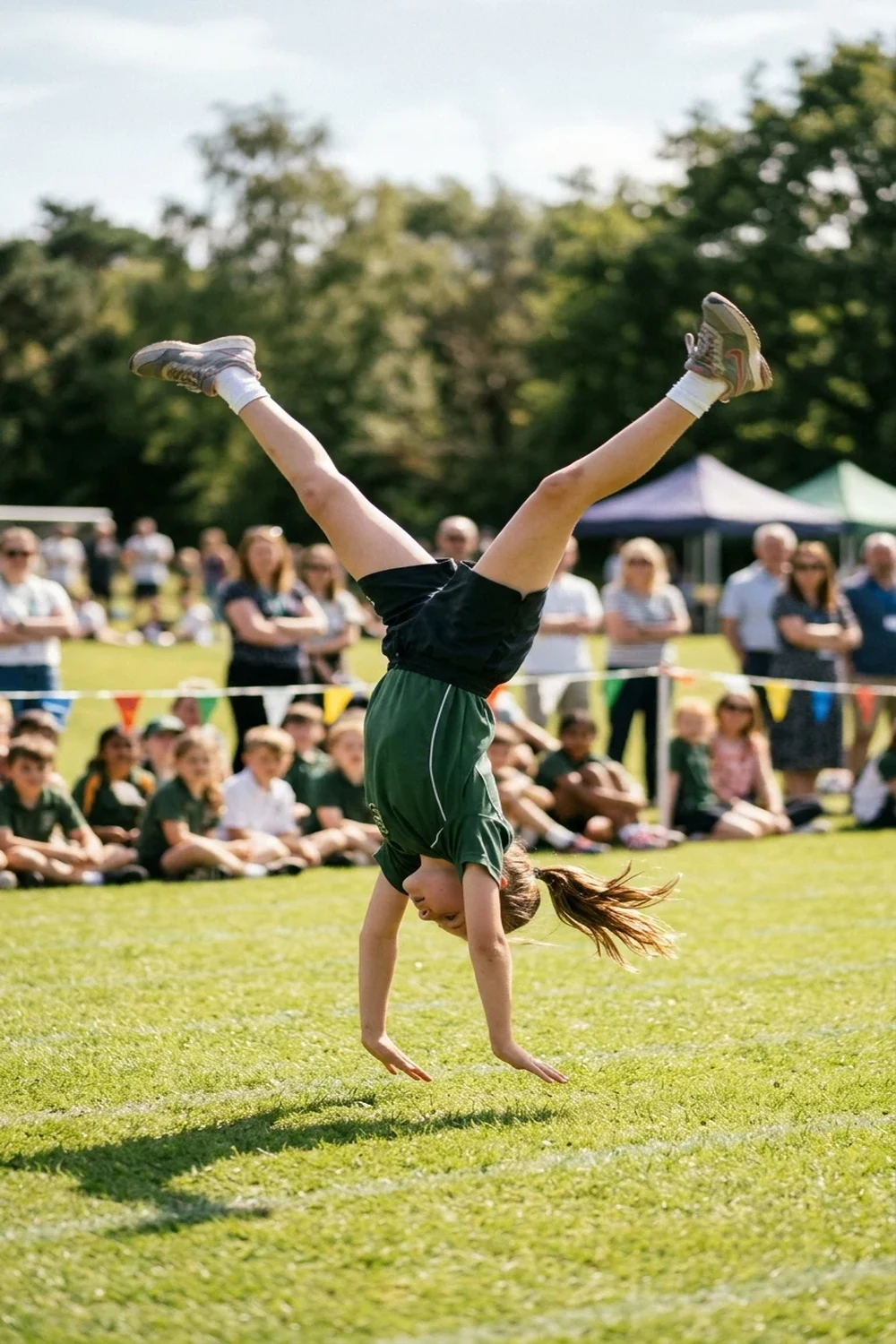
21. Cartwheel Race: High-Energy Gymnastics Agility Challenge
A Cartwheel Race is an athletic agility competition where children advance across an open field by executing consecutive, fluid cartwheels toward a designated end zone. This dynamic gymnastics drill reinforces spatial awareness, dynamic balance, and foundational lateral coordination along an open grassy strip.
- Lane Demarcation: Space boundary cones at least 8 to 10 feet apart to provide each participant an uninterrupted, safe rotational clearance corridor.
- Form Over Speed: Award primary placement to competitors who complete full sideways hand-to-foot rotations rather than haphazard tumbling maneuvers.
- Distance Optimization: Keep the course between 25 and 40 feet in total length to avoid inner-ear disorientation while sustaining athletic excitement.
- Spotter Deployment: Assign one adult supervisor per two lanes to monitor rotational trajectories and help participants navigate back on line.
- Warm-Up Protocol: Conduct five minutes of dynamic wrist flexion exercises, ankle circles, and hamstring stretches before beginning competitive rotations.
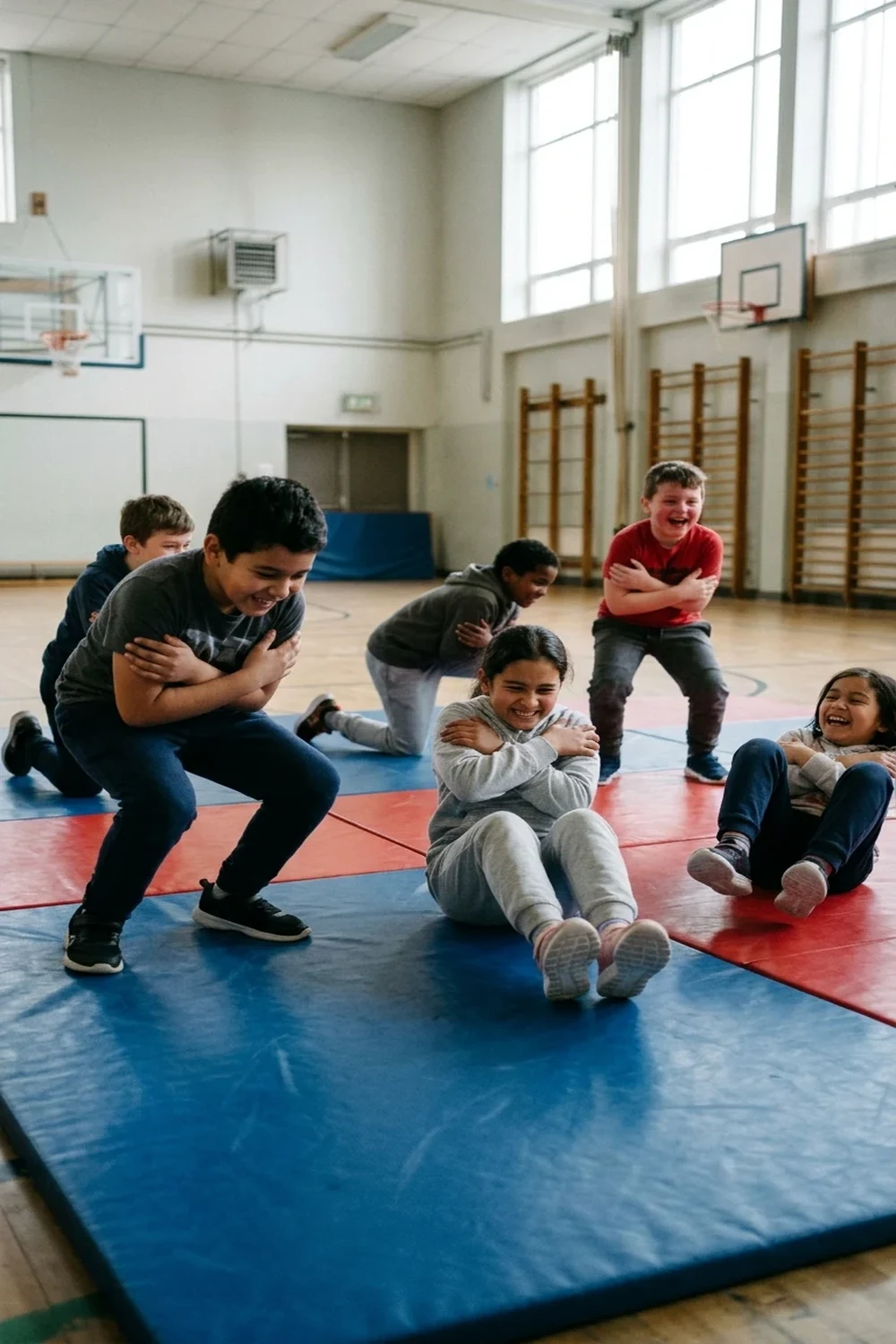
22. No Hands Get Up: Core Stability and Problem-Solving Relay
No Hands Get Up is a balance and gross motor challenge that requires children to stand up from a flat supine position without letting their elbows, forearms, or hands make contact with the floor. This engaging physical exercise isolates abdominal core strength, ankle mobility, and personal biomechanical ingenuity in a fun relay format.
- Starting Posture: Children sprint 20 feet from the starting line, recline completely flat on their backs, and cross their arms tightly across their chests.
- Elevation Technique: Competitors must rock forward onto their heels, engage their deep abdominal wall, and momentum-roll into a deep squat to stand upright.
- Strict Rule Enforcement: If any player touches an elbow, forearm, or palm to the surface during elevation, the player must reset and attempt the rise again.
- Return Sprint: Once fully upright with hips extended, the child sprints back to tag the next teammate waiting at the base line.
- Adaptation Tiering: For younger age groups, allow a single knee tap or crossed-leg pivot while keeping the hands firmly locked onto opposing shoulders.

23. Cotton Ball Race: Hilarious Sensory Motor Relay Game
The Cotton Ball Race is a cooperative indoor party relay where players transport lightweight cotton balls between two designated stations using only petroleum jelly applied to the tip of their nose. This entertaining game develops tactical body control, deliberate breathing discipline, and cooperative team communication under time constraints.
- Supply Configuration: Place a shallow bowl of twenty cotton balls at each starting station and an empty collection container ten yards away.
- Adhesive Application: Dab a nickel-sized amount of petroleum jelly onto each racer’s nose tip to act as the tactile retrieval surface.
- Hands-Free Transport: Kids must bend down, secure a single cotton ball using nose pressure alone, and crawl or speed-walk across the course.
- Drop Technique: Players release the cotton ball into the destination bucket by shaking their head or brushing the rim, strictly avoiding hand usage.
- Team Scoring Target: The first team to successfully relocate ten unbroken cotton balls into the collection bowl secures the round victory.

Snakes is an active cooperative team-building game where blindfolded children link together in a single-file line and navigate an obstacle course guided solely by non-verbal taps from their sighted caboose. This outdoor coordination challenge demands total active listening, spatial orientation, and mutual trust as every directive ripples through the entire team line from back to front.
- Core Objective: Guide a blindfolded line of teammates through a marked course using non-verbal shoulder taps without breaking contact.
- Recommended Group Size: Assemble 4 to 8 players per snake line, ensuring proper spacing and adult spotting for safe movement.
- Non-Verbal Signaling Protocol: Use single right-shoulder taps to steer right, left-shoulder taps to steer left, double taps to walk forward, and a firm double-shoulder press to freeze.
- Key Teamwork Skill: Builds foundational sensory trust and non-verbal communication discipline as players rely on physical feedback rather than visual cues.
- Facilitator Safety Tip: Run this game on a flat grass lawn clear of hard obstacles, and assign an unblindfolded spotter alongside each moving team.

25. Pop a Bag Race: Why Is This Fast-Paced Relay Ideal for Quick Coordination?
Pop a Bag Race is an energetic outdoor relay race where sprinters dash to a designated station, blow up a brown paper lunch bag, and forcefully pop it between their hands before tagging their next teammate. Unlike ordinary foot races, this physical contest combines cardiovascular sprinting with immediate tactile breath control and explosive motor action under pressure.
- Equipment Essentials: Provide one standard brown paper lunch sack per runner, placed at a turnaround table 20 to 30 feet from the starting line.
- Step-by-Step Gameplay: Sprint to the bag station on the whistle, open and inflate the paper bag with deep breaths, seal the neck, and slap it flat to produce an audible pop.
- Sensory and Physical Benefits: Sharpens oral motor development through rapid breath inflation while testing hand-eye striking accuracy under high-tempo relay conditions.
- Turnaround Penalty Rule: Require runners to produce a distinct popping sound before they can begin sprinting back to tag the next teammate in line.
- Eco-Friendly Tip: Collect all ruptured craft paper scraps into a dedicated compost bin immediately following the heat to teach active outdoor clean-up habits.

26. Consecutive Jumps: How Does Synchronized Leaping Develop Group Rhythm?
Consecutive Jumps is a rhythmic plyometric cooperation game where teammates hold hands side by side and leap synchronously across a series of chalk markers without breaking their group grip. This physical fitness exercise transforms explosive bounding into a collaborative timing challenge, teaching children how to calibrate their individual leaping strides to match collective group cadence.
- Course Setup: Mark 10 to 15 parallel chalk lines or flat agility ladders spaced 18 to 24 inches apart across a gymnasium floor or turf field.
- Synchronized Movement Rules: Link 3 to 5 players hand-in-hand along the baseline and require all team members to execute two-footed bounds into each successive zone simultaneously.
- Cadence and Verbal Cueing: Establish a rhythmic verbal chant such as ‘one-two-leap’ to help players align their jump preparation and landing mechanics.
- Motor Coordination Benefits: Enhances bilateral jumping power, joint stabilization, and shared kinetic awareness by preventing individual rushing.
- Progressive Difficulty Level: Increase task difficulty by varying jump intervals or having squads perform lateral consecutive hops across the boundary lines.

27. The 100 Inch Dash: Can Micro-Distance Snail Racing Teach Precise Body Control?
The 100 Inch Dash is a humorous micro-distance precision race where children compete to complete a course measuring exactly one hundred inches using the slowest, tiniest deliberate movements possible without halting. By inverting the standard rules of track sprints, this mindfulness activity shifts the focus from raw speed to intense neuromuscular control, isometric muscle stability, and sustained focus.
- Precise Track Setup: Measure and chalk a start and finish boundary line separated by exactly 100 inches (8.33 feet or 254 centimeters) on a flat indoor floor or patio.
- Winning Condition: Award victory to the racer whose trailing foot crosses the finish line last, provided their forward physical momentum never comes to a complete standstill.
- Strict Disqualification Rules: Assign neutral referees to monitor continuous forward movement; pausing, sliding backward, or lifting both feet simultaneously triggers a 5-second penalty.
- Gross Motor and Balance Gains: Engages deep core stabilizers, ankle dorsiflexors, and postural patience as kids balance in slow-motion heel-to-toe positions.
- Hilarious Group Variation: Run the micro-sprint as a tandem race where pairs must move like two-headed turtles with arms linked at the elbows.
.