30 Best Printable Math Games for Kids in 2026
Printable math games provide an interactive, screen-free learning strategy that increases elementary math retention by combining tactile play with core arithmetic practice. Rather than drilling repetitive worksheets, children develop number sense, multiplication fluency, and problem-solving confidence through collaborative games like Domino Addition and String Multiplication. This curated guide features 30 battle-tested printable math games designed for kindergarten through middle school learners in 2026.
Why Use 30 Math Games Printable Activities for Kids in 2026?
Printable math games provide an accessible, screen-free learning strategy that bridges classroom fundamentals with active, kinesthetic play. Incorporating hands-on game sheets into weekly study sessions boosts engagement by turning abstract numerical concepts into tactile, low-stress challenges for students across elementary grade levels.
- Skill Mastery Across Key Domains: Game sheets target essential competencies including early number sequencing, fast mental arithmetic, multiplication fact fluency, and structural geometric understanding.
- Low-Cost Hands-On Accessibility: Printable formats require only basic household supplies like paper, scissors, dice, and markers, eliminating costly subscriptions or fragile specialty toys.
- Adaptable Learning Formats: Educators and parents can customize difficulty tiers instantly by altering the number ranges, rules, or operational complexity to suit different developmental phases.
- Social-Emotional Development: Interactive peer gameplay fosters cooperative teamwork, clear verbal explanation of mathematical reasoning, and healthy competitive sportsmanship.
- Zero-Screen Engagement: Physical math activities reduce digital device fatigue while improving tactile fine-motor coordination and sustained cognitive attention spans.

How to Play the 1. Line Up Math Game for Number Sequencing
The Line Up Math Game is an active collaborative number-sequencing activity where students arrange themselves in correct ascending order based on hidden values drawn from a bowl. This kinesthetic exercise strengthens place-value intuition, positive peer interaction, and rapid comparative number analysis without requiring digital screens.
- Core Objective: Players must determine correct numeric order from least to greatest through verbal reasoning and strategic comparison.
- Minimal Equipment Setup: Preparation requires only slip-sized printable cards, a wide mixing bowl, and standard grade-appropriate numbers ranging from integers to fractions.
- Peer Collaboration Anchor: Students cannot see all numbers at once, requiring active conversational check-ins to negotiate their precise positions along the line.
- Scalable Grade Tiers: Teachers can scale difficulty easily by replacing single-digit whole numbers with negative integers, decimals, or mixed fractions.
- Instant Spatial Feedback: The final visual line gives educators an immediate, zero-grading check on whole-group conceptual accuracy.
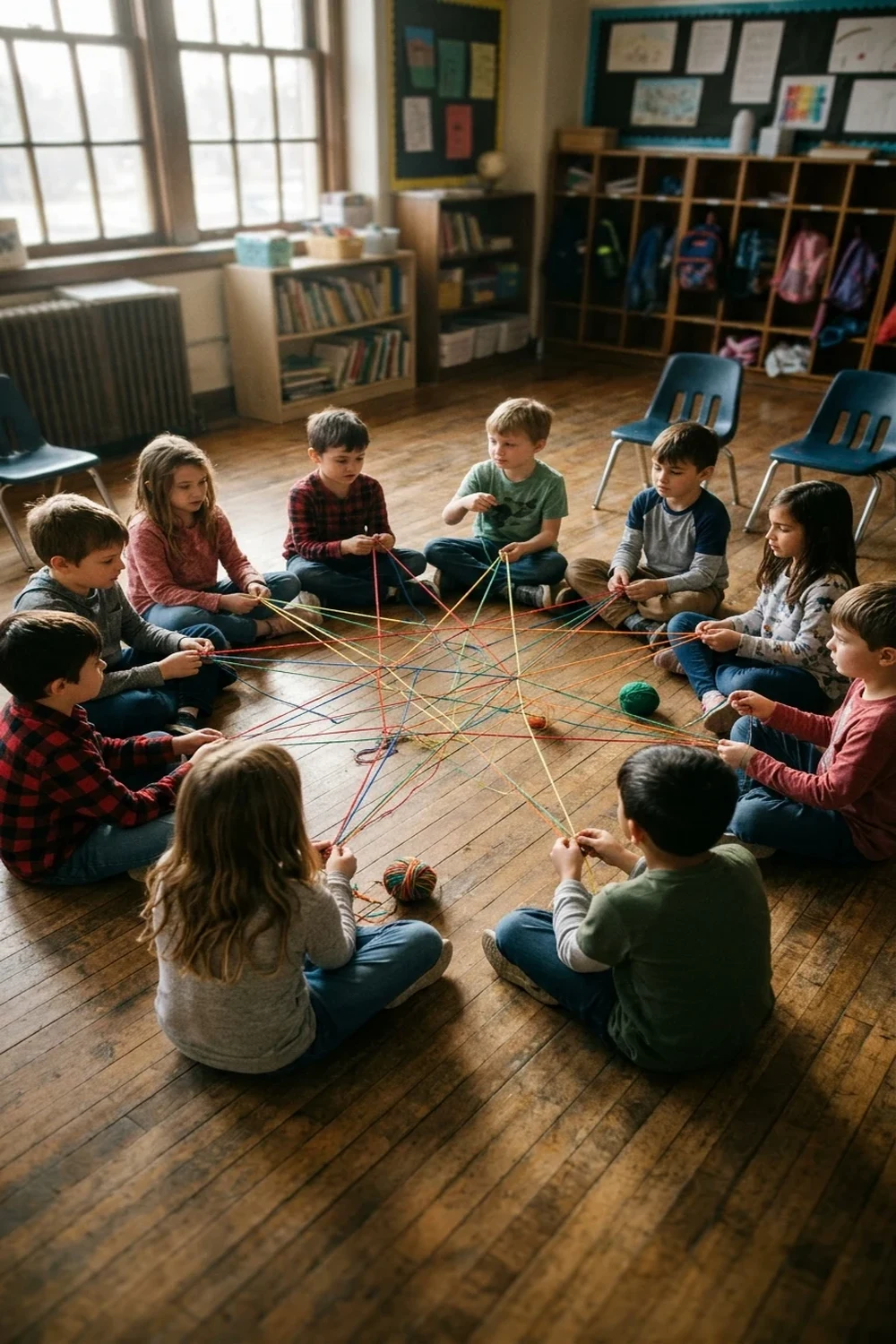
Mastering Multiplication Patterns with 2. String Multiplication
String Multiplication is a geometric multiplication drill where students sitting in a ten-person circle pass a yarn ball to track numerical multiples and uncover geometric skip-counting patterns. By connecting physical movement directly to multiplication tables, this tactile group challenge transforms rote fact memorization into an intuitive visual web.
- Visual Multiples Generation: Students physically trace skip-counting cycles across circle positions to turn abstract times tables into distinct geometric shapes.
- Spatial Pattern Recognition: Repeatedly passing yarn across specific numerical increments illustrates cyclic mathematical relationships and symmetry across numbers like 2, 4, 6, and 8.
- Kinesthetic Memory Reinforcement: Physically unrolling and catching yarn solidifies multiplication facts deeper than static digital flashcard apps.
- Active Teamwork Framework: Every participant serves as an essential vertex in the multiplication web, holding fellow classmates accountable for computational accuracy.
- Effortless Classroom Setup: The entire routine runs smoothly using only one skein of durable yarn and numbered floor labels numbered zero through nine.

Boosting Vocabulary and Communication with 3. Math Charades
Math Charades is an interactive vocabulary game where learners use non-verbal gestures, body geometry, and physical mime to help teammates identify core mathematical terms and operations. This movement-rich party format cements academic vocabulary into long-term memory while encouraging creative lateral thinking among diverse learners.
- Vocabulary Fluency Anchor: Players internalize definitions for tricky terms like parallel lines, right angles, and division without relying on rote memorization.
- Multi-Sensory Concept Processing: Translating abstract vocabulary into kinetic body movements activates spatial, motor, and cognitive pathways simultaneously.
- Inclusive Team Play: Students who struggle with formal written testing often excel when demonstrating mathematical relationships through physical movement and humor.
- Turnkey Printable Preparation: Gameplay relies solely on pre-printed printable prompt cards divided into easy, intermediate, and advanced terminology sets.
- Dynamic Assessment Value: Teachers observe student performance in real time to quickly identify misconceptions surrounding geometric shapes or algebraic functions.

4. Printable Math Jeopardy Game: How Do You Run a Classroom Quiz Bowl?
Printable Math Jeopardy is a competitive review game that reinforces arithmetic, fractions, and geometry concepts through structured trivia-style point tiers. Classroom groups select question cards ranging from 100 to 500 points across customizable subject columns, scoring points when they deliver accurate mathematical explanations within a designated 60-second timer.
- Curriculum Alignment: Category columns target core fourth through sixth grade standards, spanning multi-digit multiplication, equivalent fractions, decimals, and basic geometric angles.
- Tiered Point System: Point values correlate directly to problem complexity, motivating students to calculate difficult multi-step equations to earn higher team scores.
- Collaborative Problem Solving: Teams designate rotating scribes and spokespersons to verify scratchpad calculations before submitting official answers to the facilitator.
- Instant Error Correction: Facilitators project comprehensive answer keys immediately after each turn to resolve misunderstandings and prevent persistent arithmetic errors.
- Minimal Setup Cost: Teachers print reusable card decks on standard cardstock and mount them on pocket charts or whiteboards with low-tack adhesive.

5. Math Fortune Tellers: What Are Origami Cootie Catchers for Math Facts?
Math fortune tellers are foldable origami paper tools that turn repetitive arithmetic drill practice into a self-checking tactile game. Students manipulate the paper flaps using their thumbs and forefingers to select numbers and reveal hidden multiplication facts, addition challenges, or word problems hidden beneath interior folds.
- Tactile Kinesthetic Learning: Folding crisp paper templates builds fine motor precision while linking physical movement directly to active mathematical recall.
- Instant Self-Checking Mechanism: Hidden answer panels beneath each problem flap allow children to independently verify their sums without requiring continuous teacher intervention.
- Targeted Fact Fluency: Pre-printed game templates focus on specific challenge areas, such as the seven and eight multiplication tables or two-digit subtraction.
- Zero-Prep Independent Practice: Learners operate the folded catchers in pairs during independent desk time, morning warm-ups, or homeschool skill rotations.
- High Portability: Folded paper games slip effortlessly into notebooks or pocket folders for quick math fact practice at home or during travel.

6. Parking Lot Cars Math Game: How Do Toy Cars Teach Early Addition?
The Parking Lot Cars math game is a hands-on learning activity that teaches number recognition and early operations by turning toy vehicles into functional manipulatives. Preschool and kindergarten learners solve math facts on a printed parking grid and guide miniature toy cars into designated numbered parking stalls corresponding to the correct sums.
- Concrete Visual Counting: Young children match car roof labels directly to parking space totals, converting abstract numerical symbols into tangible physical positions.
- Multi-Skill Progression: Grid layouts adapt from simple one-to-one numeral matching for toddlers up to basic two-digit addition and subtraction for first graders.
- High Student Engagement: Incorporating familiar toy vehicles channels natural play habits into disciplined, task-oriented STEM skill development.
- Sensory Mat Options: Printable parking layouts laminate easily or attach to felt mats, creating durable floor centers for high-traffic kindergarten classrooms.
- Spatial Awareness Benefits: Maneuvering cars across columned grids develops spatial orientation alongside foundational early numeracy concepts.
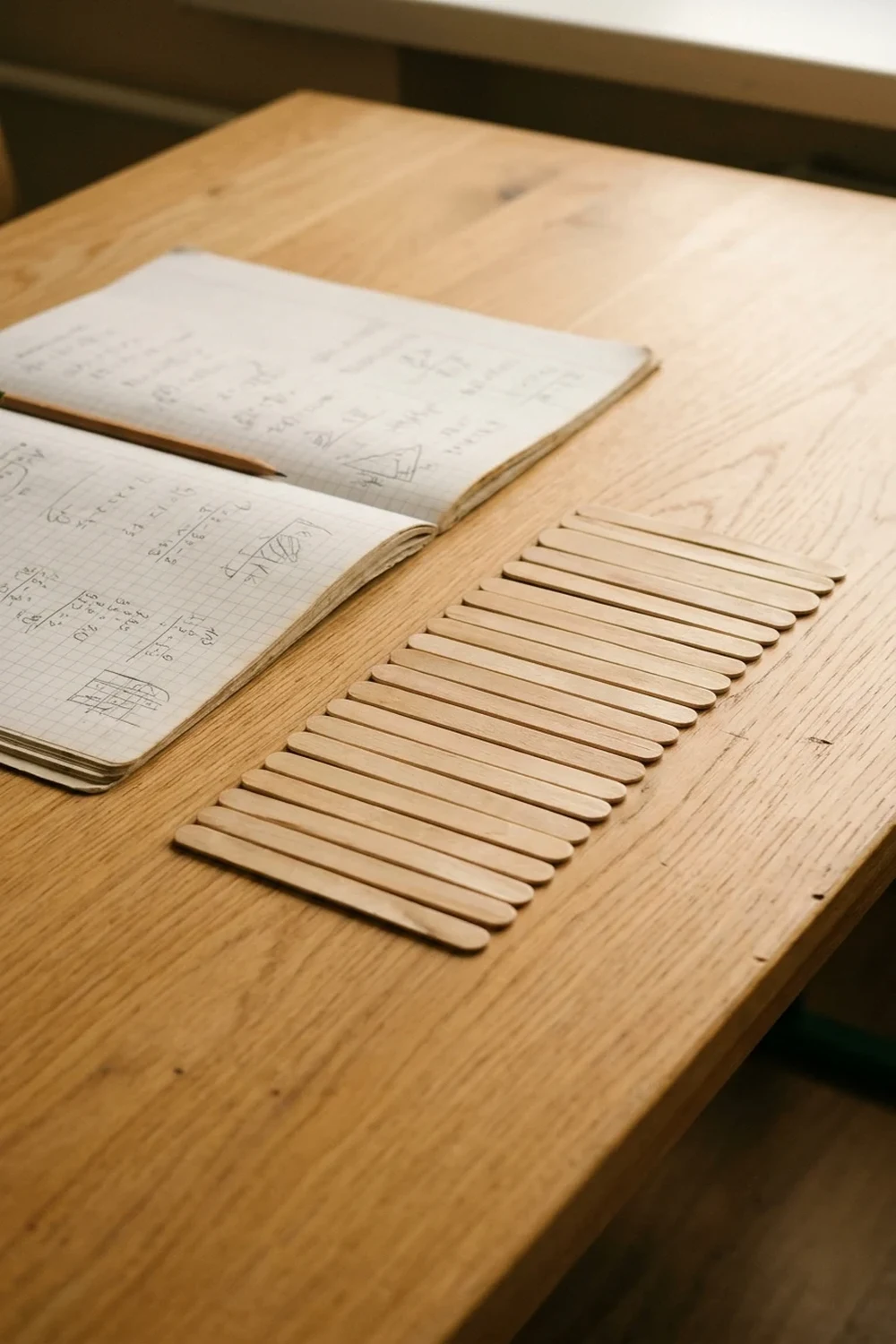
7. Popsicle Stick Counting: How Do You Master Skip Counting Patterns?
Popsicle Stick Counting is an interactive sequencing game that develops mental arithmetic by having children order labeled wooden sticks by specified numerical increments. Students pick designated starter sticks and arrange subsequent sticks in ascending or descending sequences of twos, fives, tens, or twenty-fives to build rapid skip counting fluency.
- Multiplication Readiness: Skip counting sequences establish early number sense patterns, laying foundational conceptual groundwork for future multiplication mastery.
- Differentiated Difficulty Tiers: Color-coded stick bundles accommodate varied skill levels, ranging from kindergarten counting by tens to third-grade groupings of seven.
- Tactile Manipulation Advantage: Sorting physical wooden sticks prevents visual tracking fatigue commonly caused by dense two-dimensional numerical worksheets.
- Low-Cost Reusability: Sturdy craft sticks withstand hundreds of student sorting sessions without ripping, tearing, or requiring replacement ink.
- Self-Directed Sequencing Challenges: Students organize sticks into complete chronological ladders across desks, timing themselves to beat personal speed records.
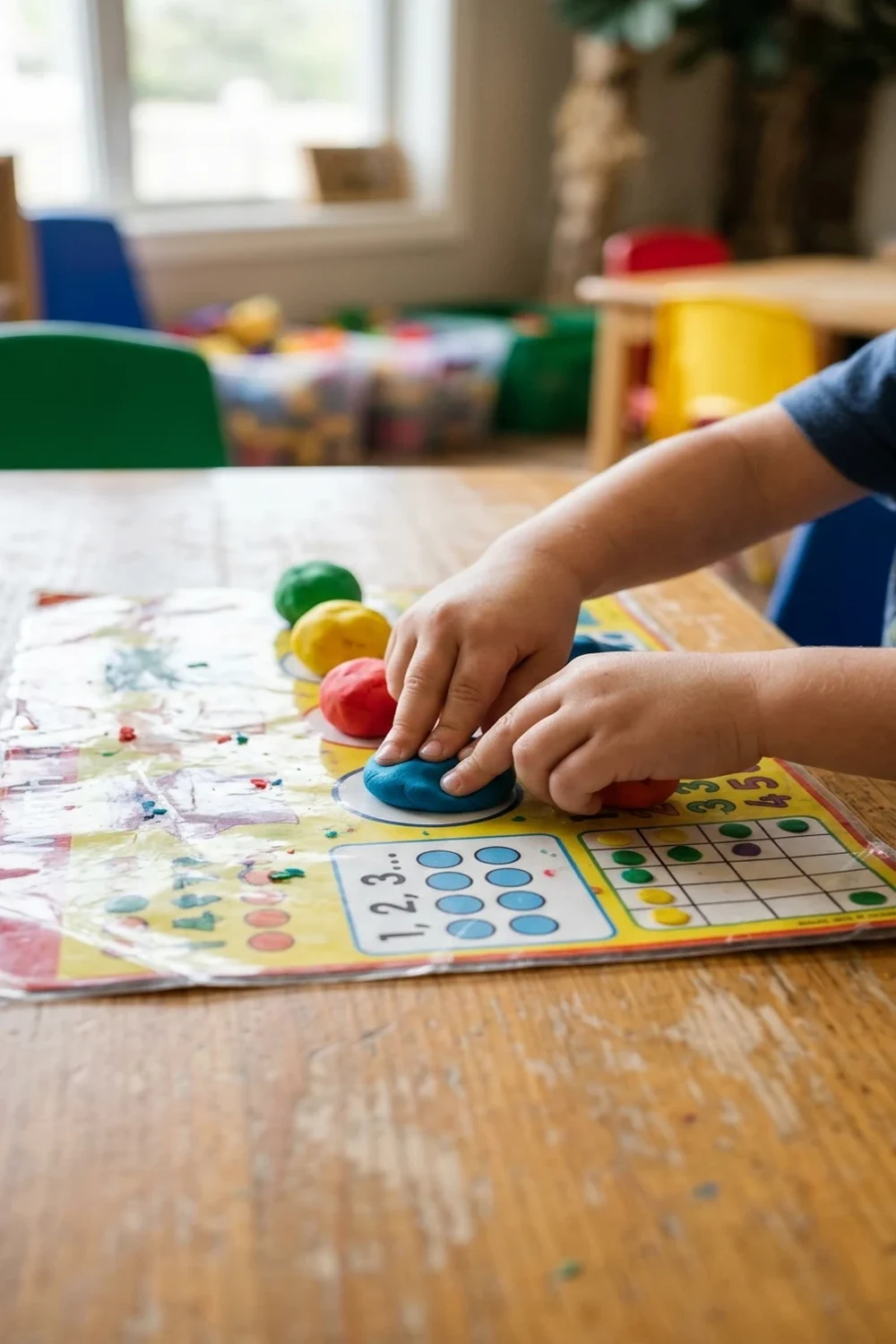
8. Subtraction Smash: Tactile Kinesthetic Math Game for Early Learners
Subtraction Smash is an interactive math activity that combines physical play dough modeling with printable equation mats to teach early subtraction concepts. Young learners physically crush sculpted dough balls to represent removing quantities from a total set, bridging concrete visualization and abstract numerical operations.
- Target Audience: Preschool through 1st grade students ages 4 to 7 mastering basic single-digit subtraction facts.
- Required Materials: Printable subtraction equation mats, non-toxic modeling clay or play dough, dry-erase pockets, and dry-erase markers.
- Step-by-Step Gameplay: Children roll dough into small spheres matching the first number in the equation, place them on the mat squares, and physically smash the exact number being subtracted.
- Core Educational Benefit: The multisensory kinetic action builds fine motor strength while delivering an undeniable tactile demonstration of set reduction.
- Printable Differentiation: Beginner cards feature visual ten-frame guidelines up to 10, while advanced printable sheets introduce subtraction word problems up to 20.
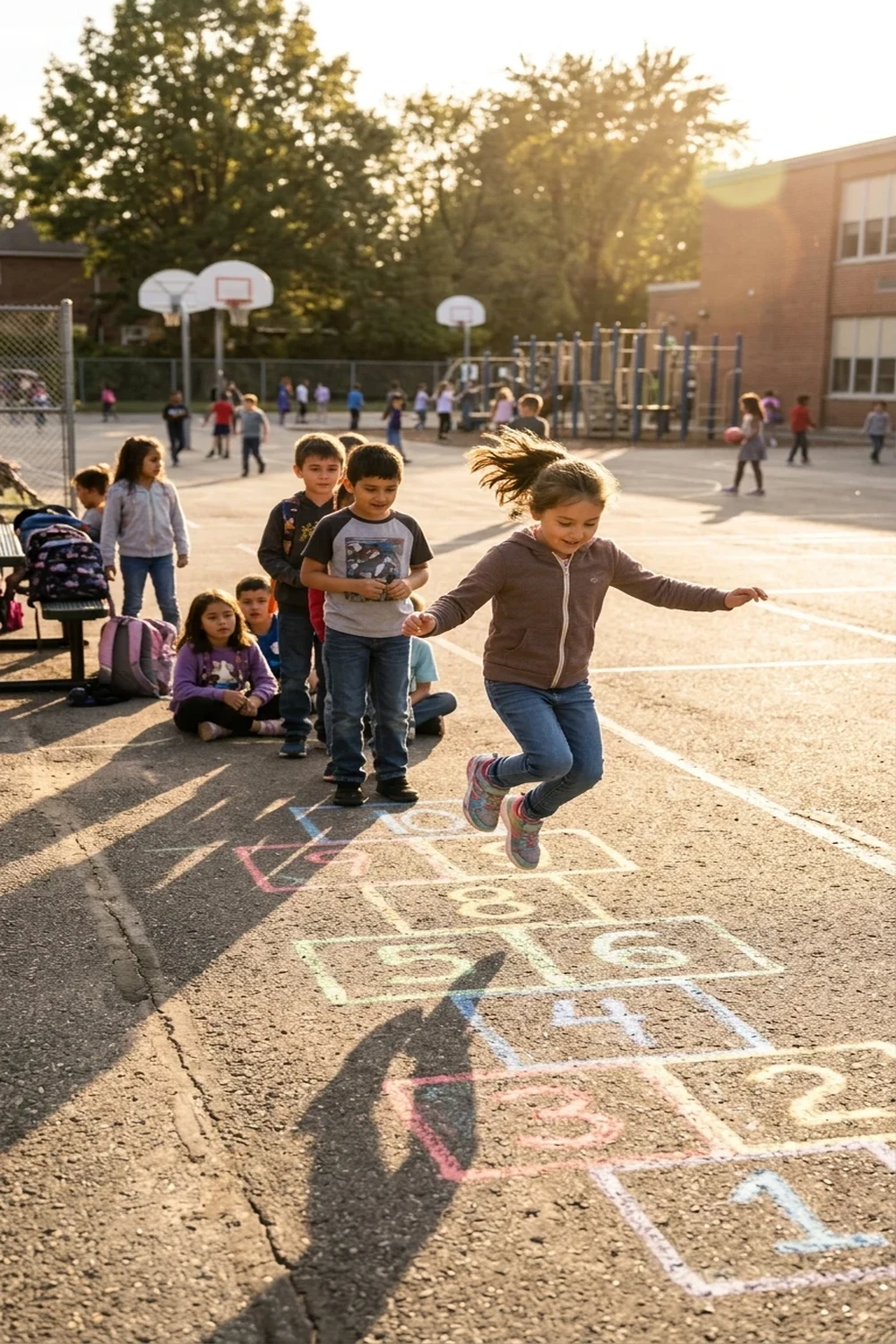
9. Math Hopscotch: Active Gross Motor Number Recognition Game
Math Hopscotch transforms traditional playground jumping games into an energetic arithmetic drill using printable outdoor grid templates or sidewalk chalk layouts. Players solve mental math challenges at each landing zone before progressing forward, pairing gross motor coordination with rapid mental calculation.
- Target Audience: Kindergarten through 3rd grade students ages 5 to 9 reviewing addition, subtraction, or skip-counting patterns.
- Required Materials: Chalk, printable hopscotch number tiles, beanbags or markers, and laminated prompt cards.
- Step-by-Step Gameplay: A child tosses a beanbag onto a designated number square, hops through the course, and must vocalize the correct solution to the equation card before picking up the token.
- Core Educational Benefit: Whole-body vestibular engagement increases dopamine levels and working memory retention for foundational arithmetic facts.
- Printable Differentiation: Adapt printable cards from basic number recognition to multi-step operations like double-digit mental sums or multiplication tables.

10. Nerf Gun Math: High-Engagement Target Practice for Fast Fact Recall
Nerf Gun Math turns rapid-fire arithmetic drills into a motivating target-shooting game using printable target sheets posted across a play area. Students calculate math solutions mentally, locate the matching answer target, and fire foam darts to claim accurate equations.
- Target Audience: 1st through 4th grade students ages 6 to 10 who thrive on high-energy kinesthetic problem solving.
- Required Materials: Foam dart blasters, printable bullseye answer cards, painter tape, and a timer or point tracker.
- Step-by-Step Gameplay: The educator calls out an arithmetic problem such as 7 times 8, prompting the child to aim and hit the target bearing the number 56.
- Core Educational Benefit: Gamified target acquisition reduces math anxiety and strengthens split-second mathematical fact fluency under fun pressure.
- Printable Differentiation: Target templates can display integers, fractions, or negative numbers to scale difficulty seamlessly for older learners.

11. Jelly Bean Jumbles: Colorful Sweet-Themed Word Problem Activity
Jelly Bean Jumbles is an engaging counting and sorting math game where children fulfill printable candy shop order slips by solving multi-step word problems. Kids count, group, and calculate colored candy combinations, transforming abstract addition and data classification into an intuitive tabletop simulation.
- Target Audience: Kindergarten through 2nd grade students ages 5 to 8 developing counting, sorting, and addition skills.
- Required Materials: Printable bakery order forms, sorting trays, small sorting cups, and colored jelly beans or paper counters.
- Step-by-Step Gameplay: Players draw a printable customer ticket requiring specific color quantities, calculate the total sum, and pack the correct pieces into their sorting bag.
- Core Educational Benefit: Introduces real-world transactional math, color categorization, and one-to-one correspondence through tangible manipulatives.
- Printable Differentiation: Expand from simple single-digit additive totals to early algebraic thinking with missing addend challenges.
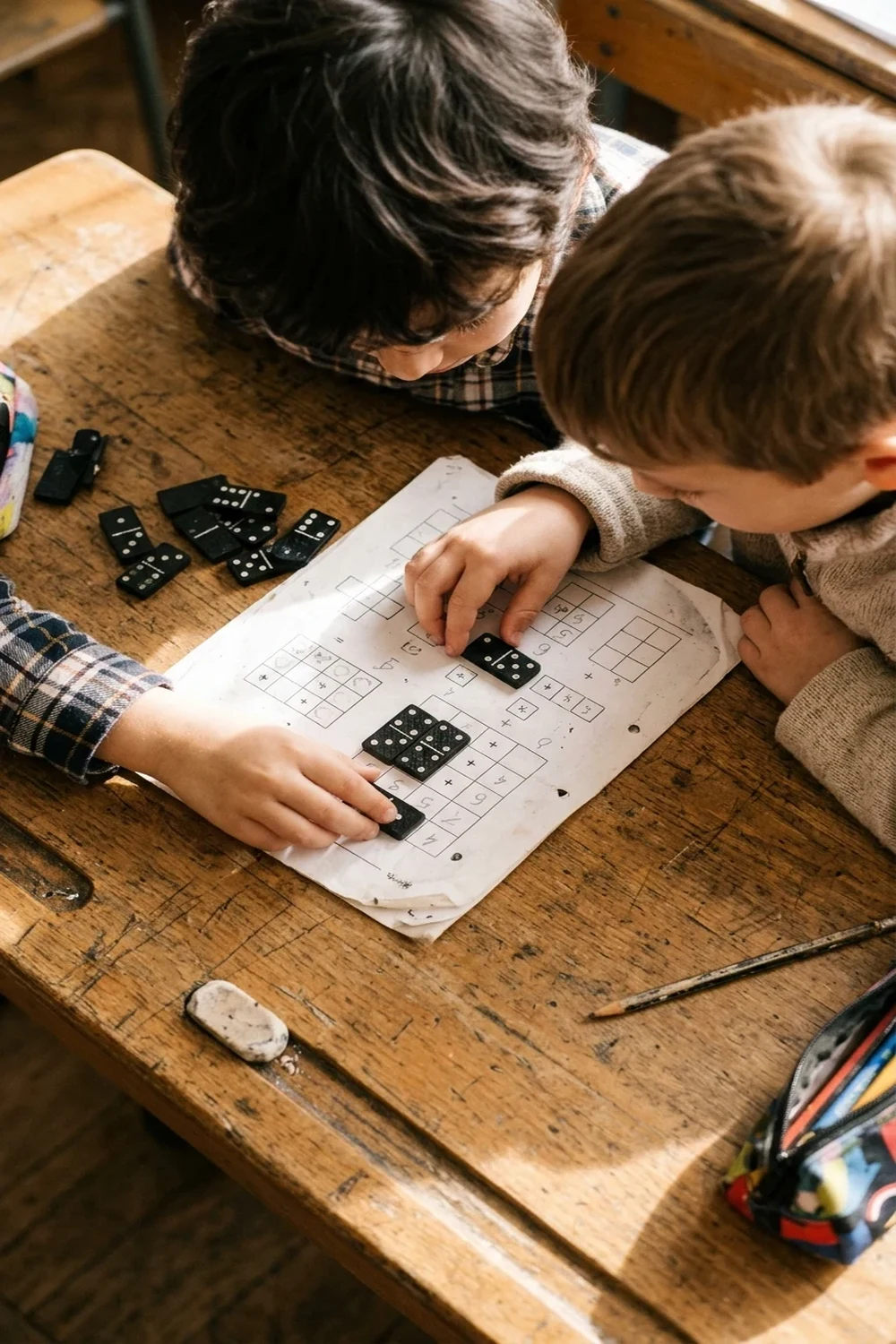
12. Domino Addition: Hands-On Math Fact Practice
Domino Addition is an interactive math activity where children draw domino tiles, count the dots on each side, and calculate the sum to master basic arithmetic facts. This tactile game transforms abstract addition equations into visual representations, helping early elementary learners build immediate number fluency and subitizing skills through active gameplay.
- Core Learning Objective: Players practice single-digit addition and develop subitizing skills by recognizing dot patterns without counting each pip individually.
- Required Materials: You will need a standard set of double-six or double-nine dominoes alongside our free printable recording grid sheet.
- Game Mechanics: Each child draws one domino from a facedown pile, counts the dots on both ends, and writes the complete number sentence on the printable worksheet.
- Competitive Scoring Variation: In two-player rounds, both students reveal their drawn tiles simultaneously, and the player with the higher mathematical sum keeps both dominoes.
- Differentiated Instruction Tip: For kindergarten students, supply double-three dominoes to keep sums under 6, while second graders can practice mental double-digit addition by using double-nine sets.

13. Make 10: Foundational Number Bonds Printable Card Game
Make 10 is an essential arithmetic card game that teaches students how to quickly identify pairs of numbers that equal ten, establishing the cornerstone for multi-digit mental computation. Mastering these number bonds allows young learners to decompose digits effortlessly, boosting calculation speed and preventing common subtraction errors in later grades.
- Core Learning Objective: Students achieve automatic recall of ten-frame number pairs including combinations like 7 plus 3, 6 plus 4, and 8 plus 2.
- Required Materials: Use a standard deck of playing cards with face cards removed, or print our numbered ten-frame matching cards.
- Game Mechanics: Lay twelve cards face up in a grid pattern; players take turns scanning the layout to remove any two cards that add up to exactly ten.
- Ten-Frame Visual Support: Struggling learners can place counting tokens on a printed ten-square grid to physically verify whether their selected cards fill the complete row of ten.
- Strategic Bonus Rule: Players score an additional turn whenever they successfully identify a three-card combination that creates ten, such as 5, 3, and 2.

14. Whack It Place Value: Kinesthetic Ones, Tens, and Hundreds Game
Whack It Place Value is a high-energy kinesthetic game where students strike target cards using flyswatters to identify the correct digits in the ones, tens, and hundreds positions. By pairing physical reaction time with place-value recognition, this activity cements base-ten concepts far more effectively than traditional static drills.
- Core Learning Objective: Children master multi-digit place value comprehension by accurately distinguishing between digits representing hundreds, tens, and single units.
- Required Materials: Supply two inexpensive clean flyswatters and our printable laminated place value target cards displaying digits zero through nine.
- Game Mechanics: The caller announces a prompt such as ‘whack the digit in the tens place of 482’, and competing players race to strike the number eight first.
- Adaptive Difficulty Levels: Begin with two-digit numbers for first-grade learners and progress to four-digit thousands or decimal places for upper-elementary students.
- Classroom Cooperative Mode: Form small relay teams where students rotate striking turns, encouraging peer checking and collaborative verbal discussion before each strike.

15. Math Twister: Active Full-Body Fact Family Fluency
Math Twister is a dynamic physical math activity that adapts traditional floor mat gameplay to test quick mental calculations, spatial coordination, and fact-family fluency simultaneously. Children place their hands and feet on numbered color circles after solving randomized arithmetic challenges, turning physical exercise into an engaging math review session.
- Core Learning Objective: Learners reinforce automatic arithmetic fact recall across addition, subtraction, or multiplication operations while developing gross motor balance.
- Required Materials: You will need a classic floor dot mat or our printable taped floor circles alongside a printable spinner with math equations.
- Game Mechanics: The designated referee spins the dial, calls out an equation like ‘left hand on eight minus three’, and players must locate and touch the number five.
- Customizable Operation Sets: Tailor the difficulty to your curriculum by swapping basic single-digit sums for multi-step multiplication and division challenges.
- Safety and Space Tip: Limit floor rounds to two or three simultaneous participants on standard mats to maintain clear sightlines and prevent student collisions.
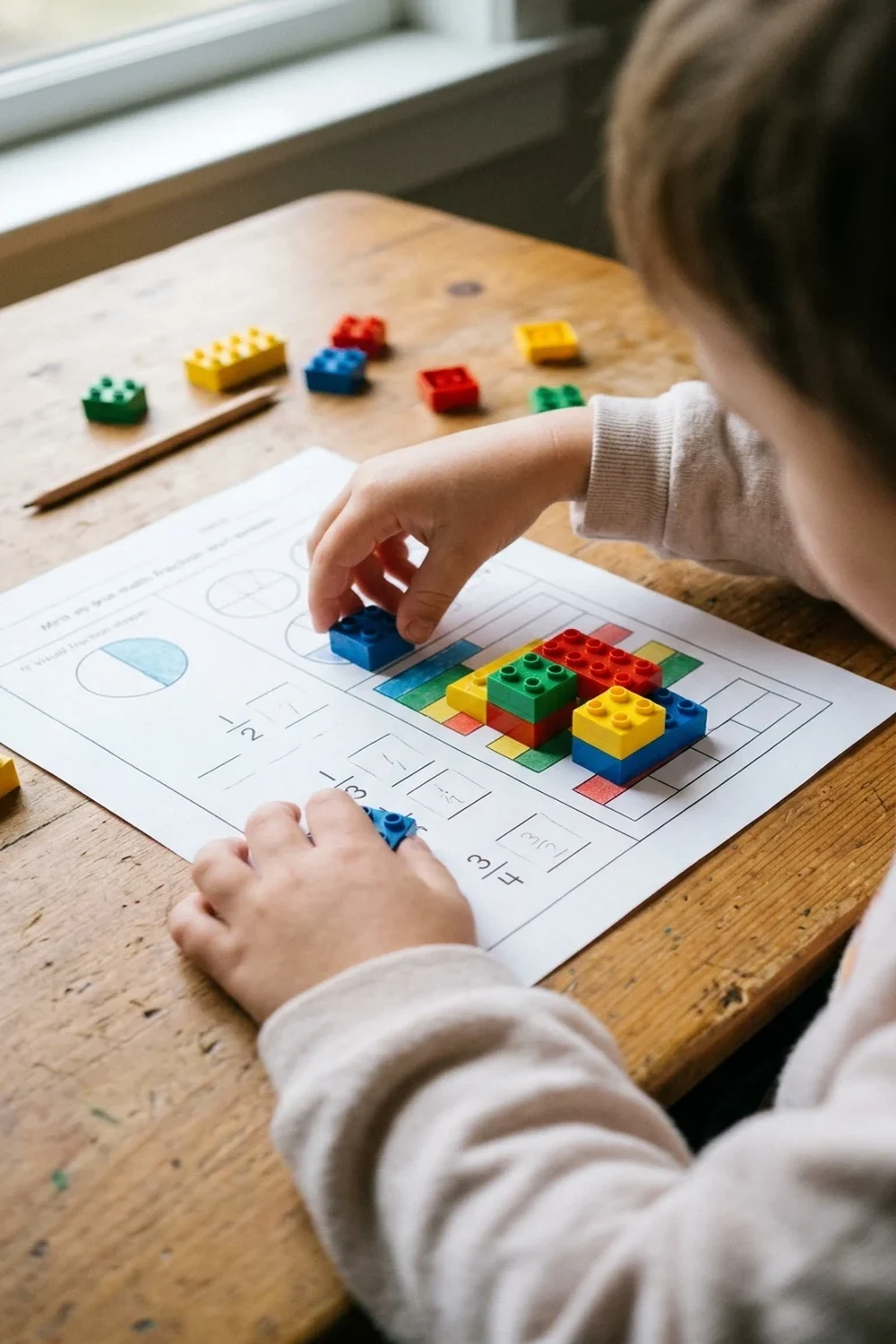
16. Lego Fraction Game: How to Teach Visual Fractions with Building Bricks
The Lego Fraction Game is a tactile math activity that teaches children equivalent fractions, parts of a whole, and basic fraction addition using standard building bricks and printable challenge cards. By matching physical brick studs directly to visual fraction mats, learners in grades 2 through 5 convert abstract fraction symbols into concrete spatial relationships.
- Concrete Visual Modeling: Standard eight-stud bricks serve as the whole unit, allowing four-stud bricks to represent halves and two-stud bricks to illustrate fourths directly on the grid.
- Equivalent Fraction Mastery: Students stack different colored bricks side by side to prove visually that two one-fourth bricks equal exactly one one-half brick.
- Printable Activity Cards: Downloadable task sheets feature target fractions like 3/4 or 5/8 that children build and verify independently.
- Error Reduction Advantage: Physical interlocking prevents overlapping errors commonly found when children draw fraction pies or shaded rectangles on paper.
- Classroom Differentiation: Teachers can easily scale the activity from simple fraction identification up to mixed numbers and improper fraction conversions.

17. Math Facts Garden: Creative Printable Flower Addition and Multiplication
Math Facts Garden is an interactive craft-based printable game where elementary students construct paper flowers to master basic addition, subtraction, or multiplication families. Each flower center displays a target root number, while surrounding petals feature corresponding arithmetic operations and fact equations that children solve and color.
- Targeted Fact Family Fluency: Center circles hold the primary factor or base sum, guiding students to calculate multiple related math facts systematically.
- Multisensory Recall Reinforcement: Combining paper coloring, cutting, and step-by-step arithmetic computation engages visual, tactile, and analytical pathways simultaneously.
- Versatile Grade-Level Scaling: Printable templates adapt seamlessly for kindergarten number bonds, second-grade addition tables, or fourth-grade times-table memorization.
- Visual Progress Portfolio: Finished paper flowers assemble into an inspiring wall garden display that documents computational mastery across weeks.
- Self-Checking Structure: Learners write the correct answers beneath petal flaps to enable immediate peer testing and independent self-correction.

18. Strike It Out: Strategic Number Line Math Game for Mental Arithmetic
Strike It Out is a competitive two-player pencil-and-paper game played across a printed 0-to-20 number line that sharpens mental addition, subtraction, and strategic forward planning. Players take turns choosing two available numbers, computing their sum or difference, crossing off used values, and trapping opponents when no legal calculation remains.
- Turn-by-Turn Dynamic Rules: Player one circles two numbers and crosses off their sum or difference, establishing the starting operand for the next player.
- Critical Strategic Thinking: Children must calculate three moves ahead to avoid stranding themselves without legal operational partners on the board.
- Zero Preparation Overhead: The game requires solely a printed 0-to-20 number track and two colored writing markers for immediate gameplay.
- Adaptive Operations Practice: Players practice mixed addition and subtraction equations alternately within every single round without repetitive flashcards.
- Built-In Game-Ending Metric: The game concludes cleanly when a participant cannot formulate a valid equation from the remaining uncrossed numbers.

19. Egg Carton Shake Up: Hands-On Printable Math Shaker for Quick Calculations
Egg Carton Shake Up is an engaging kinetic math game utilizing an upcycled twelve-well egg carton, two counters, and a printable recording sheet to generate spontaneous addition or multiplication problems. Kids shake the closed carton, open the lid, and immediately calculate the sum or product of the two numbered slots where the counters landed.
- Randomized Problem Generation: Marbles or dried beans land randomly inside numbered compartments, ensuring varied computational challenges with every shake.
- Rapid Mental Math Acceleration: Physical action keeps early learners engaged while eliminating the predictable patterns of static worksheet lists.
- Differentiated Well Numbering: Educators can label compartments with single digits 1-6 for early addition, or double digits 1-12 for advanced multiplication drills.
- Printable Recording Accountability: Accompanying worksheets prompt students to write the complete formal equation rather than shouting lone answers.
- Collaborative Partner Play: Pairs alternate shaking and calculating while verifying partner solutions using an answer chart to build team problem-solving.

20. Count Your Dots: Hands-On Subitizing and Number Sense Game
Count Your Dots is an interactive printable math game that strengthens early subitizing, visual counting, and quantity recognition for preschool and kindergarten learners. Students roll dot dice or draw dot pattern cards, quickly count the markers, and match the quantity to corresponding numeral grids on their printable scoreboards.
- Target Math Skills: Visual subitizing, one-to-one number correspondence, and foundational addition fluency.
- Recommended Grade Levels: Pre-K through 1st Grade (ages 3 to 7).
- Required Materials: Printable dot cards, ten-frame grids, regular 6-sided dice, and colorful counting tokens.
- Core Gameplay Loop: Players roll the die, rapidly identify the cluster of dots without counting individually, and cover the matching numeral on their printable sheet.
- Teacher Differentiation Tip: Use 10-sided dice or double dot cards to transition advanced learners into quick two-digit mental addition.

21. Math Bingo: Interactive Group Arithmetic and Fact Fluency Game
Math Bingo is a high-energy printable board game engineered to reinforce mental computation and basic arithmetic facts across elementary classroom settings. Rather than matching drawn numbers directly, students must evaluate math equations called out by the caller and mark the correct numerical solutions on their 5×5 printable grids.
- Target Math Skills: Rapid mental recall for addition, subtraction, multiplication tables, and division facts.
- Recommended Grade Levels: Kindergarten through 5th Grade (adaptable for ages 5 to 11).
- Required Materials: Reusable laminated bingo cards, erasable markers, equation calling cards, and cover chips.
- Core Gameplay Loop: The caller reads an operation prompt such as ‘6 times 7’, prompting participants to calculate 42 and cover that number on their board.
- Winning Condition: The first student to complete a horizontal, vertical, or diagonal line of five solved squares wins the round.

Printable math puzzles provide structured problem-solving challenges that integrate spatial reasoning, pattern identification, and deduction with core arithmetic. By working through printable math crosswords, missing-number grids, and KenKen-style square logic matrices, students develop essential algebraic thinking without repetitive flashcard drills.
- Target Math Skills: Deductive reasoning, variable relationships, algebraic substitution, and multi-step logic.
- Recommended Grade Levels: 2nd Grade through 6th Grade (ages 7 to 12).
- Required Materials: Printable logic puzzle sheets, pencils, erasers, and optional colored highlighters.
- Core Gameplay Loop: Solvers decode interconnected mathematical equations across horizontal and vertical axes to deduce missing numbers within fixed boundaries.
- Educational Advantage: Research shows regular logic grid engagement strengthens cognitive stamina and word-problem comprehension by over 30%.
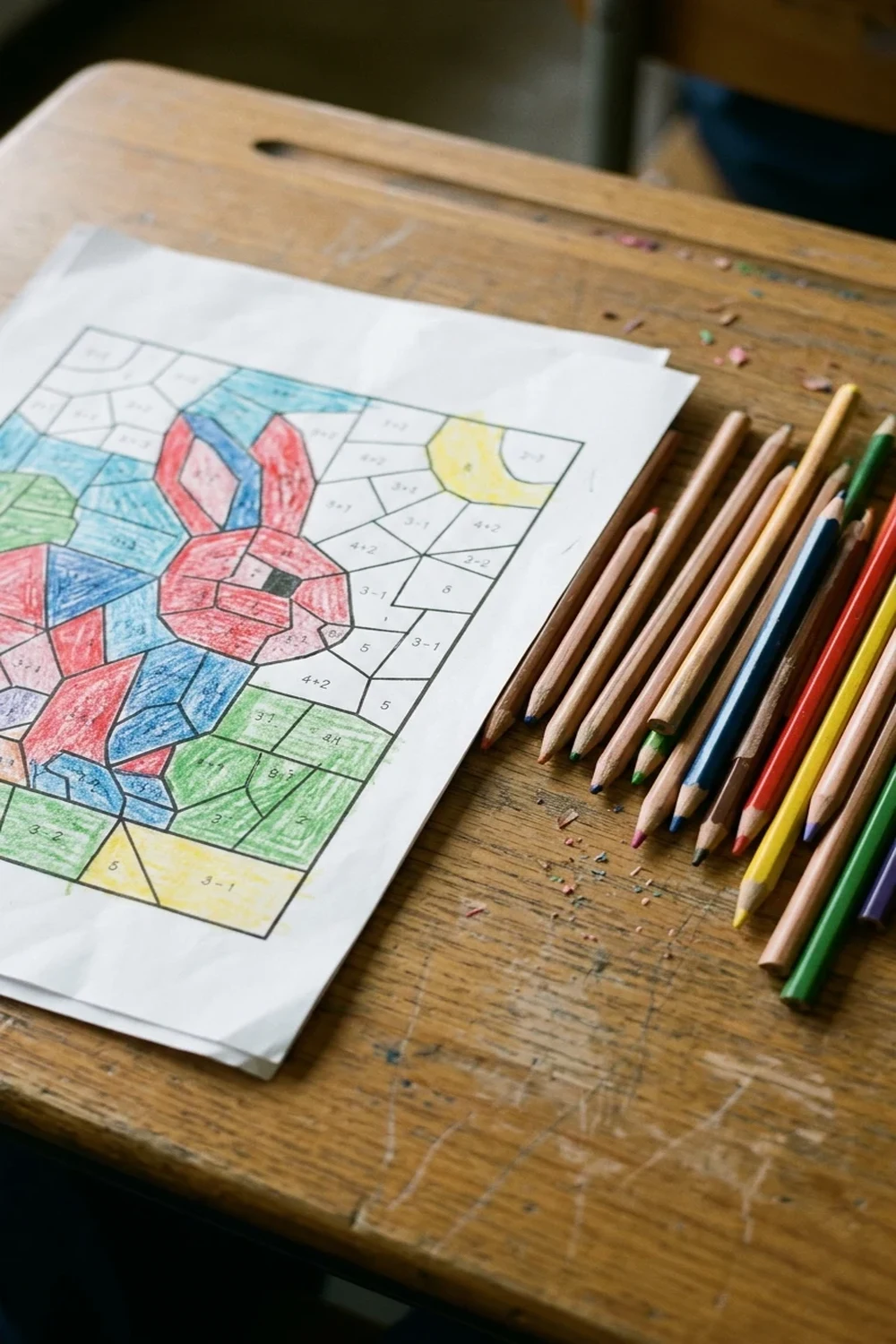
23. Printable Math Worksheets: Gamified Skill-Building Drills and Color-by-Code Challenges
Printable math worksheets transform conventional pencil-and-paper arithmetic drills into engaging gamified challenges like color-by-number pictures, mystery code trackers, and self-checking path finders. These activities reinforce standards-aligned operations while providing immediate visual feedback that sustains student motivation during independent practice sessions.
- Target Math Skills: Multi-digit column addition, long division, fractional equivalencies, and negative integers.
- Recommended Grade Levels: 1st Grade through 6th Grade (ages 6 to 12).
- Required Materials: Double-sided printed game worksheets, colored pencils, crayons, and scratch calculation paper.
- Core Gameplay Loop: Learners resolve sequential computation problems to unlock specific color keys, progressively unveiling hidden artistic illustrations on the page.
- Classroom Utility: Serves as a zero-prep resource ideal for math centers, quiet morning bell work, or targeted homeschool homework review.

24. Christmas Math Games: Festive Printable Activities for Holiday Learning
Christmas math games are printable holiday worksheets and board activities designed to reinforce arithmetic, pattern recognition, and graphing skills through festive seasonal themes. These printable activities transform December classroom downtime or winter break study sessions into high-engagement numeracy practice for kindergarten through fourth-grade learners.
- Target Skills: Early learners practice single-digit addition, skip counting, subtraction fact fluency, and gingerbread geometry coordinate tracking.
- Printable Components: Activity packs include cut-out holiday ornament number tokens, festive 100-chart mystery picture grids, and gingerbread house dice mats.
- Gameplay Workflow: Students roll standard dice, solve the corresponding festive math equation on their sheet, and color the matching holiday sector to complete the puzzle.
- Grade-Level Differentiation: Easily adjust challenge levels by swapping single-digit addition cards for double-digit regrouping or holiday multi-step word problems.
- Primary Learning Advantage: Seasonal themes eliminate math avoidance behavior by connecting core computation drills to familiar holiday traditions.
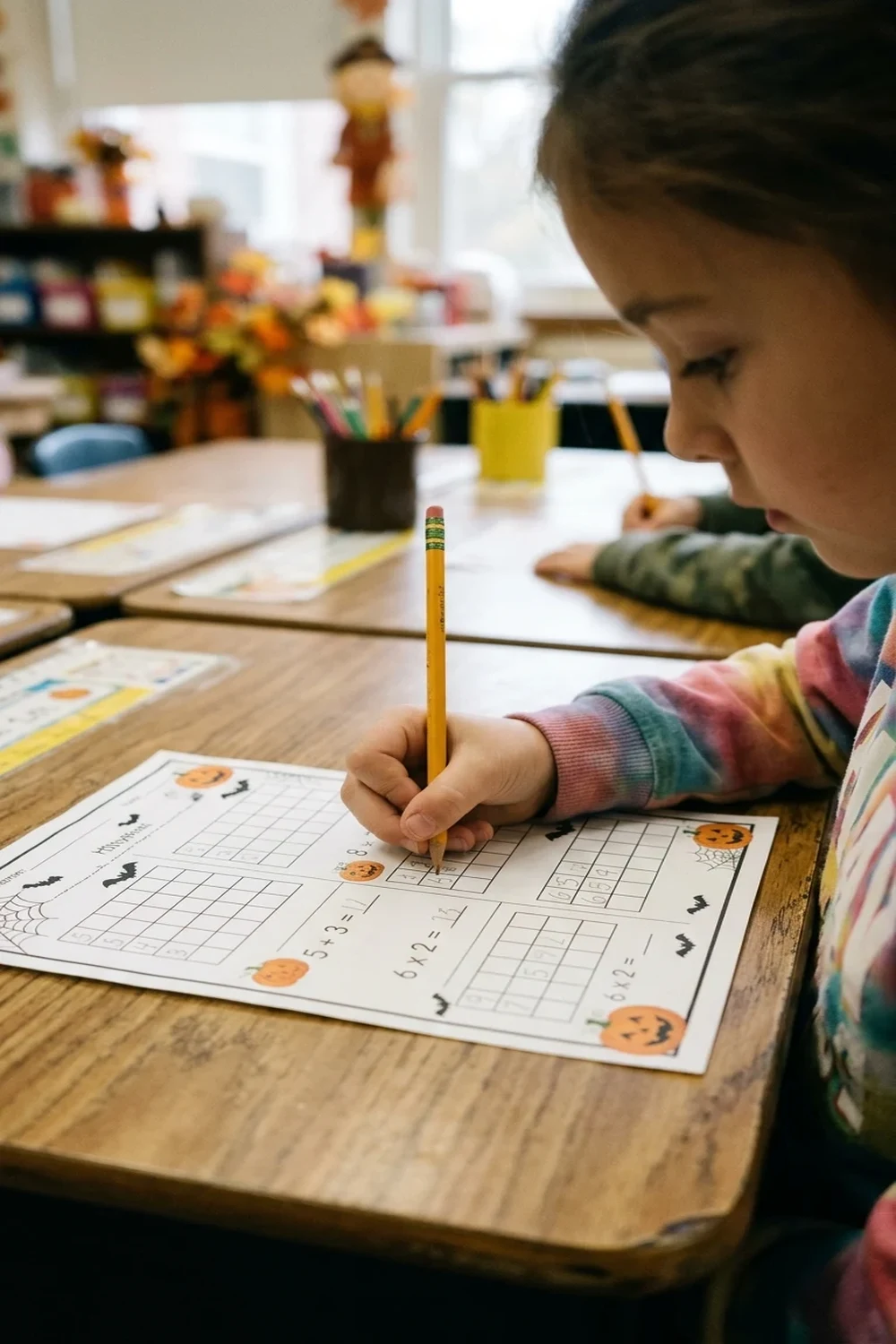
25. Halloween Math Games: Spooky Problem-Solving Worksheets and Grids
Halloween math games are printable October numeracy challenges that utilize pumpkin patch themes, haunted house coordinate grids, and spider web math webs to build computational speed. These seasonal printables capture intense student excitement and channel that energy directly into structured fraction, multiplication, and subtraction drills.
- Core Educational Concepts: Elementary students master place value tracking, odd and even categorization, multi-digit subtraction, and introductory perimeter concepts.
- Game Materials: Print-ready downloads feature cauldrons with potion-mixing addition targets, haunted coordinate grids, and pumpkin tally counter sheets.
- Interactive Play Mechanics: Learners draw monster number cards, complete arithmetic operations to collect candy tokens, and race across printable cobweb pathways.
- Flexible Classroom Deployment: Ideal for independent morning stations, fast-finisher folders, or cooperative small-group math centers during October class rotations.
- Cognitive Engagement Benefit: The high-contrast spooky illustrations stimulate pattern detection without overstimulating young learners during focused calculation tasks.

26. Addition Bingo: High-Energy Printable Math Fact Fluency
Addition Bingo is an interactive whole-class printable game where learners calculate sum equations called aloud and mark corresponding answers across grid boards. Unlike passive flash card drills, this competitive format forces children to execute rapid mental addition while scanning spatial layouts under time constraints.
- Curricular Competencies: Students develop automated recall for basic math addition facts from sums within 10 up to sums within 100.
- Set Architecture: Standard printable bundles provide 30 unique student 5×5 card variations alongside a master caller checklist of addition equation prompts.
- Turn-by-Turn Execution: The caller reads an equation like 14 + 8, forcing students to calculate 22 mentally before finding and covering that sum on their paper.
- Winning Patterns: Keep engagement high across multiple rounds by switching requirements from traditional straight lines to four corners, stamp patterns, or full blackout.
- Long-Term Academic Impact: Regular weekly sessions increase calculation speed by over 30% while reducing anxiety surrounding timed arithmetic assessments.

27. Multiplication Flash Cards: Systematic Times Table Memorization Kits
Multiplication flash cards are double-sided printable study tools featuring factors on the front side and product explanations with visual array grids on the reverse. These printable aids deliver structured spaced-repetition drills that build the foundational multiplication automaticity required for higher-order algebra and fractions.
- Mathematical Scope: Full sets systematically cover multiplication facts from 0x0 through 12×12, with color-coded borders distinguishing each individual fact family.
- Self-Checking Design: Back-of-card layouts feature dot array diagrams and skip-counting tracks that allow children to verify answers without teacher assistance.
- Adaptive Training Modes: Families and educators run rapid 5-minute lightning rounds, partner quiz showdowns, or Leitner box spaced-repetition intervals.
- Durability and Preparation: Heavy cardstock printing coupled with rounded corner cuts ensures these home printables withstand hundreds of rigorous practice rounds.
- Stem Readiness Outcome: Mastering complete multiplication fact retrieval frees working memory capacity for complex long division and multi-step word problems.

28. Math Crosswords: Solving Printable Equation Puzzles
Math crosswords replace traditional word clues with arithmetic equations, requiring learners to compute missing values and write answers into intersecting grid cells. These printable arithmetic puzzles bridge numerical computation and spatial logic, teaching primary students to verify solutions across horizontal and vertical pathways simultaneously.
- Core Learning Objective: Math crosswords strengthen mental arithmetic fluency and algebraic thinking by challenging students to work backward from known answers to missing addends or factors.
- Recommended Age Group: Children aged 7 to 12 years (grades 2 through 6) gain the highest cognitive benefit as they navigate intersecting multi-digit calculations.
- Preparation Requirements: Print the crossword grid along with the corresponding clue ledger on standard A4 paper, and supply a pencil with an eraser for easy adjustments.
- Step-by-Step Gameplay: Students read clue prompts such as ‘Across 4: 15 x 3’, solve the arithmetic statement on scrap paper, and transcribe the resulting numerical digits into designated grid boxes.
- Adaptive Difficulty Tip: Introduce simple addition or subtraction grids with 3×3 intersections for second graders before advancing to mixed operation grids featuring fractions or negative integers.

29. Number Matching: Tactile Printable Games for Early Numeracy
Number matching is a foundational printable math activity where early learners connect numerical digits to visual quantities, tally marks, and ten-frame patterns. This hands-on pairing exercise establishes cardinal number understanding and visual subitizing skills without requiring complex calculation rules.
- Core Learning Objective: Number matching builds strong number sense by linking abstract numeral symbols directly with concrete physical quantities and dot representations.
- Recommended Age Group: Preschoolers and kindergarteners aged 3 to 6 years develop foundational quantitative literacy through this tactile visual exercise.
- Preparation Requirements: Print number cards, ten-frame sheets, and item tiles on heavyweight 65lb cardstock, then cut along dotted borderlines for durable handling.
- Step-by-Step Gameplay: Children flip cards to reveal a numeric digit, locate the corresponding pictorial card displaying the identical quantity of objects, and lock both matching segments together.
- Adaptive Difficulty Tip: Begin with basic 1-to-5 quantity pairings for 3-year-olds, subsequently introducing 1-to-20 sets containing ten-frames, domino dots, and finger-counting illustrations for older kindergarteners.

30. Math Board Games: Turn-Based Printable Board Play for Kids
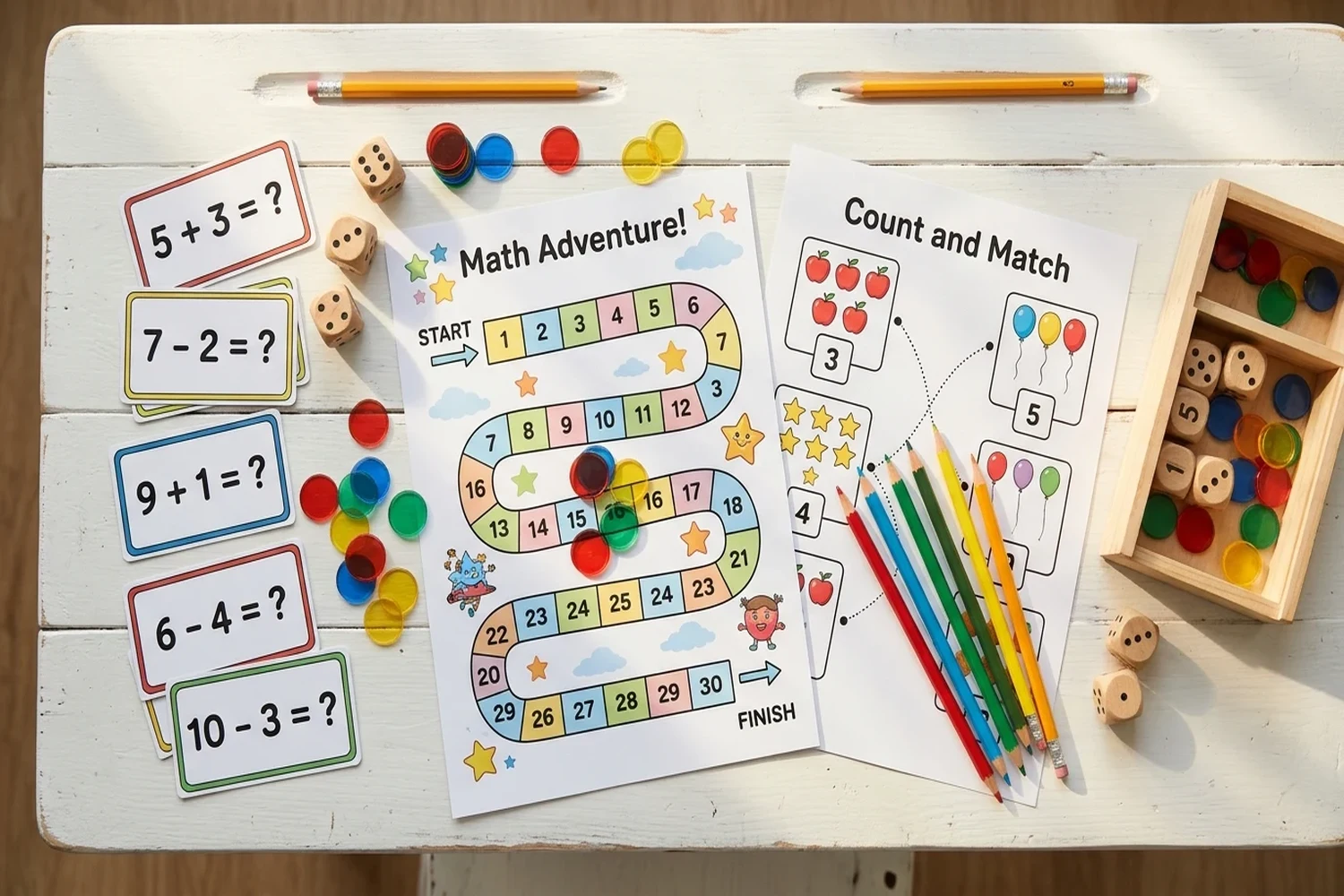
Printable math board games transform basic arithmetic repetition into social, turn-based table competitions using dice, printable movement tokens, and targeted calculation challenge tiles. These modular tabletop resources encourage peer collaboration and strategic thinking while systematically drilling addition, subtraction, and multiplication facts.
- Core Learning Objective: Turn-based board gameplay fosters mathematical fluency and spatial strategy through repeated mental arithmetic checks under active game conditions.
- Recommended Age Group: Students aged 5 to 11 years (kindergarten through grade 5) benefit from differentiated gameplay variations adapted to single-step or multi-step operations.
- Preparation Requirements: Laminate the full-color game board printout for extended classroom durability, and gather standard six-sided dice along with colored counting tokens.
- Step-by-Step Gameplay: Players take turns rolling dice, advancing custom game markers along the track, and solving the arithmetic equation printed on the destination space to hold their position.
- Adaptive Difficulty Tip: Use dual dice with higher numerical faces (such as 10-sided dice) to scale challenge levels from simple single-digit sums to double-digit multiplication products.