20 Best Solar System Projects for Kids (2026)
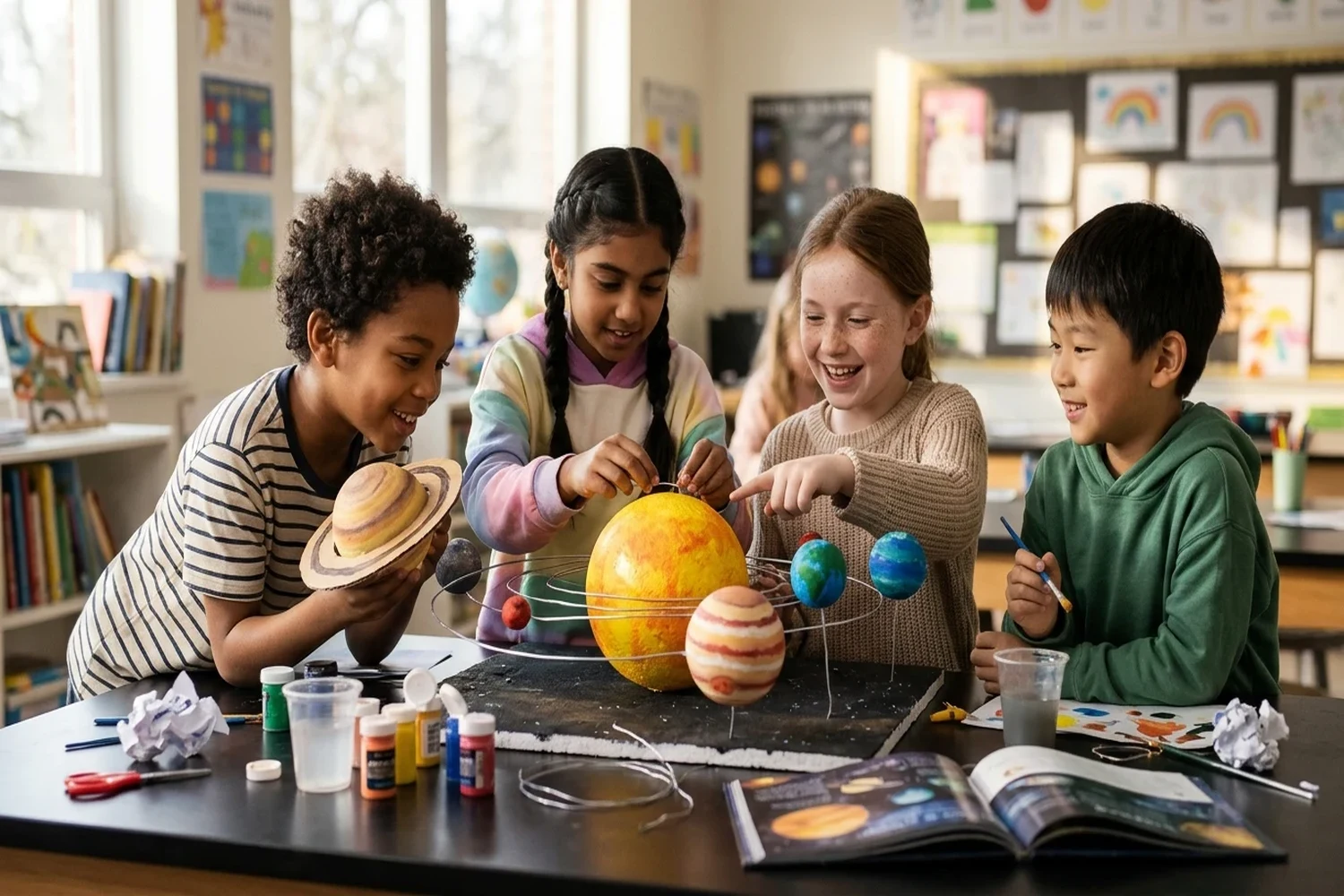
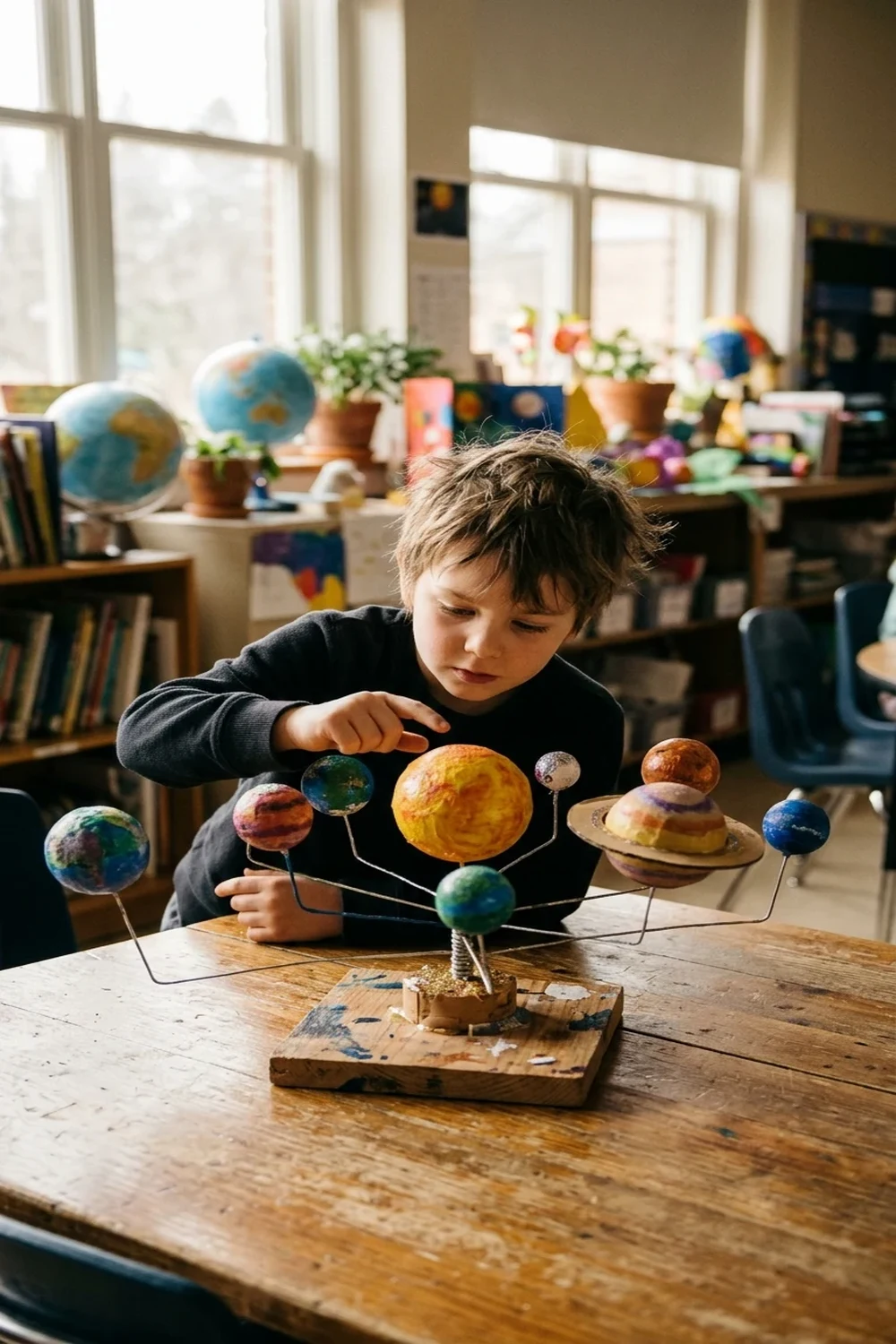
A solar system project is an interactive hands-on model that demonstrates how eight planets orbit the central Sun across gravitational pathways. Engaging children with tactile crafts such as foam spheres, LED circuits, and trifold presentation boards transforms abstract planetary science into memorable spatial learning. This curated collection delivers twenty classroom-tested project ideas engineered for effortless home builds and science fair presentations.
What is the Solar System for Kids? A Simple Guide to Our Cosmic Neighborhood
The solar system is a gravitationally bound astronomical group comprising the Sun at its center and eight primary planets orbiting through space alongside dwarf planets, moons, asteroids, and comets. Gravity from the Sun keeps every celestial body in a predictable path, functioning like an enormous cosmic traffic pattern. For young learners, understanding this system transforms abstract space concepts into an orderly neighborhood where Earth occupies the temperate Goldilocks zone suitable for human life.
- Central Anchor: The Sun contains over 99.8 percent of all mass in the solar system, exerting the gravitational pull that prevents planets from drifting into deep space.
- Planetary Order: Eight planets orbit outward from the Sun in the sequence Mercury, Venus, Earth, Mars, Jupiter, Saturn, Uranus, and Neptune.
- Habitable Zone: Earth orbits at roughly 93 million miles from the Sun, creating liquid water temperatures essential for life.
- Celestial Variety: Moons orbit individual planets, while thousands of rocky asteroids gather inside the main Asteroid Belt located between Mars and Jupiter.
- Learning Foundation: Visualizing planetary orbits as concentric tracks helps children grasp scale, planetary velocity, and seasonal daylight cycles.
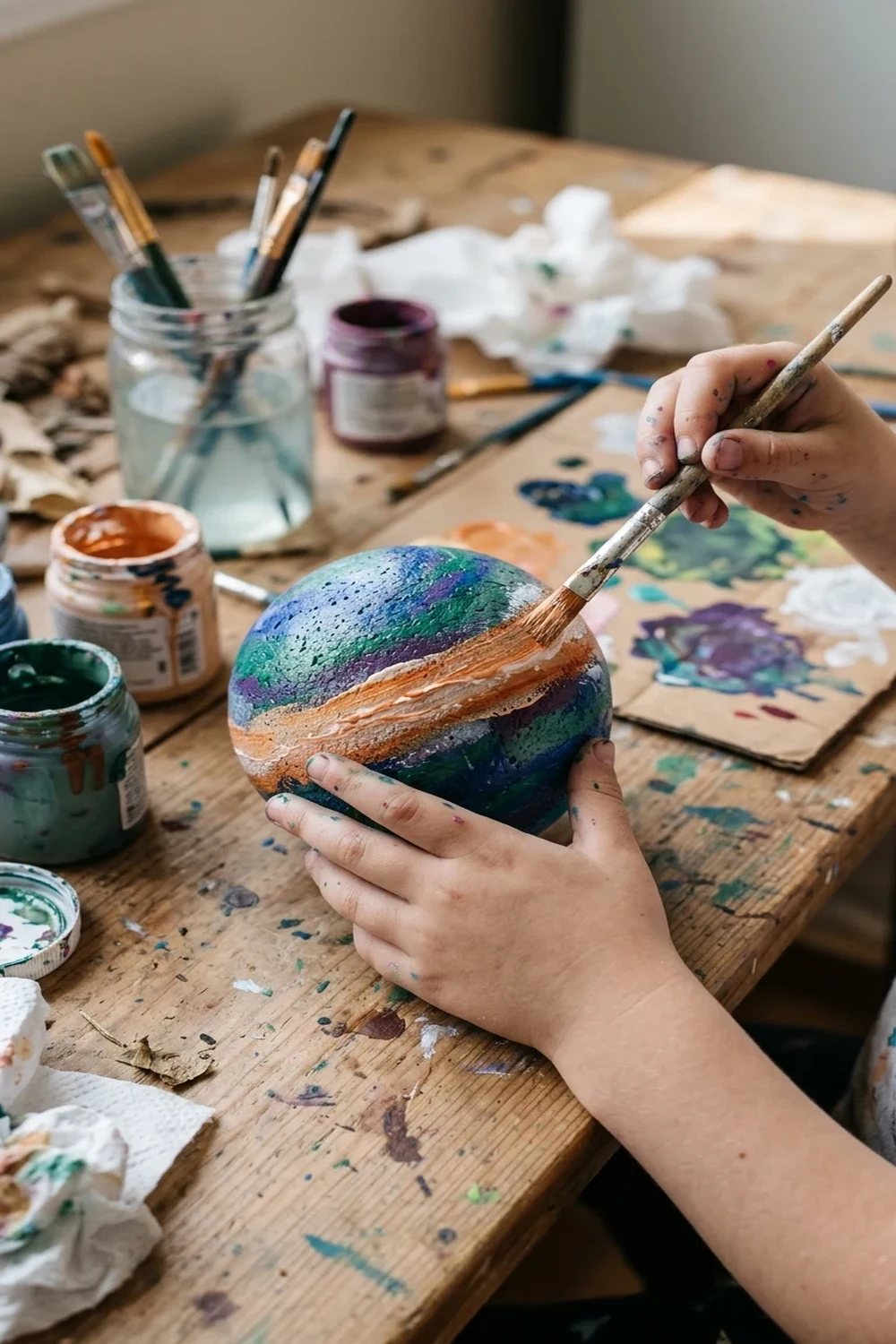
Interactive Foam Ball Solar System: Hands-On 3D Orbit Science Project
An interactive foam ball solar system is a three-dimensional physical learning model built with proportional polystyrene spheres mounted onto dowels around a central Sun. This tactile construction project allows children to handle individual planetary bodies, observe relative volumetric dimensions, and explore orbital distances through direct manipulation. Adding low-voltage micro LED string lights around the perimeter base highlights planetary pathways for science fair exhibitions.
- Relative Sizing: Smooth polystyrene craft balls ranging from one inch for Mercury up to five inches for Jupiter establish clear scale comparisons.
- Accurate Texturing: Acrylic craft paints applied with natural sea sponges simulate atmospheric cloud bands on Jupiter and polar ice caps on Mars.
- Stable Foundation: Wooden skewers secured into a dense wooden plaque or heavy styrofoam disc hold planetary rods at varying elevations.
- Orbit Illumination: Warm battery-powered fairy lights coiled along base wire rings accentuate elliptical paths across dark display boards.
- Interactive Spacing: Removable wooden dowels allow students to physically reposition planets to demonstrate planetary rotation speeds.
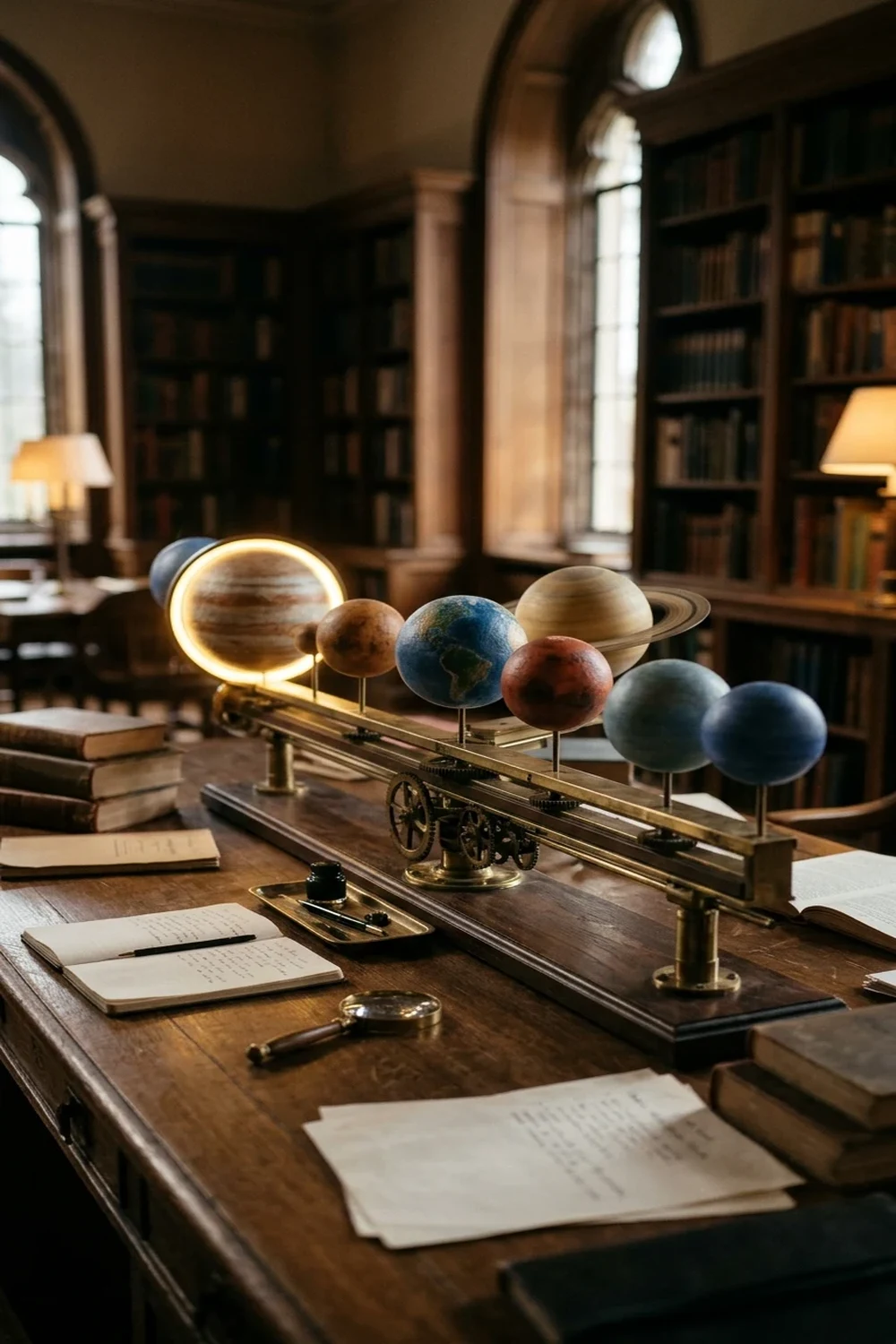
Realistic Planet Lineup Display: Comparative Scale and Order Model
A realistic planet lineup display is a linear educational presentation that arranges all eight planets along a horizontal plane to demonstrate relative planetary diameters and sequential distance from the Sun. Organizing celestial bodies in a straight path from Mercury to Neptune simplifies memorization for elementary students while making dramatic size disparities instantly obvious. Mounting an adhesive LED light strip behind the mounting board provides backlighting that highlights surface silhouettes.
- Sequential Arrangement: Planets mount in strict astronomical order starting at Mercury and ending at distant icy Neptune.
- Dramatic Contrast: Placing a diminutive one-inch Mercury directly alongside a massive six-inch Jupiter emphasizes immense volumetric variance.
- Backlight Illumination: An adhesive warm white LED strip installed beneath the mounting edge creates soft glowing halos around each silhouette.
- Clear Typographic Labels: Crisp printed index cards beneath each sphere detail surface temperatures, orbital periods, and moon counts.
- Sturdy Linear Base: A three-foot painted pine plank or heavy foam-core bar keeps the entire planetary sequence rigid during class transport.
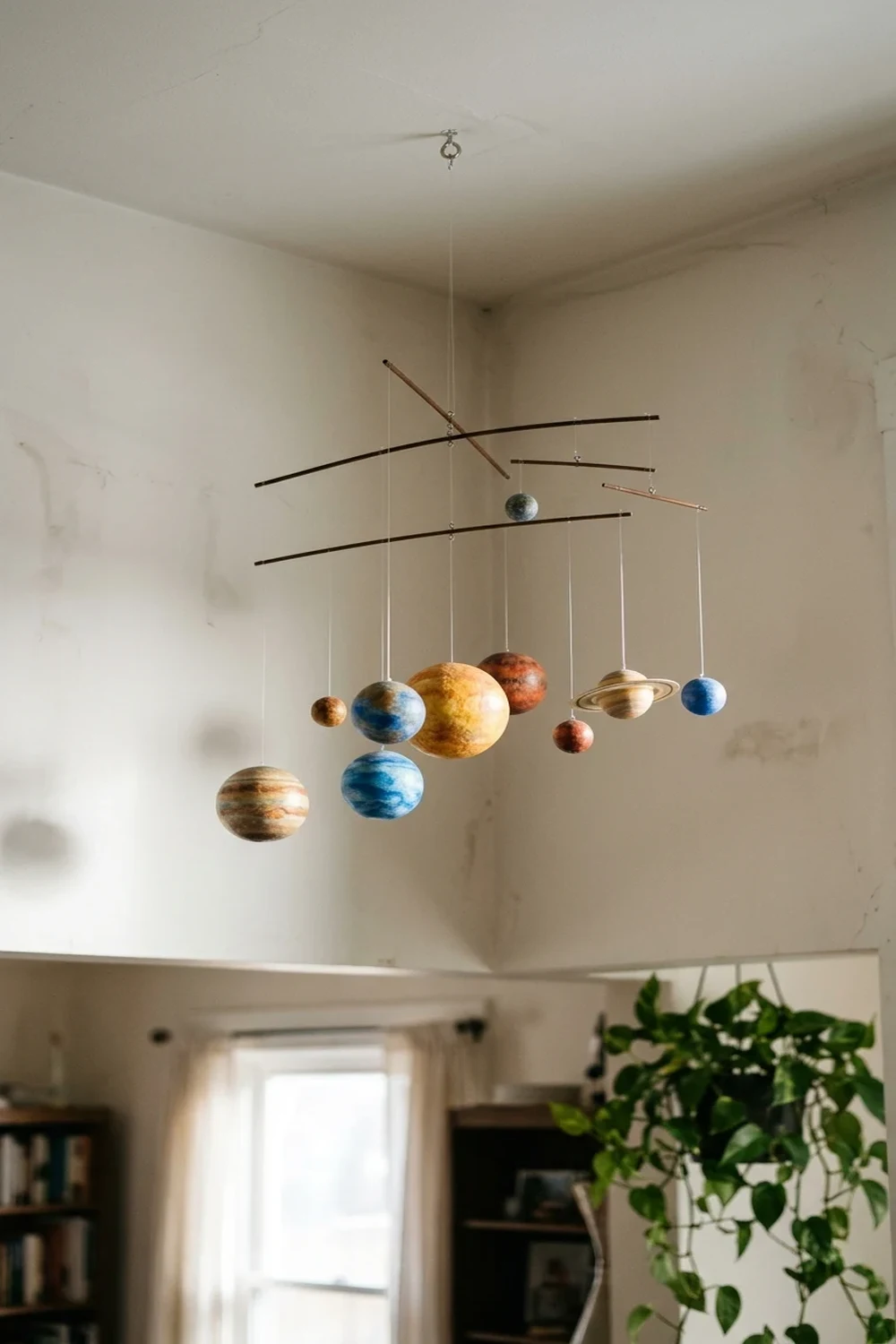
Hanging Solar System Mobile: Ceiling Space Display for Classrooms and Bedrooms
A hanging solar system mobile is a suspended kinetic display featuring painted planetary spheres balanced along horizontal wire crossbars to show planetary movement in three dimensions. Suspending spheres at staggered vertical drops creates a floating cosmic mobile that rotates gently with room airflow, making classroom corners and study bedrooms dynamic learning spaces. Integrating miniature battery-operated fairy lights across the suspension canopy produces a soft nocturnal glow.
- Balanced Suspension: Crossed wooden embroidery hoops or lightweight steel coat hangers establish an even overhead radial armature.
- Staggered Depths: Clear monofilament nylon cords cut at varied lengths position inner rocky planets higher than wide-orbit gas giants.
- Rotational Dynamics: Gentle indoor air currents provide continuous rotational motion that mimics orbital revolutions without motors.
- Canopy Lighting: Micro warm LEDs woven through the upper circular frame cast downward light onto spinning spheres below.
- Space-Saving Footprint: Suspending the full solar system overhead keeps work surfaces clear while serving as an active visual reference.
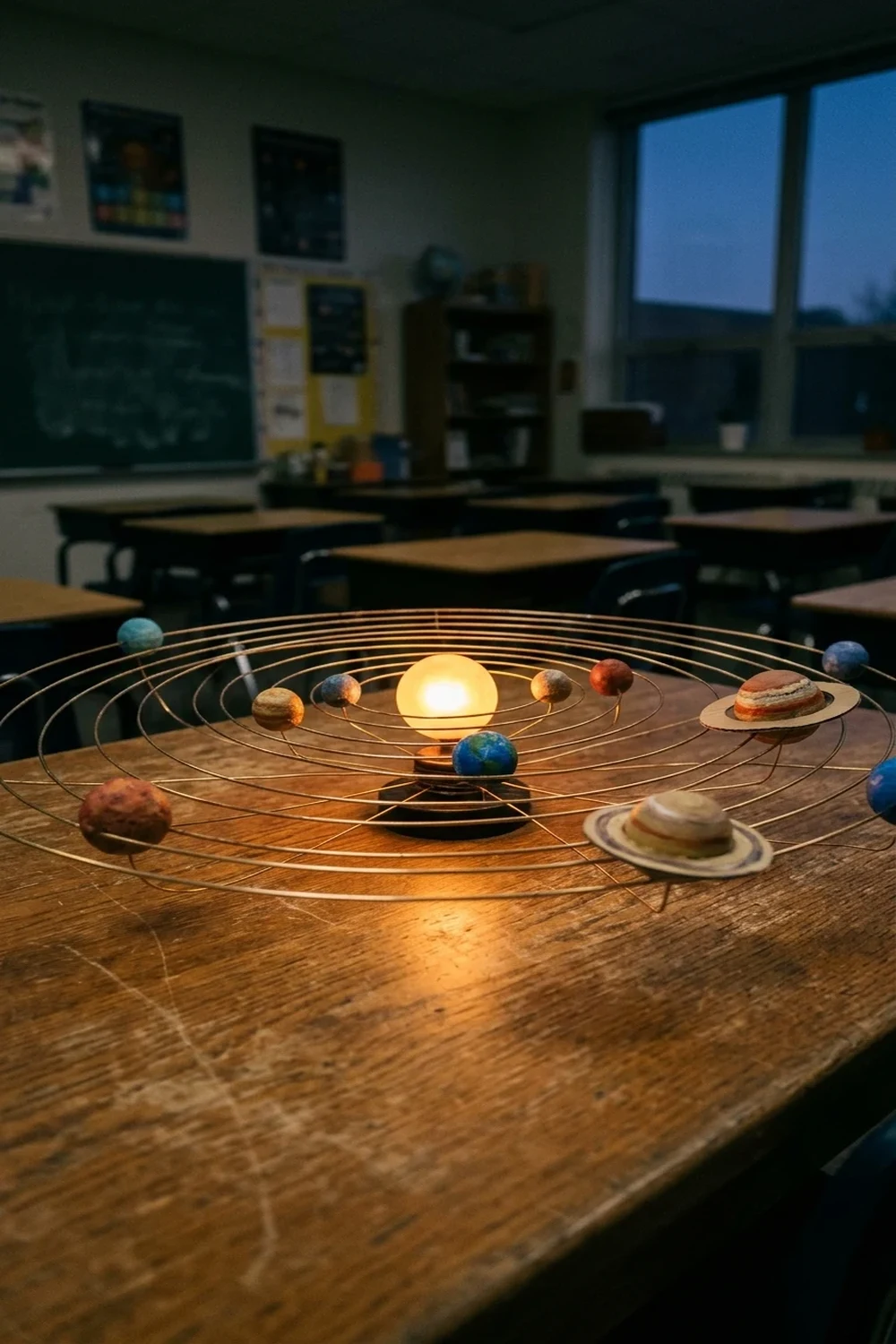
Glowing Orbit Model for Interactive Science Fair Demonstrations
A glowing orbit model is a three-dimensional astronomical display that utilizes an illuminated central Sun and concentric wire tracks to demonstrate planetary revolutions in low-light environments. This dynamic setup instantly captures attention at school science fairs by visually separating inner terrestrial planets from outer gas giants through realistic light and shadow contrasts.
- Central Illumination: Embed a battery-operated warm LED globe at the center to represent solar radiation and cast realistic shadows across surrounding planetary bodies.
- Concentric Orbit Tracks: Shape sturdy galvanized craft wire into eight elliptical rings anchored to a weighted wooden base to simulate actual gravitational paths.
- Textured Planet Spheres: Paint high-density polystyrene foam balls using acrylic washes to replicate surface characteristics such as Jupiter’s Great Red Spot and Saturn’s ring system.
- Phosphorescent Accents: Coat planet surfaces with glow-in-the-dark acrylic varnish to ensure orbital paths remain visible during dark classroom demonstrations.
- Educational Impact: This luminous arrangement helps elementary students grasp celestial mechanics and relative planetary distances through direct visual observation.
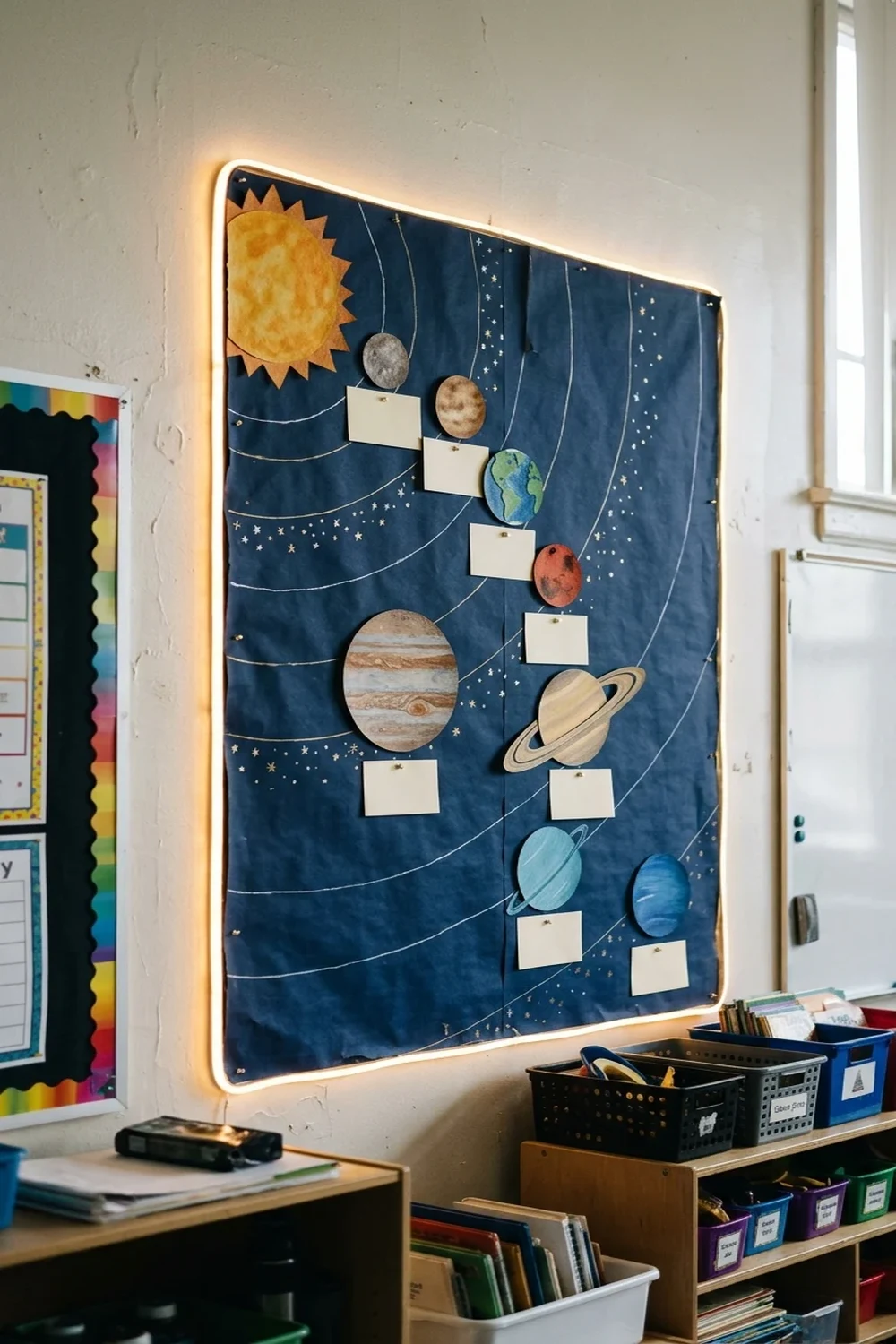
Solar System Wall Chart with Labeled Planetary Dimensions
A solar system wall chart is a large-format vertical learning poster that presents the Sun and eight planets in sequential order alongside scaled physical statistics and orbital timelines. Wall charts offer an ideal space-saving educational solution for homeschool areas and classroom bulletin boards, delivering rapid reference data without requiring table space.
- Sequential Spatial Layout: Mount a deep navy or black heavyweight cardstock backing measuring 36 by 48 inches to establish an expansive cosmic canvas.
- Scale-Proportional Cutouts: Cut vibrant textured cardstock circles matching the relative size ratios from diminutive Mercury up to massive Jupiter.
- Comprehensive Fact Callouts: Position color-coded index cards beneath each celestial body detailing average surface temperatures, moon counts, and orbital periods.
- Perimeter Accent Lighting: Install warm white adhesive LED strip lights along the outer wooden frame border to enhance nighttime legibility.
- Curriculum Utility: Students reference this structured wall diagram daily to memorize planetary sequences and comparative planetary diameters.
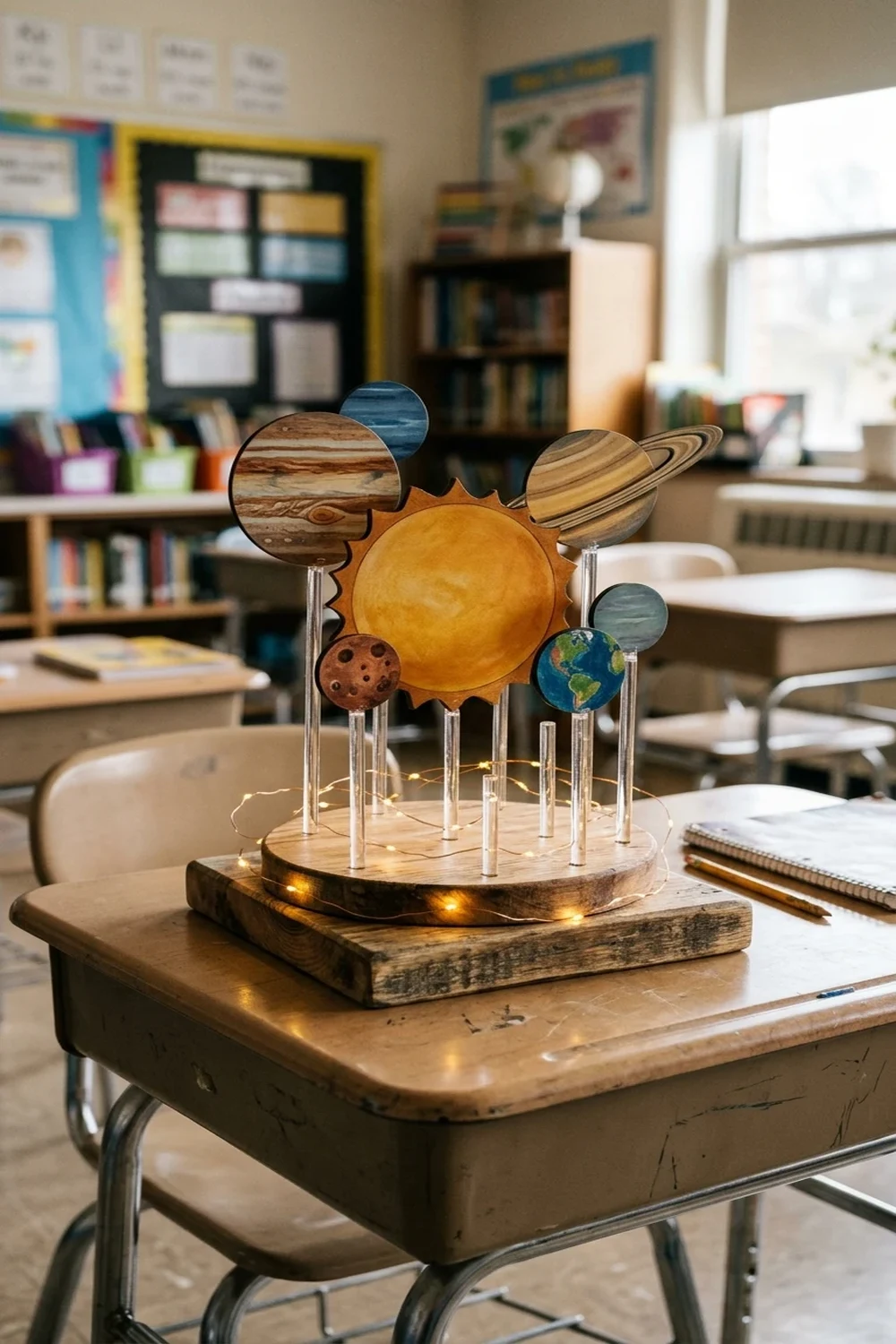
Stand-Up Solar System Display for Desk and Shelf Presentations
A stand-up solar system display is a self-supporting desktop dioramas constructed with rigid foam board or timber uprights that positions planets in a tiered semi-circle. This compact structure provides student presenters with a durable, transportable platform that remains perfectly upright during science fair judging interviews.
- Rigid Upright Foundation: Utilize a slotted heavy foam-core board or layered balsa wood base to support vertical dowels without wobbling on flat desks.
- Tiered Staggered Heights: Mount individual painted planet cutouts at varying vertical elevations using clear acrylic rods to prevent visual overlapping.
- Direct Metric Labeling: Affix bold single-line placards displaying astronomical names and distances from the Sun measured in astronomical units.
- Base Micro-Lighting: Tuck warm fairy wire lights into the bottom recessed groove to project a gentle upward spotlight across each planet.
- Presentation Efficiency: The sturdy freestanding footprint allows young learners to confidently rotate and present individual planetary facts without risk of tipping.
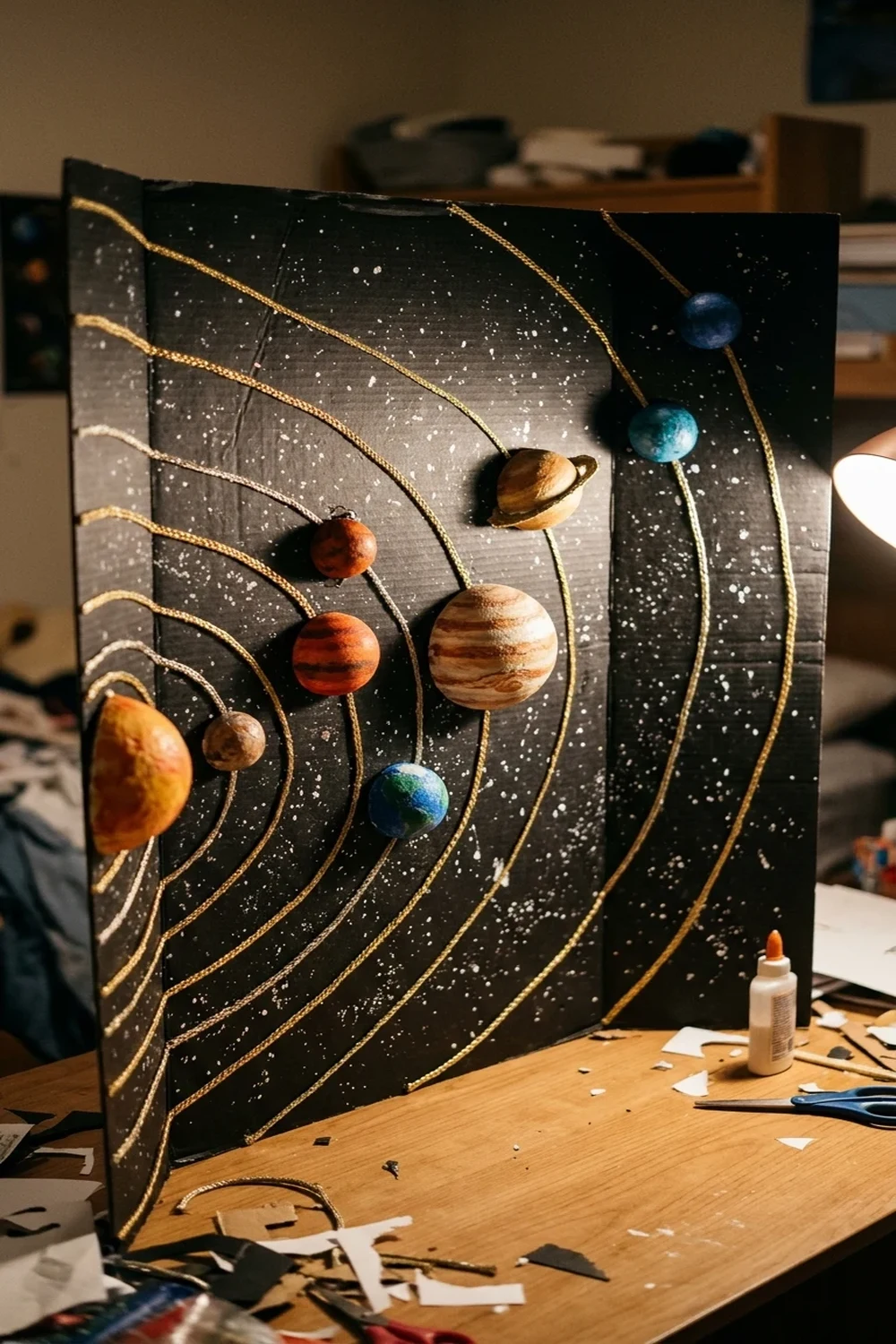
Orbit Path Project Board with Three-Dimensional Trajectories
An orbit path project board is a tri-fold scientific poster display that integrates tactile orbital loops made from cord or wire directly onto a matte black celestial background. By rendering orbital eccentricity in physical relief, this board clarifies Keplerian planetary motion and prevents common student misconceptions regarding circular versus elliptical space trajectories.
- Textured Trajectory Guides: Glue colored piping cord, thick metallic yarn, or flexible pipe cleaners in expanding ellipses to emphasize orbital pathways.
- Three-Dimensional Foam Hemispheres: Affix halved foam spheres directly onto the board surface along their respective paths for a tactile 3D relief effect.
- Splatter Starfield Backdrop: Flick white and silver gouache paint across matte black poster board using a stiff bristle brush to craft a realistic galaxy backdrop.
- Centerpiece Solar Glow: Mount a battery-powered push light directly behind the central yellow solar hemisphere to produce dramatic backlighting.
- Interactive Data Anchors: Pin flip-cards along the bottom margin containing essential facts regarding orbital velocity and gravitational attraction.
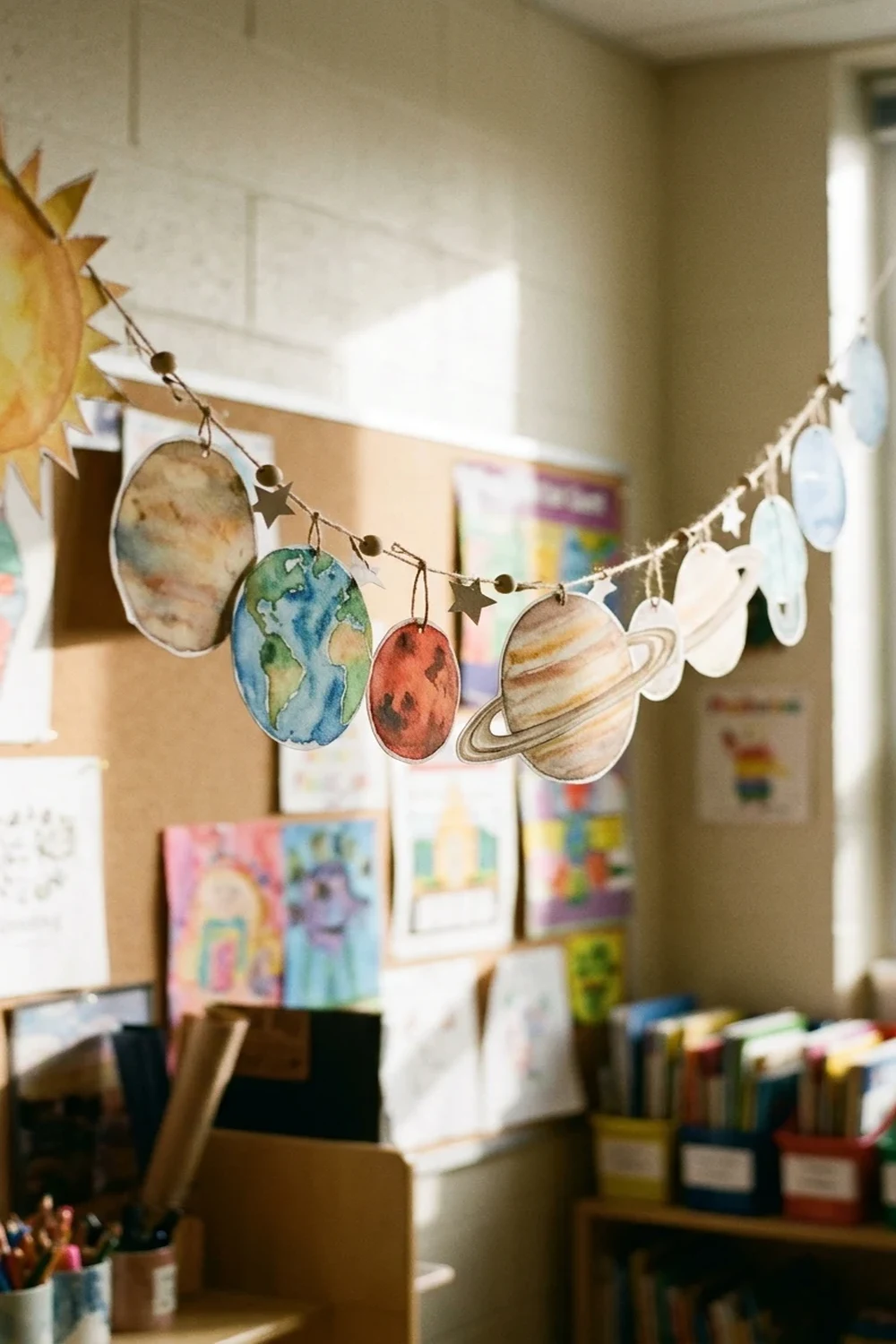
Hanging Planet Garland: Easy DIY Solar System Craft for Kids
A hanging planet garland is a lightweight solar system craft made from painted watercolor cardstock discs strung sequentially along baker twine to demonstrate correct planetary order in small spaces. This horizontal hanging model functions as both an interactive astronomical sequencing lesson and an eye-catching classroom decoration that requires minimal storage footprint.
- Sequential Planetary Order: Students string the celestial bodies in exact distance order from the central Sun through Neptune, reinforcing cosmic layout without bulky pedestals.
- Watercolor Layering Technique: Kids apply wet-on-wet watercolor washes on 200 GSM watercolor paper circles to mimic gaseous storms on Jupiter and rusty atmospheric banding across Mars.
- Illuminated Twine Assembly: Weaving micro LED fairy lights along natural jute twine casts a soft ambient glow across each numbered orbit disc for low-light science presentations.
- Space-Saving Wall Display: Weighing under 8 ounces, the entire lightweight planet banner mounts securely to classroom drywalls or window frames with simple adhesive putty.
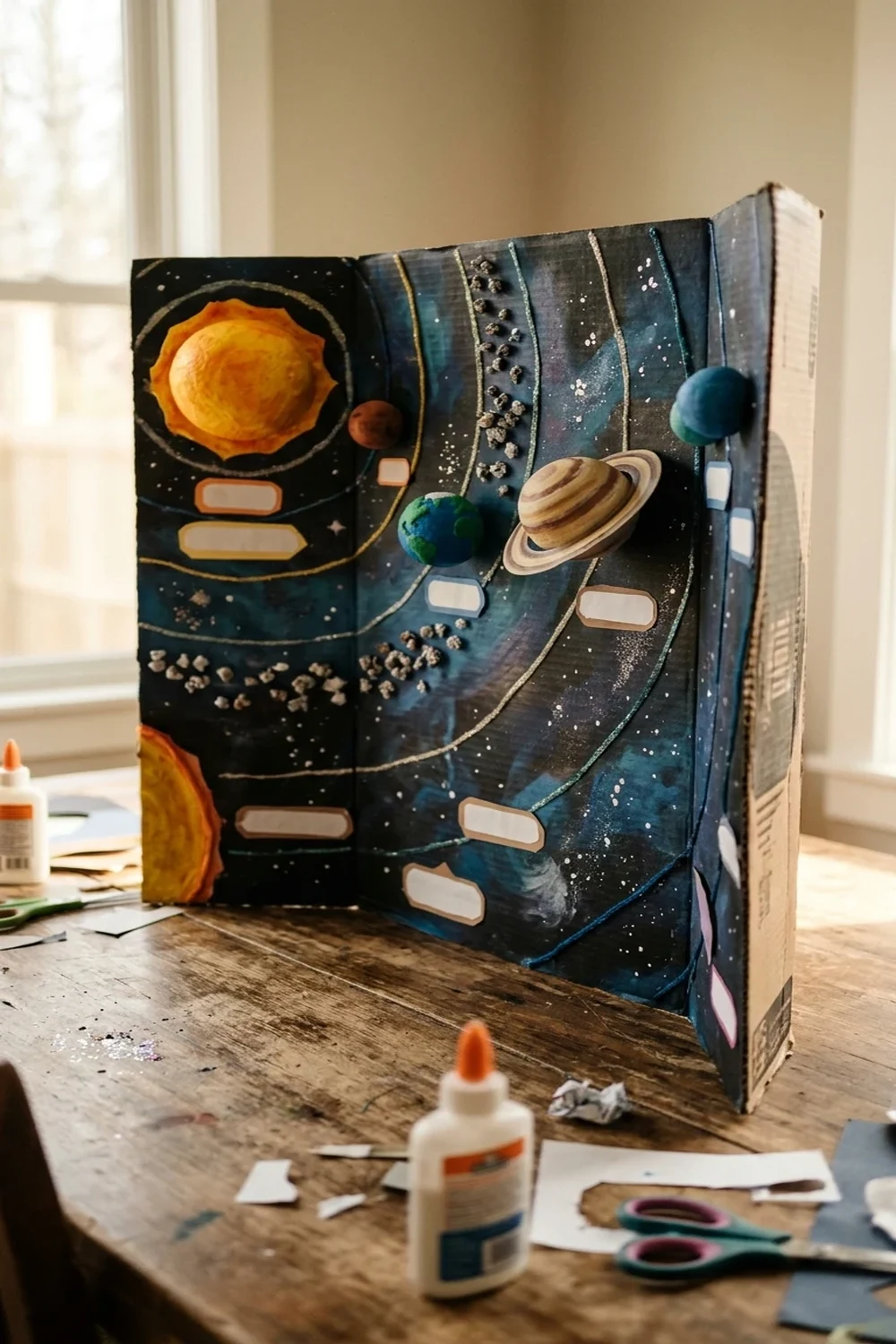
3D Foldable Solar System Board: Portable Space Science Fair Project
A 3D foldable solar system board is a tri-fold cardboard presentation display featuring split foam hemispheres, flexible craft wire orbits, and collapsible celestial markers designed for quick transport and desk presentations. This compact STEM model bridges the gap between static posters and complex models by folding flat into standard backpacks while preserving dimensional planetary structures.
- Hinged Tri-Fold Construction: Standard 36-by-48-inch cardboard project boards provide three distinct presentation zones while folding down to an easy-to-carry 12-inch profile.
- Hemispheric Foam Mounting: Cutting expanded polystyrene balls in half allows creators to glue flat backsides directly onto card panels while maintaining realistic 3D forward curves.
- Concentric Wire Orbit Paths: Thin 18-gauge floral wire bends into dimensional orbital tracks that physically elevate inner rocky planets above outer gas giants.
- Backlit Celestial Focal Point: Threading warm battery-powered LED rice bulbs behind a recessed central Sun cutout creates an illuminated core that immediately attracts competition judges.
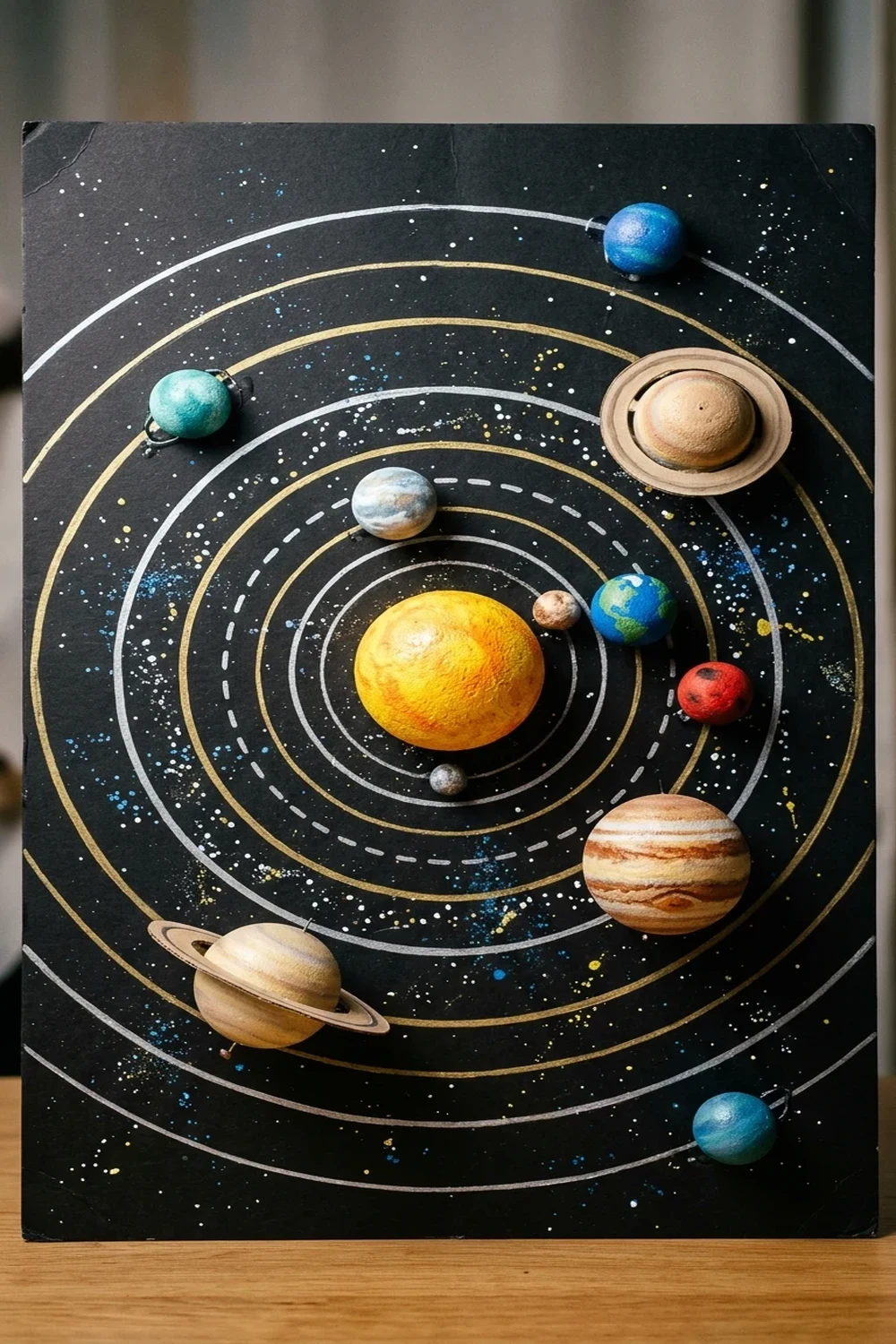
Presentation Board Solar System: Radial Layout for Classroom Demonstrations
A presentation board solar system utilizes a radial astronomical layout on a jet-black poster board to contrast planetary diameters against precise orbital distances from the Sun. This structured visual guide serves as an optimal oral speaking aid for grade-school science symposiums, allowing students to point directly to distinct celestial mechanics during demonstrations.
- Radial Coordinate Formatting: Marking orbital pathways with white chalk pencils in expanding concentric arcs makes comparative astronomical distances instantly clear to viewers.
- Scale-Proportioned Planet Spheres: Sizing spheres from 1-inch wooden beads for Mercury up to 4-inch foam spheres for Jupiter visually establishes tangible mass ratios.
- Starfield Splatter Art: Spraying diluted white acrylic paint with a stiff bristle brush across matte black foam board replicates thousands of realistic distant background galaxies.
- Tactile Explanatory Callouts: Fastening high-contrast index cards beneath each planet gives student presenters clear bullet points for atmospheric composition and surface temperatures.
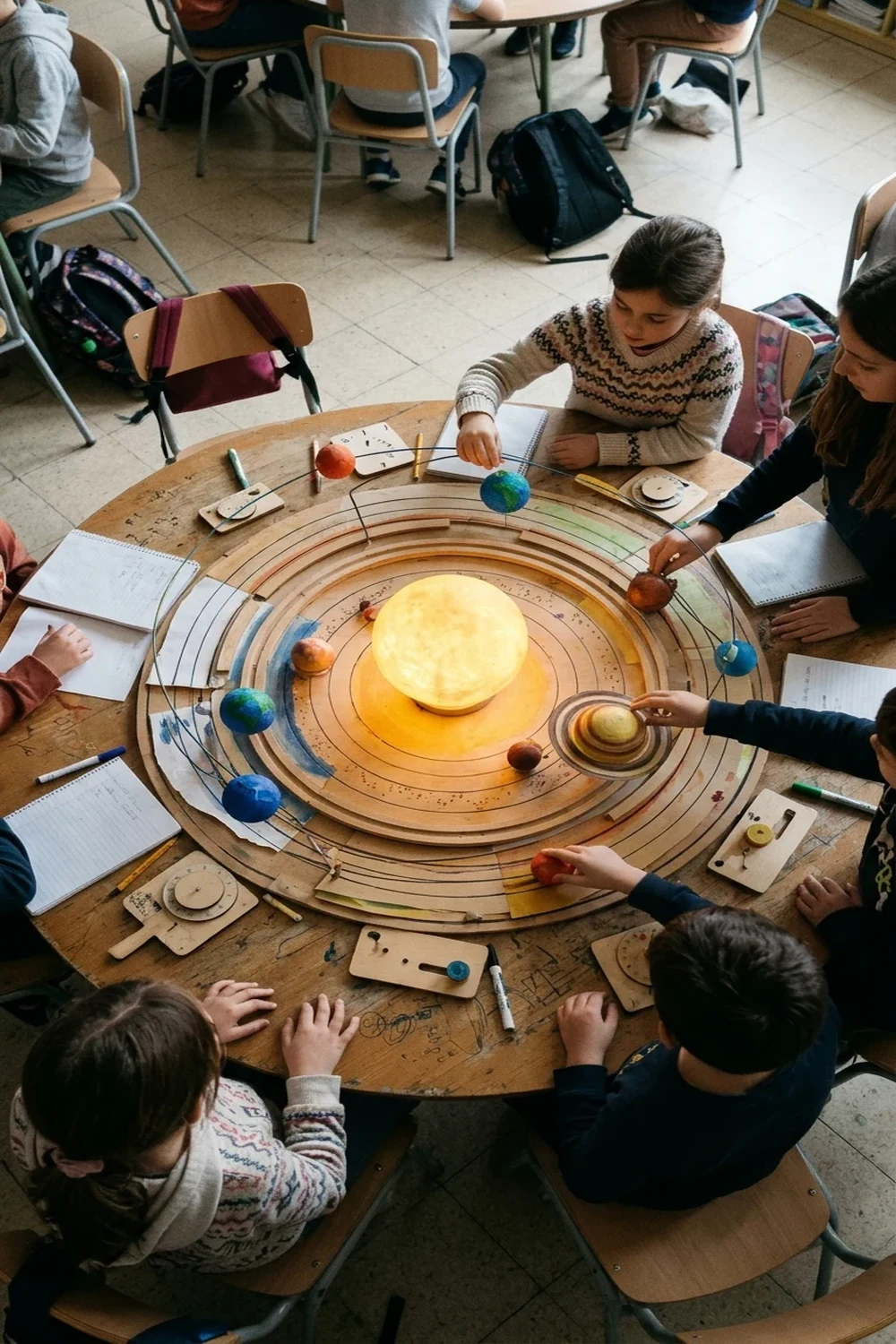
Classroom Orbit Activity Table: Interactive Space Station for Group Learning
A classroom orbit activity table is a collaborative round-table learning station where students use color-coded spherical models and chalk perimeter tracks to physically manipulate planetary revolutions around a luminous central star. This multi-sensory setup promotes cooperative exploration by letting multiple children handle orbit speeds and distances simultaneously.
- Circular Revolving Layout: Utilizing a 48-inch round activity table naturally simulates orbital geometry without corners, enabling smooth physical tracking of planetary years.
- Chalk-Drawn Elliptical Tracks: Washable liquid chalk markers allow young learners to map and adjust perihelion and aphelion points directly on wipeable desktop surfaces.
- Central Luminous Sun Globe: Placing an amber-toned acrylic dome light at the exact center establishes an intuitive visual reference for planetary light exposure and shadows.
- Collaborative Group Exploration: Four to six learners can simultaneously rotate individual planets along marked tracks, actively discovering why Mercury orbits faster than distant Neptune.
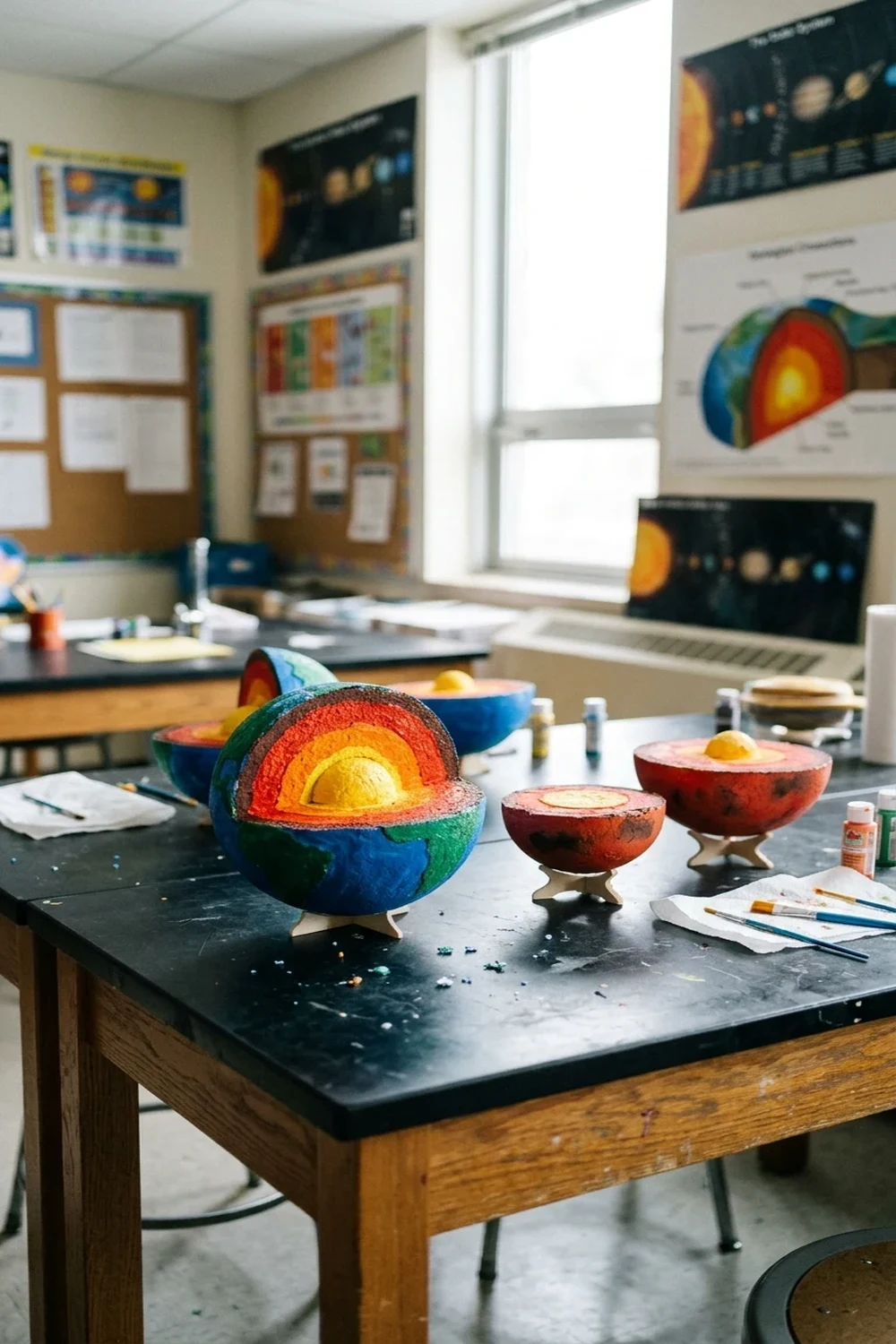
Planet Layers Learning Station: Hands-On Planetary Geology Project
A planet layers learning station is an interactive science display that reveals the internal cross-sections of planetary bodies like Earth and Mars through sliced three-dimensional models. By peering beneath planetary crusts, young learners transition from memorizing external surface colors to understanding core density, convective mantles, and atmospheric retention.
- Cross-Sectional Foam Spheres: Halve 4-inch to 6-inch dense polystyrene spheres with a craft knife to reveal interior geological boundaries painted in distinct tempera colors.
- Concentric Layer Modeling: Paint the inner core metallic gold, outer core liquid orange, mantle structural red, and external crust solid green to accurately represent thermodynamic heat gradients.
- Hanging Reference Anatomy Scroll: Suspend a labeled linen or cardstock diagram above the station that contrasts terrestrial rock layers with gas giant atmospheric depths.
- Tactile Density Samples: Pair each planetary hemisphere with real-world density benchmarks, such as iron bearings for metallic cores and pumice stones for porous outer crusts.
- Focused Station Lighting: Mount a warm 3000K LED gooseneck spotlight directly above the dissectible models to clearly illuminate planetary strata during student demonstrations.
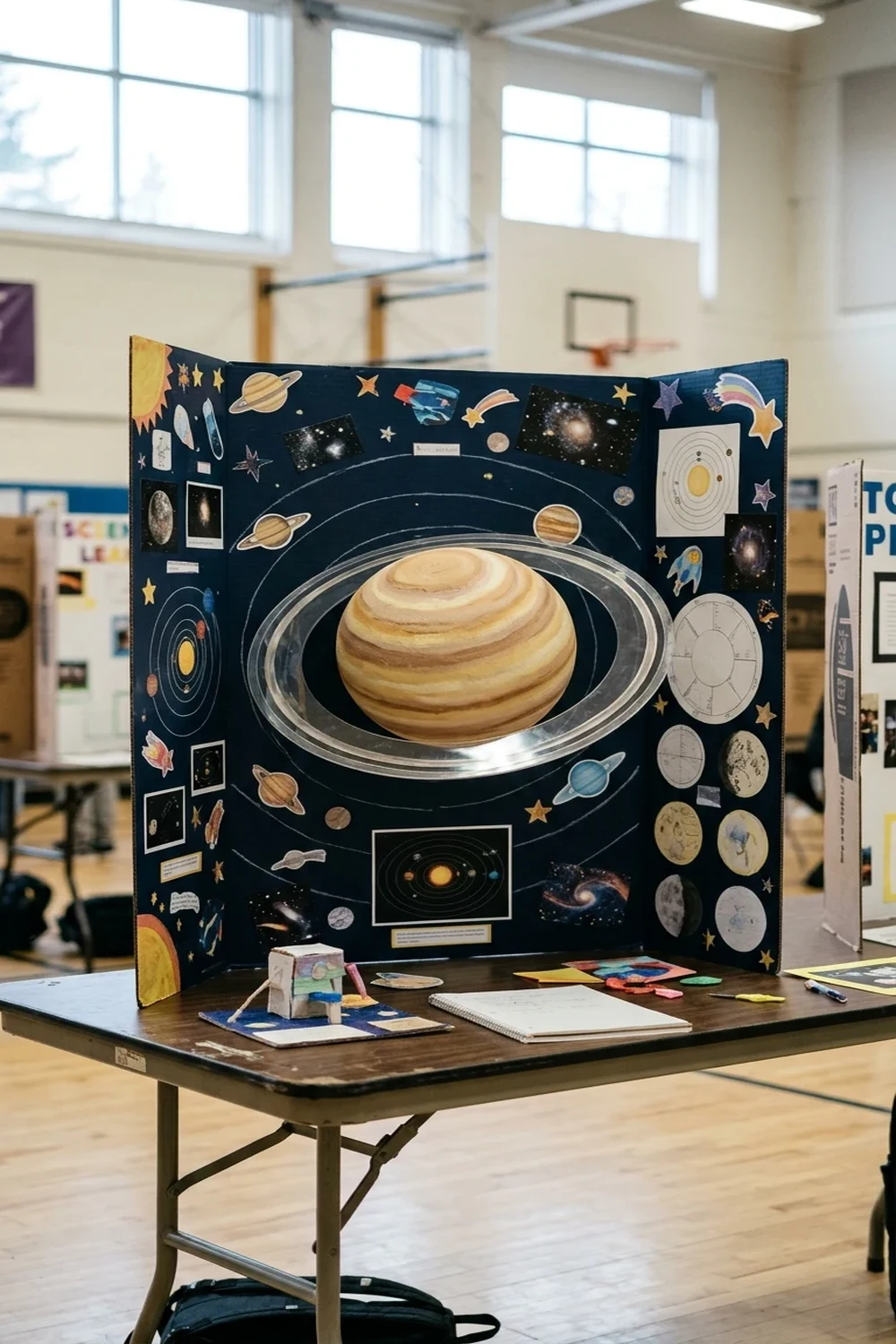
Focused Planet Display Board: In-Depth Single Planet STEM Showcase
A focused planet display board is an intensive single-topic presentation format that spotlights one celestial body, such as ringed Saturn or volatile Jupiter, using a central 3D relief model paired with comprehensive astronomical metrics. This focused approach allows students to explore atmospheric chemistry, orbital resonance, and extreme temperatures without visual clutter.
- Sturdy Tri-Fold Foundation: Build upon a standard 36-by-48-inch matte black presentation board to establish an expansive, high-contrast astronomical backdrop.
- Prominent Relief Centerpiece: Mount a halved 8-inch painted foam sphere at center height, attaching clear polycarbonate sheets cut into planetary rings for gas giants like Saturn or Uranus.
- Atmospheric Data Infographics: Organize key metrics across lateral panels, featuring exact atmospheric gas ratios, surface gravitational constants, and axial tilt degrees.
- Comparative Orbital Scale: Affix smaller 1-inch scale cutouts of neighboring planets along the lower baseline to preserve relative size perspective and solar distance contexts.
- Rear Backlit Halo: Affix warm white adhesive LED strip lights along the rear perimeter of the central sphere to create a soft luminous coronal glow.

Planet Art Card Series: Modular Watercolor Astronomy Flashcards
A planet art card series is a modular STEM-art activity where students illustrate each of the eight recognized planets on heavy individual cardstock tiles using mixed-media texture techniques. These standalone cards function simultaneously as artistic wall galleries, sequencing games, and portable scientific revision flashcards.
- Heavyweight Cotton Substrate: Cut archival 300 GSM watercolor paper into uniform 6-by-8-inch index panels to prevent paper warping during wet pigment application.
- Textured Surface Layering: Apply salt sprinkles over wet ultramarine watercolor washes for Earth, or use dry sea sponge dabbing with burnt sienna to mimic Martian crater topography.
- Essential Scientific Taxonomy: Record standardized astronomical data along the reverse panel, noting planetary radius, atmospheric composition, orbital period, and known natural satellite counts.
- Chronological Clothespin Lineup: Clip cards sequentially along natural jute twine using miniature wooden pegs from Mercury to Neptune to demonstrate true orbital sequence.
- Ambient Constellation Illumination: Intertwine battery-operated warm micro-fairy lights along the display wire to highlight pigment gradations against dark walls.
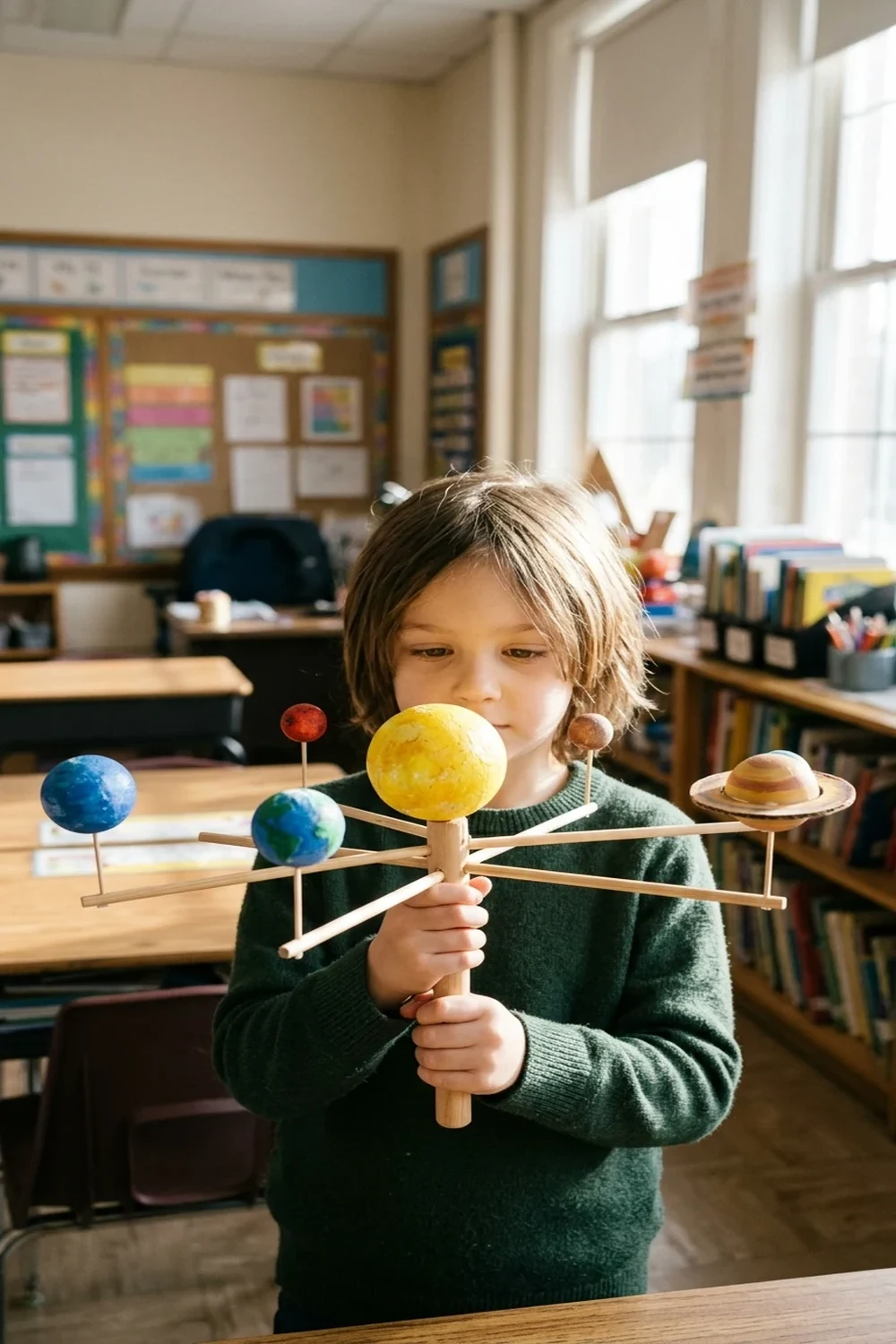
Handheld Solar System Model: Portable Orbit Demonstration Prop
A handheld solar system model is a balanced, lightweight kinetic apparatus that allows students to manually carry and demonstrate planetary spacing and axial positions during live classroom walk-throughs. The unified central-rod architecture makes this project far more durable and portable than delicate ceiling mobiles during lively presentations.
- Balanced Central Dowel Base: Anchor a central vertical pine dowel into a weighted 6-inch circular wooden plinth to guarantee complete structural stability while carrying.
- Variable Bamboo Cantilever Arms: Insert rigid horizontal skewers at graduated heights along the main mast, extending radial arm lengths proportionately from 3 inches to 14 inches.
- Graduated Lightweight Spheres: Paint ultra-light polystyrene balls ranging from 0.75-inch beads for Mercury to 3-inch globes for Jupiter using resilient non-toxic acrylics.
- Quick-Spin Presentation Pivot: Secure planet pivot joints with flexible rubber grommets so students can smoothly rotate individual celestial bodies during oral questions.
- Illuminated Core Illuminator: Insert a compact, push-button yellow LED diode inside a translucent hollow Sun sphere at the top mast to cast directional rays outward.
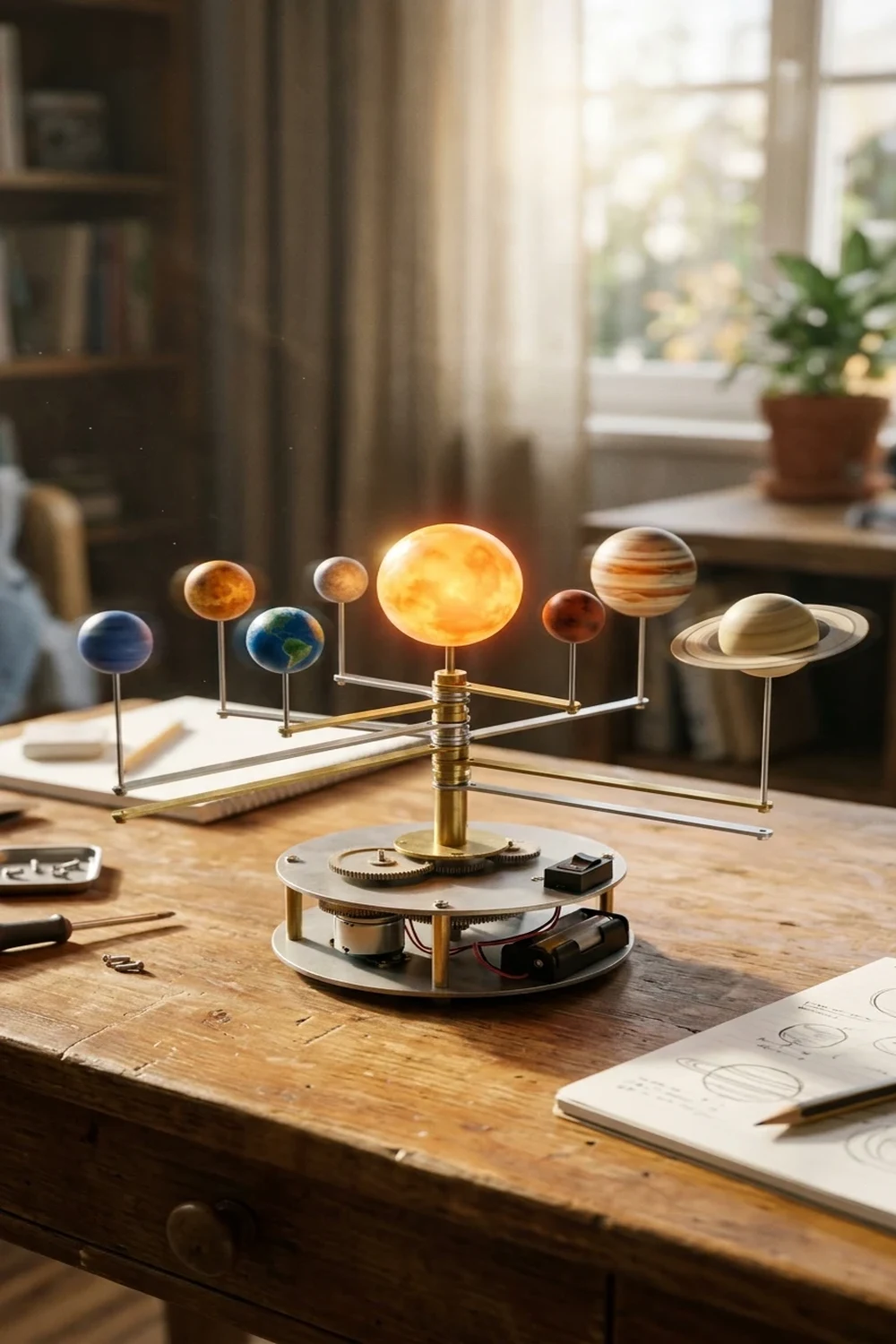
17. Interactive STEM Solar System Kit: Hands-On Mechanical Space Learning
An interactive STEM solar system kit is a motorized or geared mechanical space model that allows children to physically observe orbital mechanics and planetary revolutions in real time. Unlike static posters, these interactive educational kits use gear trains, rotating arms, and central illumination to replicate how the eight planets orbit around the Sun at proportional speeds.
- Hands-On Planetary Mechanics: Geared mechanical arms rotate multi-speed planetary spheres simultaneously, demonstrating orbital synchronization and axial rotation across the solar neighborhood.
- Illuminated Sun Centerpiece: An internal LED bulb inside the central yellow Sun projects radial light patterns onto surrounding celestial bodies to illustrate daylight, shadows, and planetary eclipses.
- Curriculum-Aligned Space Science: Building and assembling the interlocking plastic pieces teaches elementary students core engineering principles alongside primary astronomical facts.
- Tactile Screen-Free Exploration: Physical push buttons, motorized controls, and textured planetary spheres keep young learners actively engaged without digital screen fatigue.
- Quick Assembly and Portability: Standardized interlocking components ensure children aged six to twelve can assemble the desktop planetarium in under 45 minutes.
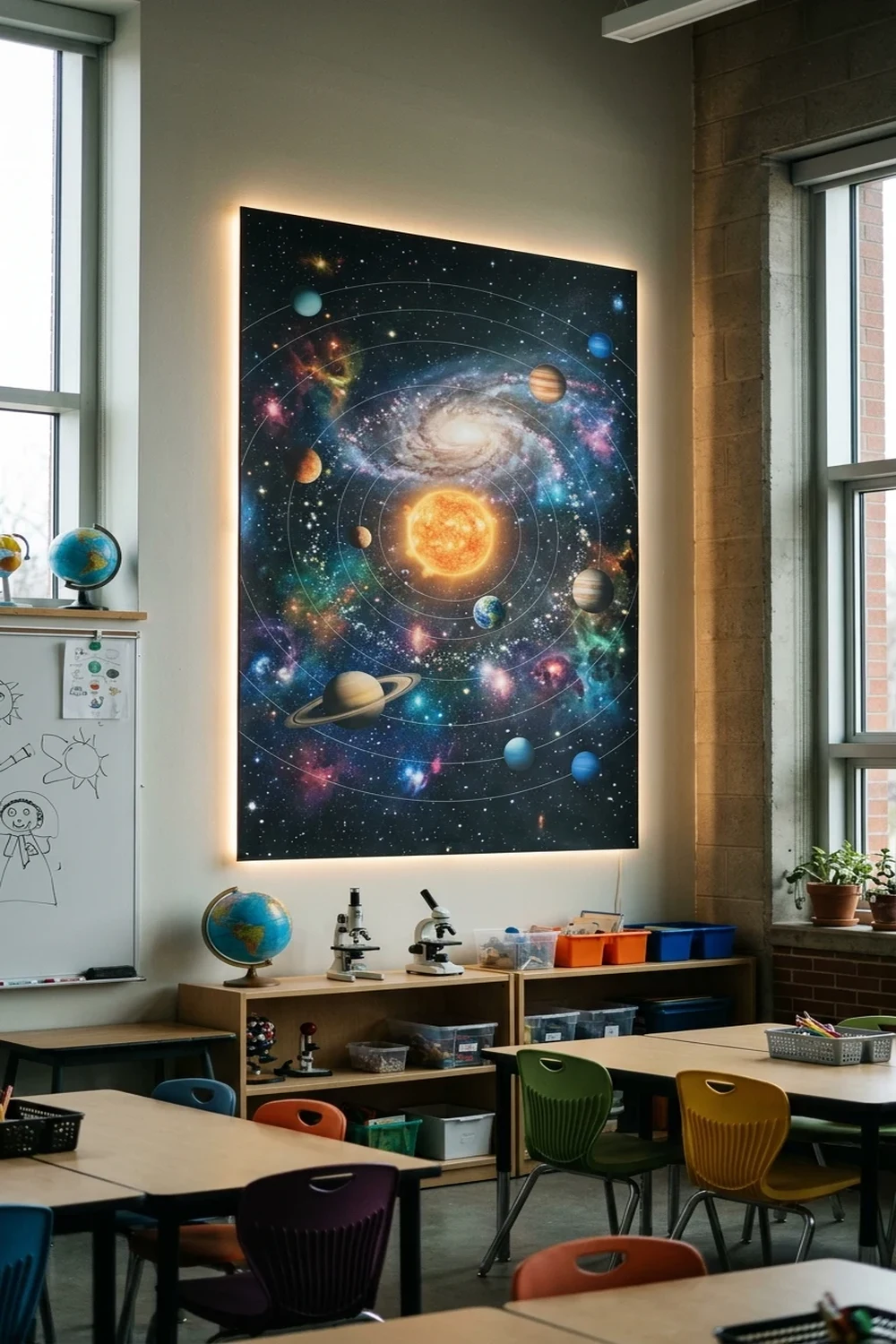
18. Solar System Galaxy Poster: Visual Scale and Deep-Space Reference Chart
A solar system galaxy poster is an authoritative visual learning chart designed to display planetary distances, relative celestial sizes, and cosmic neighborhood structures on a single flat surface. This large-format educational display organizes orbital trajectories, planetary ring systems, and deep-space objects against an authentic Milky Way backdrop for rapid visual reference in bedrooms and classrooms.
- Scaled Planetary Comparative Layout: High-resolution graphic illustrations show correct comparative sizes from tiny Mercury to massive Jupiter, clarifying common misconceptions about planetary proportions.
- Orbital Mapping and Trajectory Lines: Crisp elliptical orbital rings detail exact planetary positions from the inner rocky planets to the outer gas giants.
- Durable Laminated Classroom Construction: Heavyweight 250 GSM paper with double-sided matte lamination resists tearing, marker smudges, and moisture during daily student interactions.
- Ambient Backlight Integration: Mounting subtle LED strip lights behind the poster frame creates a soft celestial glow that highlights star clusters and dark cosmic dust lanes.
- Comprehensive Informational Labels: Dedicated typographic callout blocks specify planetary diameter, surface temperature, and moon counts for quick student reference.
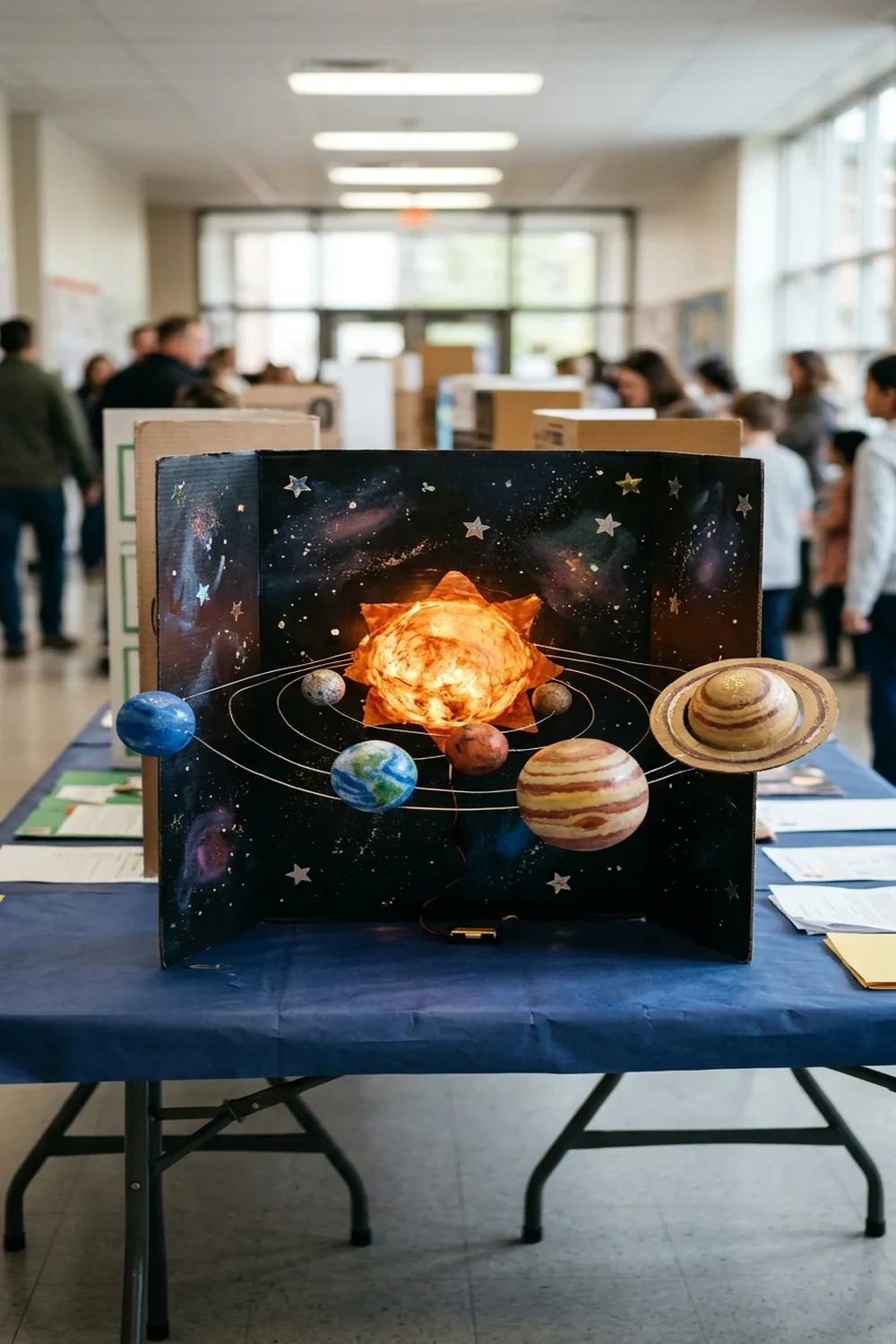
19. Student Presentation Models: Structured Science Fair Tri-Fold Displays
A student presentation model is a portable science fair exhibition display combining three-dimensional planet representations, structured data callouts, and mounted celestial spheres on a sturdy presentation board. This specialized educational project framework helps young students systematically organize research findings, scientific hypotheses, and physical models for clear verbal delivery during classroom evaluations.
- Balanced Structural Balance: Lightweight high-density foam spheres securely attached to skewers and mounted to a rigid baseboard ensure total physical stability during transport.
- Hierarchical Information Flow: Logical left-to-right project sections guide judges seamlessly through project objectives, planetary statistics, and empirical conclusions.
- Illuminated Focal Accents: Low-voltage warm LED micro-lights integrated into the central Sun fixture immediately draw observer attention during busy school science fairs.
- Student-Led Oral Cue Cards: Integrated modular label blocks allow young presenters to explain complex orbital periods and atmospheric compositions with complete confidence.
- Collaborative Team Assembly: Segmented crafting roles enable multi-student project groups to divide painting, data charting, and construction tasks equally.
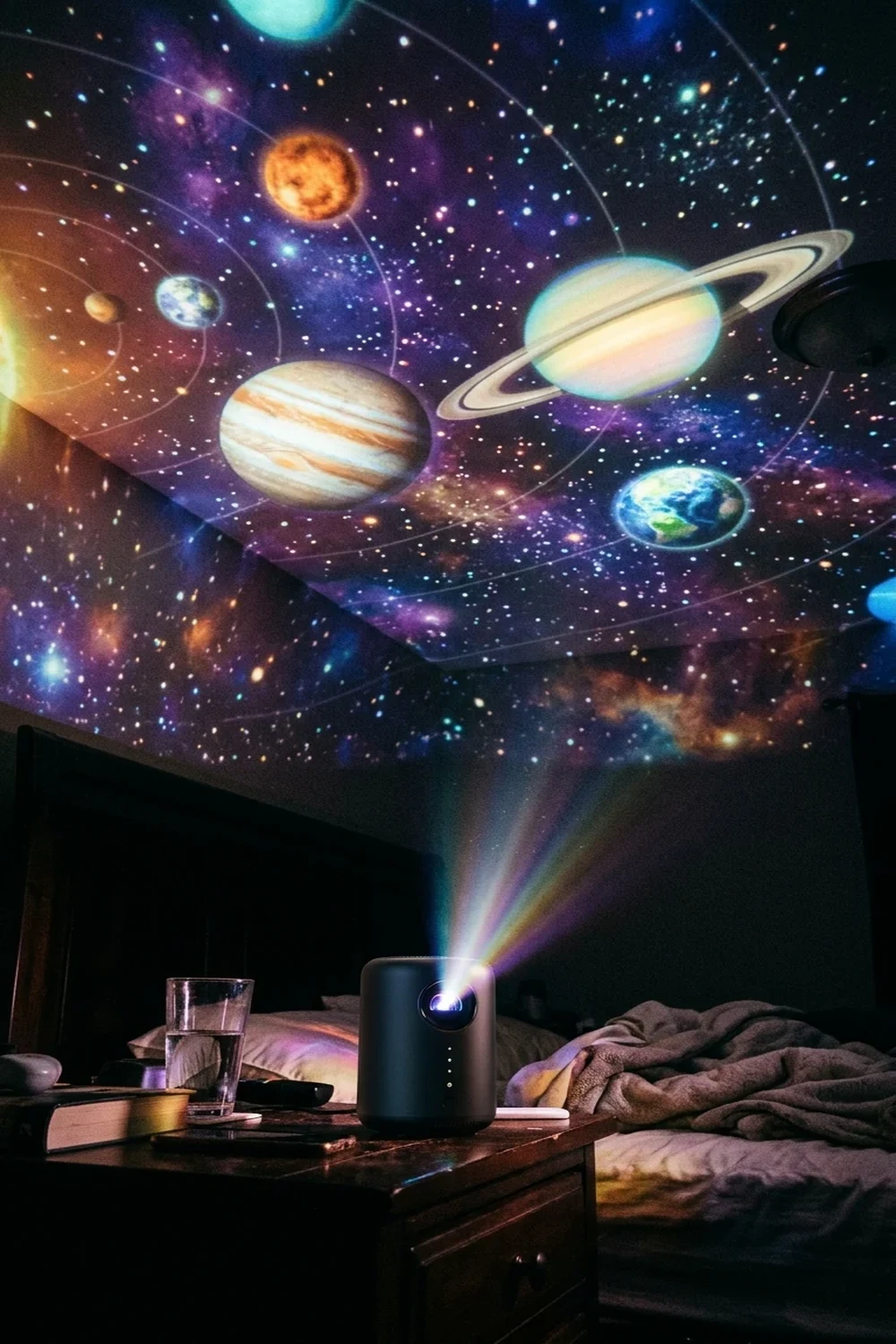
20. Solar System Projector Display: Immersive Optical Planetarium Experience
A solar system projector display is an optical celestial projection device that casts realistic rotating constellations, planetary surfaces, and cosmic nebulae directly onto classroom ceilings and walls. By eliminating physical crafting debris, this immersive planetarium system converts any darkened indoor learning area into a 360-degree interactive astronomical theater for experiential space education.
- 360-Degree Optical Projection: High-definition interchangeable disc lenses project high-fidelity astronomical imagery across full ceiling surfaces up to 500 square feet.
- Zero-Mess Space Exploration: Replaces paints, glues, and styrofoam components with a reusable plug-and-play optical device suitable for any indoor environment.
- Dynamic Constellation Motion: Motorized internal rotation mechanisms simulate real celestial hemisphere movement to explain nighttime starry changes.
- Multi-Disc Planetary Content: Included image cassettes highlight individual celestial targets like Mars craters, Saturn ring planes, and the Moon surface.
- Calming Ambient Illumination: Soft, adjustable luminescence functions effectively as both a focused educational teaching aid and a soothing cosmic nightlight.
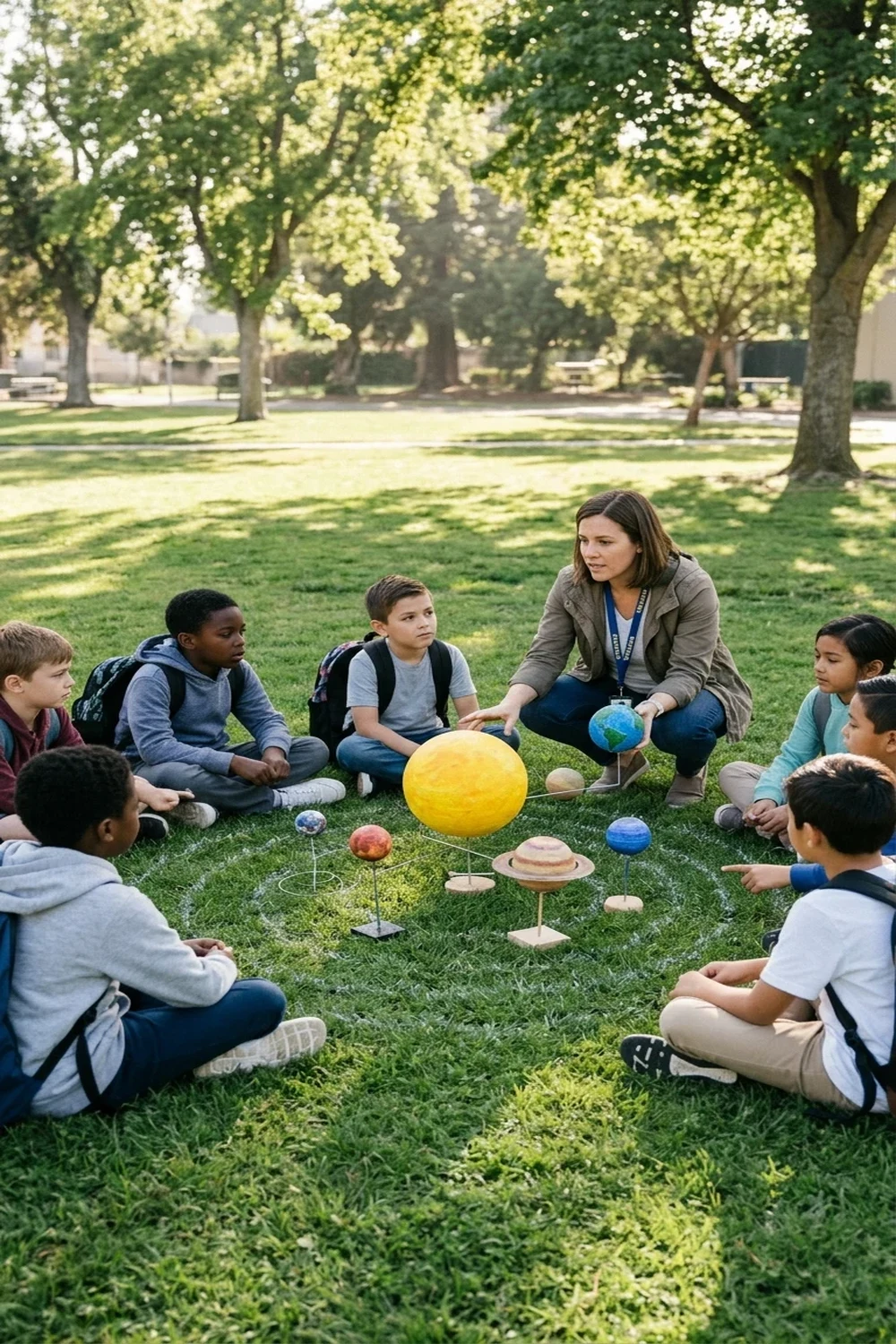
Outdoor Solar System Circle Time for Active Learning
Outdoor solar system circle time is an experiential learning activity that transitions astronomy lessons into open-air spaces using physical movement and oversized visual models to explain planetary orbits. Taking science outside gives elementary students the physical space required to model relative astronomical distances that typical indoor classrooms cannot accommodate.
- Kinesthetic Orbit Modeling: Students embody individual planets by walking designated elliptical paths around a central Sun marker, directly experiencing how orbital speeds decrease with distance from the Sun.
- True-to-Scale Pacing: Educators use playground chalk lines or measuring ropes across school lawns to demonstrate proportional spacing from Mercury to Neptune without spatial crowding.
- Sensory Visual Anchors: Weatherproof foam props and portable battery-operated display boards help young learners touch, rotate, and examine topological planetary features in daylight.
- Collaborative Group Discussions: Open-ground seating encourages peer-led inquiries about day-and-night cycles, gravity wells, and why outer gas giants take decades to complete one solar circuit.
Equipping children with portable orbital props turns abstract cosmic distances into an unforgettable physical exploration on the school lawn.
Frequently Asked Questions About Solar System Projects for Kids
Navigating hands-on astronomy crafts involves choosing age-appropriate materials, balancing orbital accuracy with safety, and keeping young learners curious throughout the build. Below are direct answers to the most common questions educators and parents ask when planning elementary school space models.
- Ideal Age Ranges: Foam ball mobiles and poster boards work best for grades K through 3, while dynamic motorized or scale-measured dioramas engage grades 4 through 8.
- Mess-Free Craft Materials: Pre-painted wooden spheres, reusable sticker wall decals, and color-coded modeling clay eliminate wet acrylic paint spills during quick classroom periods.
- Scale Versus Visibility: Science teachers prioritize visible surface details over true astronomical scale because realistic size ratios make inner terrestrial planets nearly microscopic beside Jupiter.
- LED Lighting Safety: Low-voltage battery-operated micro fairy lights inside a translucent Sun orb provide dramatic illumination without electrical hazards or cord clutter.
Reviewing these foundational guidelines guarantees an educational space project that remains safe, budget-conscious, and visually rewarding.
How to Start a Solar System Project: Step-by-Step Guide
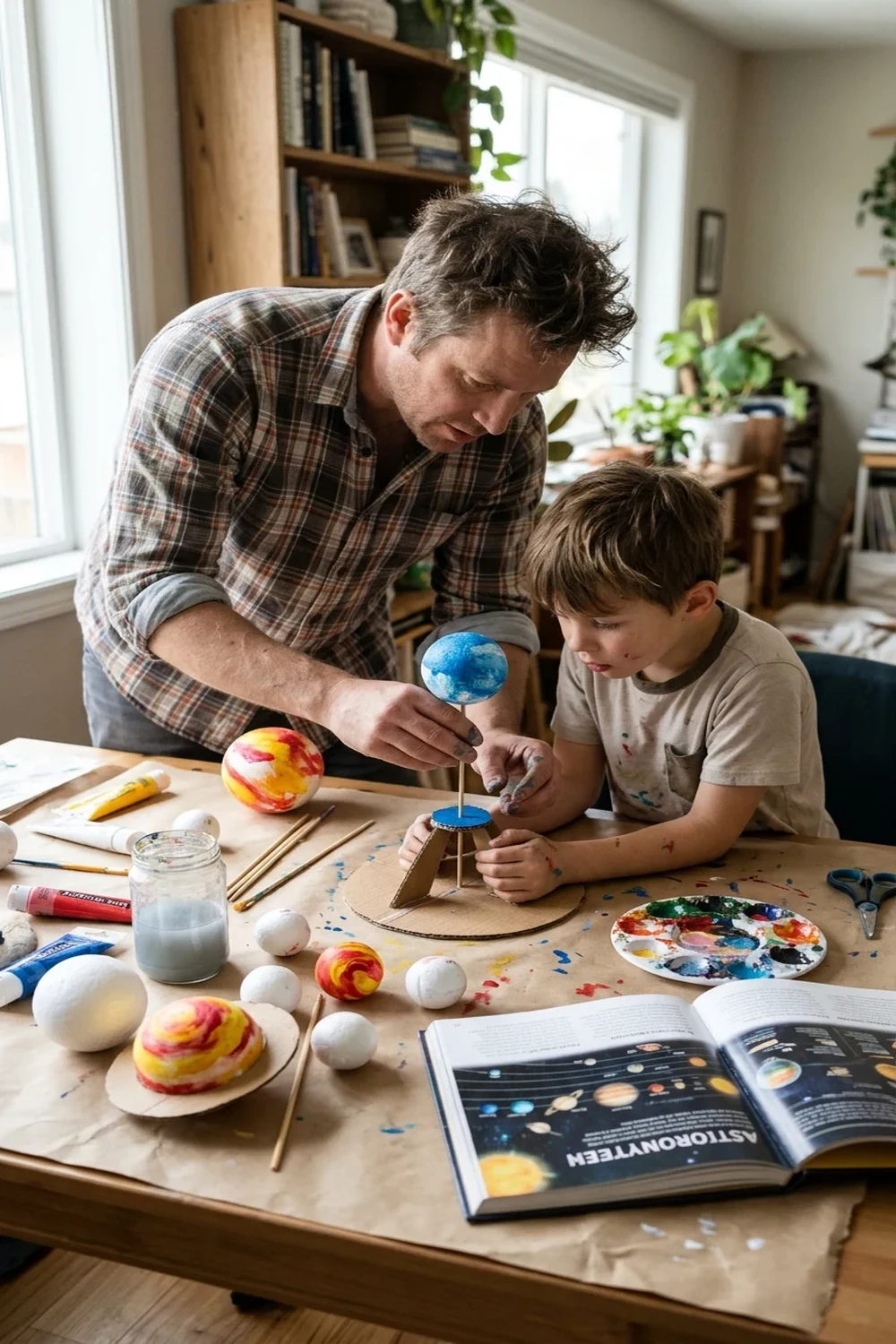
To start a solar system project, select a format aligned with the student age group, assemble non-toxic spherical craft supplies, and map planet positions from the Sun outward before applying paint or adhesive. A structured preparation workflow prevents assembly mistakes and guarantees an accurate astronomical sequence.
- Format Selection: Choose between a 3D hanging mobile, a flat trifold presentation board, or a desktop orbit track based on your available display space.
- Material Assembly: Gather eight graduated smooth foam spheres, one large central Sun orb, bamboo skewers, acrylic craft paints, and black presentation foam board.
- Chronological Planet Mapping: Arrange planets in correct order from the Sun outward (Mercury, Venus, Earth, Mars, Jupiter, Saturn, Uranus, Neptune) to establish proper spacing.
- Layered Construction and Detailing: Paint atmospheric bands and planetary rings first, allow 45 minutes drying time, and anchor each body with floral wire or dowels.
- Illumination Accents: Wrap warm micro-LED string lights along orbit lines to highlight elliptical trajectories and create a striking exhibition display.
Following this sequential roadmap ensures students complete an eye-catching, scientifically sound space showcase with minimal stress.
Why is the Solar System Important for Kids to Learn?
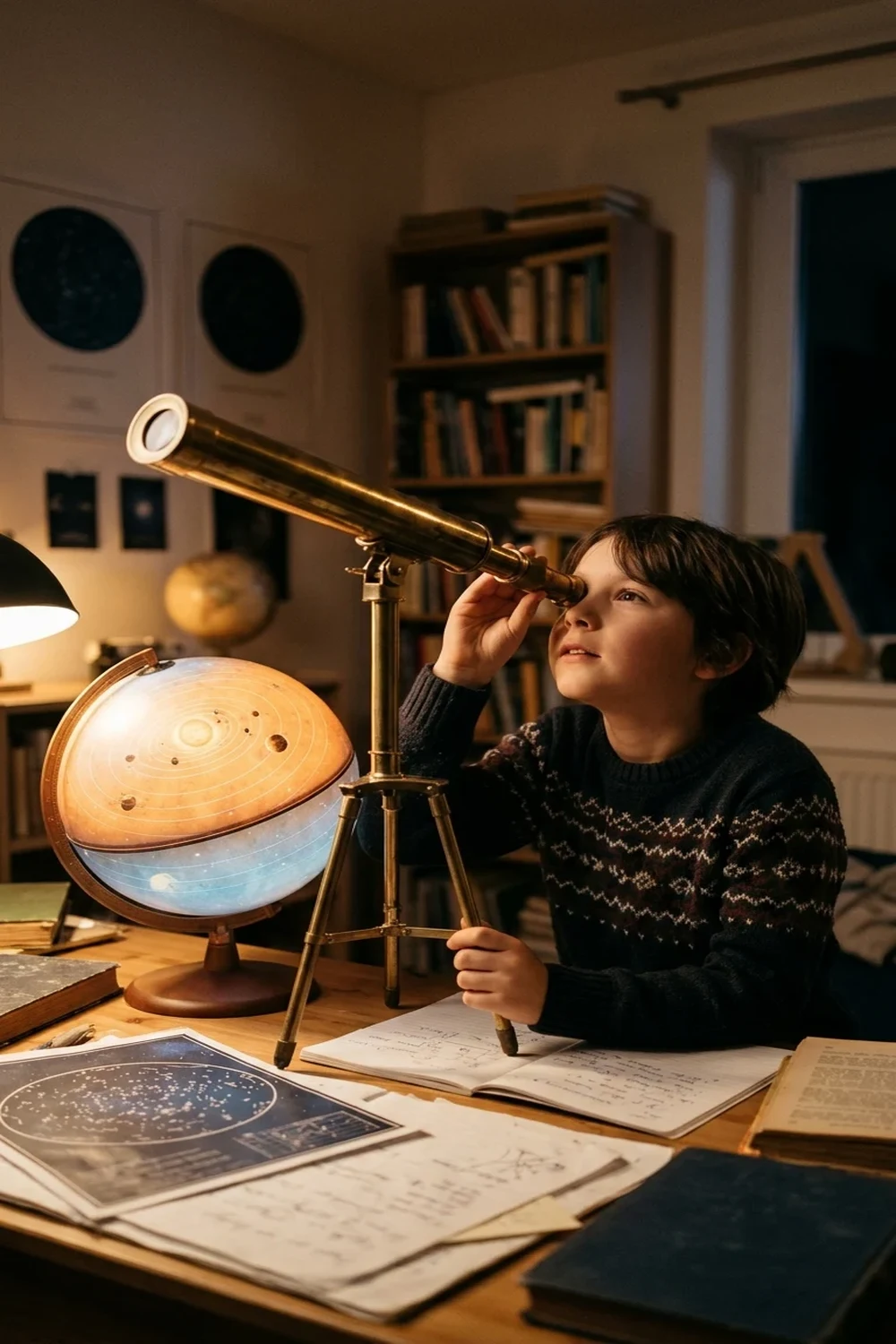
Learning about the solar system is important because it introduces children to foundational planetary physics, seasonal climate drivers, and Earth’s unique habitable ecosystem known as the circumstellar Goldilocks zone. Studying local planetary mechanics fosters early scientific literacy and contextualizes humanity’s place in the broader universe.
- Foundations of Natural Cycles: Grasping axial tilt and orbital revolution directly explains daily daylight changes, lunar phases, and annual seasonal shifts.
- Habitability and Environmental Awareness: Comparing Venus’s greenhouse extremes and Mars’s thin atmosphere highlights why Earth’s biosphere requires thoughtful preservation.
- Spatial Reasoning Development: Visualizing three-dimensional planetary distances and mass variations strengthens abstract mathematical scaling and spatial cognition.
- Inspiration for STEM Careers: Exploring planetary robotics, Artemis lunar missions, and James Webb Space Telescope discoveries ignites lasting interest in aerospace engineering and physics.
Connecting space science to observable daily phenomena inspires students to ask deeper questions about life, gravity, and future cosmic exploration.
Key Takeaways & Final Thoughts
Building a planetary model bridges astronomical science and creative problem solving, allowing young learners to visualize accurate planetary order, relative scale, and orbital mechanics through physical craft. Selecting an appropriate build style—whether an illuminated foam centerpiece, a compact hanging garland, or an analytical cross-section board—ensures children stay motivated while meeting curriculum benchmarks.
Begin by selecting two or three core materials like recycled paper or lightweight polystyrene spheres, establish the orbital scale, and let kids lead the painting and assembly process for maximum educational impact.